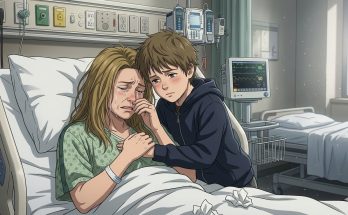
Aaron’s worst mistake became a warning.
His later choices became proof that accountability could lead somewhere.
Natalie’s regret became a reminder that noticing something is not the same as acting.
Grace’s voice became a practice.
Emma inherited the practice.
Then her children.
Then strangers.
Doctors.
Teachers.
Parents.
People who would never know any of their names.
And somewhere, far beyond the original house and hospital, another frightened child would say:
Something hurts.
An adult would answer:
Tell me more.
The child would not realize those words had a history.
They would not know that a teenage girl once stopped speaking because she believed nobody wanted to hear her.
They would not know about the scan.
The hidden appointment.
The lie.
The therapy.
The apologies.
The notebook.
The sticky note.
The generations that followed.
They would only know that someone listened.
And perhaps that was the final ending after all.
Not when Grace’s pain disappeared.
Not when Aaron changed.
Not when Natalie forgave herself.
Not when the family remembered.
But when the lesson became so ordinary that nobody had to remember where it came from.
A child spoke.
Someone listened.
Help came when needed.
And silence was no longer part of the inheritance.
PART ONE HUNDRED FORTY-EIGHT — THE CALL FROM A STRANGER
The phone call came on a quiet Sunday afternoon.
Sophie almost ignored it.
The number was unfamiliar.
She was tired.
Her grandchildren had just left.
The kitchen still carried the noise of lunch even though the house itself had gone still.
She answered anyway.
“Hello?”
A woman’s voice replied:
“Is this Sophie Morgan?”
“Yes.”
“My name is Dr. Elise Warren.”
Sophie sat down.
“I work with a pediatric communication program.”
There was a pause.
“I’m calling about Grace.”
Sophie smiled faintly.
Even after all these years, that name could still rearrange the room.
“What about her?”
“We’re creating a training module about dismissive language in adolescent care.”
Sophie waited.
“We would like permission to use part of her story.”
Sophie looked toward the old archive box in the corner of her study.
“Which part?”
“The early part.”
Of course.
The pain.
The silence.
The father.
The hospital.
The question.
Sophie’s fingers tightened around the phone.
Grace had spent a lifetime becoming more than that moment.
But that moment still seemed to be where strangers found her.
“What exactly do you want to use?”
Dr. Warren answered carefully.
“Not the sensational details.”
Sophie relaxed slightly.
“We want to focus on how repeated dismissal changes the way young patients communicate.”
That was different.
That was Grace.
Sophie asked:
“What will the students be taught?”
“To recognize when a patient begins minimizing their own symptoms.”
Another pause.
“And to ask why.”
Sophie closed her eyes.
Maybe I’m imagining it.
The old notebook line.
Still alive.
Still teaching.
“You can use it.”
PART ONE HUNDRED FORTY-NINE — THE TRAINING ROOM
Months later, a group of young clinicians sat in a classroom.
Nobody there had met Grace.
Nobody had known Aaron.
Most had been born long after Natalie died.
A screen at the front displayed one sentence:
I stopped telling Dad when it hurts.
The room became quiet.
The instructor did not explain immediately.
Instead, she asked:
“What does this sentence tell you?”
One student raised a hand.
“That the patient has pain.”
“Yes.”
Another:
“That the father dismisses it.”
“Possibly.”
Another:
“That she doesn’t feel safe reporting symptoms.”
The instructor nodded.
“Good.”
Then:
“What doesn’t it tell you?”
Silence.
A resident said:
“It doesn’t tell us the diagnosis.”
“Exactly.”
The instructor changed the slide.
NORMAL TESTS DO NOT MEAN NORMAL EXPERIENCE.
She said:
“The mistake is not uncertainty.”
“The mistake is using uncertainty as permission to stop listening.”
Grace would have liked that sentence.
PART ONE HUNDRED FIFTY — THE STUDENT WHO GOT DEFENSIVE
One resident raised his hand.
“What if the family really is overusing healthcare?”
The instructor nodded.
“Then we assess that.”
“What if anxiety is contributing?”
“We assess that too.”
“What if the symptoms are functional?”
“Same answer.”
The resident frowned.
“So we just validate everything?”
The instructor smiled.
“No.”
“We validate that the patient is experiencing something.”
Then she continued.
“We investigate the cause separately.”
Another student wrote quickly.
The first resident leaned back.
It was clear he was not fully convinced.
That was fine.
Grace had never believed good teaching required immediate agreement.
It required planting a better question.
PART ONE HUNDRED FIFTY-ONE — THREE WEEKS LATER
That same resident was working overnight.
A fourteen-year-old girl came in with recurring abdominal pain.
Third visit in two months.
Previous workup unrevealing.
Her father looked exhausted.
Her mother looked embarrassed.
The girl barely spoke.
The father said:
“She gets worked up about everything.”
The resident felt the old instinct rise.
Probably anxiety.
Then he remembered the slide.
What doesn’t the sentence tell you?
Diagnosis.
He asked the girl:
“When it’s at its worst, what can’t you do?”
She looked at him.
Then at her father.
“Walk.”
The father immediately said:
“She can walk.”
The resident held up a hand.
“Let her finish.”
The girl swallowed.
“I can walk.”
She said.
“But I have to bend forward.”
The resident’s attention sharpened.
Further evaluation was ordered.
The final diagnosis was not dramatic.
Not rare.
Not life-threatening.
But it required treatment.
The resident sat alone afterward.
He thought about how easily he could have stopped at:
Probably anxiety.
PART ONE HUNDRED FIFTY-TWO — THE EMAIL HE SENT
The next morning, he emailed the instructor.
You were right.
She responded:
About what?
He typed:
I was more interested in my first explanation than in whether it was complete.
The reply came five minutes later.
That is exactly the danger.
PART ONE HUNDRED FIFTY-THREE — SOPHIE READS THE FEEDBACK
Months later, Sophie received a summary of the program.
No names.
No private medical details.
Only anonymous feedback.
One participant wrote:
The story made me realize that patients can learn to underreport because of prior dismissal.
Another:
I now ask what happened the last time someone tried to get help.
Another:
I am less likely to interpret hesitation as lack of severity.
Sophie read them slowly.
Grace had been gone for decades.
Yet somehow she was still standing in rooms asking people to pause before deciding.
PART ONE HUNDRED FIFTY-FOUR — THE OLD PHOTOGRAPH
Sophie went to the archive.
She found the photograph of Grace at fifteen.
Volleyball uniform.
Smile.
One hand near her side.
She had seen it many times.
This time she noticed something else.
Everyone looking at that photograph had interpreted the smile as evidence she was okay.
Maybe Grace herself had too.
That was the danger.
People assume suffering announces itself.
Sometimes it does.
Sometimes it smiles for the camera.
Sophie placed the photo beside the old notebook page.
Maybe I’m imagining it.
Then beside Grace’s final line.
And then we taught others.
Three pieces of paper.
An entire lifetime.
PART ONE HUNDRED FIFTY-FIVE — THE QUESTION AT DINNER
That Christmas, Sophie’s granddaughter Maya asked:
“Why do you still keep all those old papers?”
Sophie looked at her.
“Family history.”
“Is it sad?”
“Some of it.”
“Then why keep it?”
Sophie thought.
“Because sadness can become useful if you don’t worship it.”
Maya frowned.
“What does that mean?”
Sophie laughed.
“That was too complicated.”
“Yes.”
“Okay.”
She tried again.
“We keep enough to remember what we learned.”
Maya nodded.
“That makes more sense.”
PART ONE HUNDRED FIFTY-SIX — MAYA’S SCHOOL PROJECT
Months later, Maya had to complete a school project about family history.
She asked Sophie:
“Can I use Grace?”
Sophie hesitated.
“What part?”
“The listening part.”
“Not the medical details?”
“No.”
Sophie smiled.
“Then yes.”
Maya created a presentation titled:
HOW ONE FAMILY CHANGED THE WAY IT LISTENED.
She included no photographs of Grace in pain.
No hospital images.
No dramatic reconstruction.
Instead, she built the presentation around four phrases.
I hurt.
Tell me more.
I believe you.
Let’s figure it out.
Her teacher gave her the highest mark.
But what mattered came afterward.
Another student approached Maya privately.
“My mom doesn’t believe my headaches.”
Maya froze.
She was thirteen.
Not a doctor.
Not a counselor.
Not responsible for solving another child’s life.
She remembered Sophie’s advice.
“Tell an adult you trust.”
The student nodded.
“Would the school nurse count?”
“Yes.”
Maya answered.
“I think so.”
The next day, the student did.
That was how lessons moved.
Not always through grand speeches.
Sometimes through one thirteen-year-old telling another:
Ask someone else.
PART ONE HUNDRED FIFTY-SEVEN — THE FIRST TIME MAYA UNDERSTOOD
That evening, Maya told Sophie what happened.
Sophie listened.
Then:
“You handled that well.”
“I didn’t fix anything.”
“You weren’t supposed to.”
Maya frowned.
“I just told her to talk to somebody.”
“Exactly.”
Sophie smiled.
“Grace spent years learning that help doesn’t always mean solving.”
“It can mean opening the next door.”
Maya thought about it.
“So listening is like a door?”
“Sometimes.”
PART ONE HUNDRED FIFTY-EIGHT — THE DOOR GRACE NEVER HAD
At fifteen, Grace had tried several doors.
Her father.
Closed.
Her own judgment.
Slowly closing.
Her mother.
She feared that one was blocked by work, stress, and Aaron’s authority.
Then finally, on a bathroom floor, she tried again.
That door opened.
Not perfectly.
Not soon enough.
But it opened.
Everything afterward depended on that.
PART ONE HUNDRED FIFTY-NINE — THE LETTER FROM THE STUDENT’S MOTHER
Months after Maya’s school project, a letter arrived.
It was addressed to Sophie.
The mother of Maya’s classmate had written.
She explained that her daughter had been evaluated.
The headaches turned out to be migraines.
Manageable.
Treatable.
But real.
The mother wrote:
I had been telling her she was tired because she stayed up too late.
I didn’t realize she had stopped telling me how often it happened.
Sophie’s eyes filled.
The letter continued:
My daughter showed me Maya’s project.
I apologized.
We are doing better.
Sophie placed the letter in the archive.
Then she changed her mind.
She took it back out.
Not every new story needed to become another permanent artifact.
She photocopied one sentence.
I didn’t realize she had stopped telling me.
That was enough.
PART ONE HUNDRED SIXTY — THE PHRASE THAT ALWAYS RETURNED
Stopped telling.
Grace stopped telling Aaron.
The classmate stopped telling her mother.
Patients stopped telling clinicians.
Adults stopped telling spouses.
Children stopped telling teachers.
The silence rarely started with one enormous betrayal.
It formed gradually.
One eye roll.
One joke.
One dismissal.
One:
You’re fine.
One:
Not again.
One:
You always do this.
Eventually, silence becomes efficient.
Why risk humiliation if you already know the response?
That was why the family rule had always been more complicated than:
Believe everything.
It was:
Make speaking safe enough that people keep giving you information.
PART ONE HUNDRED SIXTY-ONE — SOPHIE’S OWN MISTAKE
Sophie was not immune.
Nobody was.
One afternoon, Maya complained:
“I’m exhausted.”
Sophie replied without thinking:
“You stayed up too late.”
Maya’s face changed.
It lasted one second.
Sophie heard herself.
She stopped.
“Wait.”
Maya looked at her.
“I just did the thing.”
“What thing?”
“I decided before asking.”
Maya smiled slightly.
“Yeah.”
Sophie sat beside her.
“Tell me more.”
Maya explained.
She had slept normally.
She had been exhausted for days.
Sophie listened.
No emergency.
No dramatic diagnosis.
Just a stressful week and a mild virus.
But the moment mattered.
Sophie later wrote in a journal:
Family lessons are not vaccines.
You do not learn them once and become permanently protected.
You practice.
PART ONE HUNDRED SIXTY-TWO — THE QUOTE THAT SPREAD
That journal line eventually appeared in one of Sophie’s essays.
Family lessons are not vaccines.
You practice.
The phrase circulated.
Parents shared it.
Therapists quoted it.
Teachers used it in workshops.
Sophie laughed every time someone called it profound.
“It came from snapping at my granddaughter.”
Maybe that was why it worked.
Useful wisdom rarely emerges from perfect people.
PART ONE HUNDRED SIXTY-THREE — THE FAMILY’S NEWEST TRADITION
Every New Year’s Day, Sophie’s family began asking one question at dinner.
“What should we listen better to this year?”
The answers were rarely medical.
Work stress.
Marriage.
Teenage privacy.
A child’s anxiety about school.
A grandparent’s loneliness.
Someone’s need for rest.
The rule had grown beyond pain.
Because the deeper principle had never been only medical.
It was about refusing to treat another person’s inner experience as an inconvenience.
PART ONE HUNDRED SIXTY-FOUR — THE YEAR MAYA ANSWERED FIRST
One New Year’s Day, Maya was sixteen.
Sophie asked:
“What should we listen better to this year?”
Maya answered immediately.
“Ourselves.”
Everyone looked at her.
She continued.
“I think sometimes we’re all good at listening to other people now.”
She smiled.
“But we still ignore ourselves.”
Sophie thought of Aaron’s chest pain.
Daniel’s fatigue.
Grace’s old notebook.
Maya was right.
Listening inward was part of the inheritance too.
PART ONE HUNDRED SIXTY-FIVE — THE FINAL MEDICAL LESSON
Years later, Maya became a nurse.
Nobody was surprised.
On her first week, an elderly woman repeatedly pressed the call button.
Some staff became frustrated.
Maya heard:
“She’s anxious.”
“She’s lonely.”
“She keeps calling for nothing.”
Maya entered the room.
The woman said:
“I feel strange.”
Not helpful.
Not specific.
Easy to dismiss.
Maya asked:
“What does strange mean?”
The patient hesitated.
Then described pressure and dizziness.
Maya checked her.
Something was wrong.
The team responded.
Later, the physician thanked her.
Maya shrugged.
“She said she felt strange.”
The doctor laughed.
“That’s not exactly a diagnostic term.”
“No.”
Maya smiled.
“But it was information.”
Grace would have loved her.
PART ONE HUNDRED SIXTY-SIX — MAYA CALLS SOPHIE
Maya called that night.
“I think I finally understand the whole Grace thing.”
Sophie laughed.
“The whole Grace thing?”
“You know what I mean.”
“What happened?”
Maya told her.
Then:
“If I’d decided she was lonely, I might have stopped listening.”
“Yes.”
“It’s weird.”
“What?”
“People think listening is passive.”
Sophie smiled.
“It isn’t.”
“No.”
Maya said.
“It’s work.”
PART ONE HUNDRED SIXTY-SEVEN — THE PLAQUE IS REMOVED
Years later, the hospital renovated again.
Grace’s old plaque was taken down.
Sophie received an email asking whether the family wanted it.
She said yes.
The plaque arrived wrapped in brown paper.
DR. GRACE MORGAN
Clinician.
Educator.
Advocate for listening before judgment.
Sophie placed it on her dining table.
Maya touched the edge.
“Where are you putting it?”
Sophie thought.
“Nowhere.”
Maya looked surprised.
“What?”
“I don’t want the house becoming a museum.”
She smiled.
“We’ll keep it with the archive.”
The lesson did not need to dominate the walls.
PART ONE HUNDRED SIXTY-EIGHT — THE EMPTY WALL
At the hospital, another photograph replaced Grace’s.
A newer clinician.
A newer contribution.
Some family members felt sad.
Sophie did not.
She visited once.
Stood where Grace’s plaque had been.
Then smiled.
This was exactly what Grace had wanted.
Not permanence.
Integration.
The wall could change.
The questions remained.
PART ONE HUNDRED SIXTY-NINE — THE LAST CLASS THAT USED GRACE’S NAME
Eventually, medical educators stopped teaching the case under Grace’s name.
Privacy standards changed.
Curricula changed.
The story became a composite teaching scenario.
A teenager.
Recurring pain.
A parent who dismisses.
A delayed evaluation.
No names.
One instructor asked:
“What might happen if the patient repeatedly receives the message that symptoms are exaggerated?”
A student answered:
“She might stop reporting them.”
Exactly.
Grace had disappeared from the scenario.
But her experience remained inside the question.
PART ONE HUNDRED SEVENTY — MAYA REALIZES WHAT SUCCESS LOOKS LIKE
Maya attended that class years later as a guest educator.
She read the anonymous case.
For a moment, she wanted to say:
That was my family.
Then she stopped.
She smiled.
Nobody needed to know.
The lesson was working without the story’s ownership.
Afterward, a student asked:
“Where did this case come from?”
Maya answered:
“From something that happens in more families than it should.”
That was enough.
PART ONE HUNDRED SEVENTY-ONE — THE FAMILY ARCHIVE SHRINKS
Each generation kept less.
Not because they cared less.
Because the purpose changed.
Letters were digitized.
Duplicate papers destroyed.
Medical details protected.
Photographs returned to family albums.
The archive became smaller.
Eventually only one box remained.
Inside:
Grace’s letter.
Natalie’s note.
Aaron’s letter.
The pain notebook.
The three-line family rule.
And a handful of later reflections.
The entire history fit beneath one bed.
PART ONE HUNDRED SEVENTY-TWO — SOPHIE’S FINAL NOTE
Before Sophie died, she added a note.
She wrote:
We kept this story because silence once caused harm.
Do not keep it because guilt feels sacred.
If the lesson lives without the box, let the box go.
Maya read it years later.
She understood.
PART ONE HUNDRED SEVENTY-THREE — THE FIRE
A flood damaged part of Maya’s home.
The archive box got wet.
Some pages were ruined.
Maya panicked.
Then remembered Sophie’s note.
Do not keep it because guilt feels sacred.
She salvaged what she could.
Grace’s final letter.
The notebook.
The family rule.
Several other things were lost.
For the first time, nobody tried to reconstruct them.
The family let some history disappear.
It felt strangely peaceful.
PART ONE HUNDRED SEVENTY-FOUR — WHAT SURVIVED
The notebook survived.
Barely.
The ink had bled on several pages.
But the important sentences remained.
Maybe I’m imagining it.
I told them eventually.
They learned to listen.
And then we taught others.
Maya read them.
Four lines.
Four generations of meaning.
PART ONE HUNDRED SEVENTY-FIVE — THE LAST TIME THE NOTEBOOK WAS OPENED
Maya was old when she opened the notebook one final time.
Her granddaughter sat beside her.
“What is that?”
“A very old story.”
“Sad?”
“At first.”
“Happy?”
“Eventually.”
The girl frowned.
“That’s confusing.”
Maya laughed.
“Most families are.”
She showed her the first line.
Maybe I’m imagining it.
“What does that mean?”
“It means someone stopped trusting what they felt.”
“Why?”
“Because people kept telling her she was wrong.”
The girl looked offended.
“That’s mean.”
“Yes.”
“What happened?”
Maya showed the later lines.
They learned to listen.
The girl smiled.
“Good.”
Then:
“Can I have a snack?”
Maya laughed so hard she cried.
“Yes.”
History had lost the child’s attention.
Perfect.
PART ONE HUNDRED SEVENTY-SIX — THE NOTEBOOK IS PUT AWAY
Maya closed it.
Not ceremonially.
Not dramatically.
She placed it in a drawer.
Her granddaughter had already moved on.
That was exactly right.
The wound was no longer the center of the family.
It was context.
PART ONE HUNDRED SEVENTY-SEVEN — ANOTHER CHILD SAYS IT HURTS
Years later, that same granddaughter was a mother.
Her little boy woke at night crying.
“My ear hurts.”
She sat beside him.
“How much?”
“A lot.”
“Okay.”
No irritation.
No:
You were fine earlier.
No:
Go back to sleep.
She checked his temperature.
Called the after-hours line.
Followed the advice.
Ear infection.
Antibiotics.
Routine.
Simple.
The boy never knew there was anything remarkable about being believed.
That was the inheritance.
PART ONE HUNDRED SEVENTY-EIGHT — THE FAMILY RULE WITHOUT WORDS
Eventually nobody in the family had the sticky note anymore.
Nobody recited the three lines.
They simply acted differently.
A daughter spoke.
A mother listened.
A husband admitted fear.
A teenager asked for help.
A grandfather went to the doctor instead of waiting.
A child cried without being told to toughen up.
The rule had moved from refrigerator to behavior.
That was stronger.
PART ONE HUNDRED SEVENTY-NINE — THE STORY BECOMES INVISIBLE
The most successful family changes eventually become invisible.
Children assume:
Of course you tell someone if you hurt.
Of course adults ask questions.
Of course normal tests don’t mean fake symptoms.
Of course you can apologize without being destroyed.
Of course boundaries can coexist with love.
Of course people can change.
None of those things had been obvious to Aaron.
They became obvious to his descendants.
That was his legacy too.
Not only the damage.
The correction.
PART ONE HUNDRED EIGHTY — THE FINAL QUESTION
Many generations after Grace, a child asked her mother:
“Why do you always say ‘tell me more’?”
The mother thought.
“I don’t know.”
The child laughed.
“You say it all the time.”
The mother smiled.
“I guess my mom said it.”
“Why?”
“Probably because her mom said it.”
The child nodded.
“Okay.”
The origin was gone.
The behavior remained.
Grace had predicted this.
It will mean the lesson outlived the wound.
FINAL ENDING — WHEN NOBODY REMEMBERED WHY
Eventually, nobody remembered Aaron’s face.
Nobody remembered Natalie’s kitchen.
Nobody remembered the exact hospital corridor.
Nobody remembered who first wrote the sticky note.
Nobody remembered the volleyball photograph.
Nobody remembered the family arguments.
Somewhere, Grace’s name remained in an old database.
An archived article.
A citation.
Maybe a photograph no one looked at anymore.
That was fine.
Because in homes far away, children still spoke.
Parents still paused.
Doctors still asked one more question.
Teachers still noticed when quiet students became quieter.
Partners still learned to say:
Do you want advice or do you want me to listen?
And people still discovered that the answer:
I don’t know.
could be healthier than pretending certainty.
The original wound had faded.
The practice remained.
Once, a fifteen-year-old girl had sat in pain believing silence was safer.
Generations later, a little boy climbed onto his mother’s bed at midnight and said:
“Something hurts.”
His mother opened her eyes.
She did not sigh.
She did not argue.
She did not demand proof.
She simply moved closer.
“Tell me more.”
And somewhere, in whatever part of history still remembered Grace Morgan, that was enough.
PART ONE HUNDRED EIGHTY-ONE — THE BOX IN THE BASEMENT
The box sat beneath a workbench for nearly twelve years.
Nobody remembered putting it there.
The basement belonged to Maya’s grandson, Thomas.
He had inherited the house after his mother moved into a smaller apartment.
The basement was full of things families save because throwing them away feels too final.
Old tools.
Christmas ornaments.
Children’s books.
Broken picture frames.
A sewing machine nobody used.
And one water-stained cardboard box sealed with aging tape.
Thomas found it while looking for an extension cord.
He dragged it into the light.
On the side, barely visible beneath a brown stain, someone had written:
MORGAN FAMILY.
Thomas frowned.
The name meant something.
But only vaguely.
His grandmother had talked about the Morgans.
Grace.
Emma.
Aaron.
Stories blurred across generations.
Thomas carried the box upstairs.
His wife, Elena, looked at it.
“What’s that?”
“Family stuff, apparently.”
“Whose?”
“I think Grandma Maya’s.”
“Open it.”
He laughed.
“You’re nosier than I am.”
“Correct.”
They cut the tape.
Inside were papers warped by age.
Photographs.
A few handwritten letters.
A photocopy of a yellow sticky note.
And the old notebook.
Thomas picked it up.
The cover was almost detached.
“What is this?”
Elena opened the first page carefully.
Short entries.
Dates.
Pain scores.
Notes.
Then she reached the sentence:
Maybe I’m imagining it.
Elena stopped.
“What?”
Thomas asked.
She looked at him.
“I think this is Grace’s.”
He stared.
“The doctor?”
“The family story.”
Thomas sat down.
He had heard pieces growing up.
A girl who had been sick.
A father who didn’t listen.
A family rule.
But the story had always sounded distant.
Almost symbolic.
Now he was holding the handwriting of the girl who had lived it.
PART ONE HUNDRED EIGHTY-TWO — THOMAS CALLS HIS MOTHER
His mother, Rachel, answered on the third ring.
“Hi.”
“Mom, I found a box.”
“That sounds ominous.”
“Family stuff.”
Silence.
“What kind?”
“The Morgan box.”
Another pause.
“Oh.”
Thomas looked at Elena.
“You know it?”
“I thought Maya had gotten rid of most of that.”
“There’s a notebook.”
Rachel became quiet.
“Grace’s?”
“I think so.”
Rachel sighed.
“I haven’t seen that since I was a kid.”
“What do I do with it?”
Rachel laughed softly.
“Why are you asking me?”
“Because apparently this family has been emotionally outsourcing decisions for generations.”
Elena covered her mouth to stop laughing.
Rachel said:
“Very funny.”
Then:
“Read it if you want.”
“Should I?”
“That depends.”
“On what?”
“Whether you’re reading it to understand people or to judge them.”
Thomas looked at the notebook.
That sounded like something from the family story too.
PART ONE HUNDRED EIGHTY-THREE — WHAT THOMAS KNEW
Thomas knew only the simplified version.
Aaron had not believed Grace.
Grace got sick.
Doctors found something.
Aaron changed.
Grace became a clinician.
The family learned to listen.
That was how stories shrink over time.
Sharp edges disappear.
Contradictions get polished.
People become roles.
The father who failed.
The daughter who survived.
The mother who learned.
But the notebook refused simplicity.
Grace’s entries were not eloquent.
They were frightened.
Hurts after dinner.
Couldn’t sleep.
Didn’t tell Dad.
Maybe Mom is too busy.
Better today.
Bad again.
Thomas read in silence.
Then he found the stars.
“What are these?”
Elena looked.
“No idea.”
They kept reading until they found Grace’s later explanation.
Days I thought about asking Dad for help.
Thomas put the notebook down.
“That’s horrible.”
Elena nodded.
Then:
“Don’t stop there.”
“What?”
“You already know he changed.”
Thomas looked at her.
“I’m not defending him.”
“I know.”
She closed the notebook.
“But Grace didn’t keep the story so everybody could spend three hundred years hating one dead man.”
Thomas laughed despite himself.
“Probably true.”
PART ONE HUNDRED EIGHTY-FOUR — THE LETTER FROM AARON
They found Aaron’s letter next.
Thomas hesitated before opening it.
Elena said:
“Maybe that one is private.”
“He’s been dead for generations.”
“That doesn’t automatically make everything public.”
Thomas considered.
That too felt like something Grace would have appreciated.
They called Rachel again.
She gave permission.
Thomas read.
Aaron’s words were slower than Grace’s.
More deliberate.
He wrote about regret.
Authority.
Fear.
The terrible difference between meaning well and doing well.
Thomas reached the line:
I spent too much of your childhood confusing love with authority.
He stopped.
Elena whispered:
“That’s good.”
“Too late.”
“Yes.”
She looked at him.
“But still good.”
Thomas nodded.
That was the uncomfortable thing about change.
It rarely arrives before harm.
If it did, nobody would call it change.
PART ONE HUNDRED EIGHTY-FIVE — THE SECOND BOX
Rachel remembered something else.
“There might be another box.”
“Where?”
“No idea.”
“Helpful.”
“Your grandmother used to keep some things in the upstairs closet.”
Thomas searched.
Nothing.
Then Elena found a small wooden case behind old blankets.
Inside were photographs.
A hospital bracelet.
The volleyball picture.
Grace at fifteen.
Smiling.
One hand near her side.
Thomas stared at it.
“She looks fine.”
Elena looked at him.
He immediately caught himself.
“That’s the point, isn’t it?”
“Yes.”
He held the photograph differently after that.
PART ONE HUNDRED EIGHTY-SIX — THE CONVERSATION AT DINNER
Thomas and Elena had two children.
A daughter named Claire.
A son named Noah.
That night, Claire saw the old photographs on the table.
“Who’s that?”
Thomas looked at Grace’s picture.
“Your very distant relative.”
“What happened to her?”
Thomas hesitated.
Elena rescued him.
“She got sick when she was young.”
“Did she get better?”
“Yes.”
Claire picked up the volleyball picture.
“She looks happy.”
Thomas nodded.
“She probably was happy sometimes.”
Claire frowned.
“Sometimes?”
“People can be happy and still hurt.”
Claire accepted that instantly.
Children do not always need the false simplicity adults prefer.
PART ONE HUNDRED EIGHTY-SEVEN — NOAH’S QUESTION
Noah was nine.
He pointed to Aaron’s photograph.
“Who’s that?”
“Grace’s dad.”
“Was he nice?”
Thomas paused.
Elena watched him.
The old temptation appeared.
Simplify.
“Yes.”
Or:
“No.”
Both would have been incomplete.
Thomas said:
“Sometimes.”
Noah looked confused.
“Did he love her?”
“Yes.”
“Did he do something bad?”
“Yes.”
“Did he say sorry?”
“Yes.”
“Did she forgive him?”
“Eventually.”
Noah thought.
Then:
“Did he do it again?”
Thomas smiled.
“Not in the same way.”
Noah nodded.
“That’s important.”
Thomas looked at Elena.
Apparently the family still produced children who summarized decades of therapy in six words.
PART ONE HUNDRED EIGHTY-EIGHT — THE RULE RETURNS TO THE FRIDGE
Claire found the photocopy of the old sticky note.
NO ONE NEEDS A COURT CASE TO PROVE THEY FEEL BAD.
She laughed.
“That’s funny.”
“It was serious.”
“Can we put it on the fridge?”
Thomas shrugged.
“Why not?”
They did.
Then Noah added another note underneath.
ASK FIRST.
Thomas looked at it.
“What does that mean?”
Noah shrugged.
“Before deciding.”
Elena smiled.
Grace’s descendants were editing the family philosophy again.
PART ONE HUNDRED EIGHTY-NINE — THE FIRST TEST
Weeks later, Noah came home from school quiet.
Thomas barely noticed at first.
Homework.
Dinner.
Work emails.
Then Elena asked:
“You okay?”
Noah shrugged.
“Yeah.”
Old Grace would have stopped there.
So would old Aaron.
But Elena sat beside him.
“Want me to leave you alone or ask one more time?”
Noah looked at her.
“One more time.”
“What happened?”
A boy at school had been mocking him.
Nothing physical.
Nothing dangerous.
But painful.
Thomas started:
“Just ignore—”
Then stopped.
Noah saw it.
“What?”
Thomas sighed.
“I almost decided for you.”
Noah smiled slightly.
“Family curse?”
“Apparently.”
Thomas sat down.
“Tell me what’s been happening.”
Noah did.
PART ONE HUNDRED NINETY — THE NEW VERSION OF TOUGHNESS
Thomas wanted to tell Noah:
Stand up for yourself.
Don’t let people bother you.
Be tough.
Instead, he asked:
“What would help?”
Noah thought.
“I want you to talk to the teacher.”
“Okay.”
“I don’t want you to call the kid’s parents.”
“Okay.”
“Not yet.”
“Okay.”
Thomas wanted more action.
He wanted to fix.
But he remembered what Grace had written.
Listening before judgment.
Listening before control.
He followed Noah’s lead.
The situation improved.
No dramatic confrontation.
No heroic speech.
Just a child asking.
An adult respecting the request.
PART ONE HUNDRED NINETY-ONE — THOMAS UNDERSTANDS THE STORY
That night Thomas told Elena:
“I think I finally get why they kept all this.”
“The box?”
“Yeah.”
He looked toward the refrigerator.
“It isn’t about pain.”
“Not only.”
“It’s about what happens when people with authority get too sure.”
Elena nodded.
“Parents.”
“Doctors.”
“Teachers.”
“Spouses.”
“Bosses.”
Thomas leaned back.
“Anybody who can make someone else doubt themselves.”
PART ONE HUNDRED NINETY-TWO — THE OTHER SIDE OF THE LESSON
Months later, Claire came home convinced she had a serious illness.
She had watched a video online.
Then another.
Then twenty.
Her symptoms were vague.
She was frightened.
Elena listened.
Thomas listened.
They did not laugh.
They did not immediately agree either.
Thomas said:
“I believe you’re scared.”
Claire nodded.
“And I believe you’re noticing something.”
Another nod.
“But we don’t know what it means yet.”
Claire looked at him.
“So you don’t think I have it?”
“I don’t know.”
He smiled gently.
“That’s why we investigate instead of guessing.”
They scheduled a routine appointment.
Nothing serious was found.
Claire’s anxiety settled.
Thomas realized the family lesson worked in both directions.
Listening did not mean confirming every fear.
It meant refusing to replace uncertainty with ridicule.
PART ONE HUNDRED NINETY-THREE — THE PEDIATRICIAN
At Claire’s appointment, the pediatrician noticed how Thomas spoke.
Afterward she said:
“You handled that well.”
“What?”
“You validated her without reinforcing the diagnosis she found online.”
Thomas laughed.
“My family has a very long history with this.”
The doctor smiled.
“Good history?”
“Eventually.”
PART ONE HUNDRED NINETY-FOUR — THE BOX BECOMES A FAMILY NIGHT
One rainy weekend, Thomas decided to organize the archive.
Claire and Noah joined.
Not because he forced them.
Because old family secrets are irresistible.
They spread photographs across the dining table.
Grace.
Aaron.
Natalie.
Emma.
Maya.
People whose lives had become names.
Thomas read selected parts of Grace’s letter aloud.
Not the most private pieces.
Only what felt meant for descendants.
Claire asked:
“Why didn’t Grace hate Aaron forever?”
Thomas answered:
“Maybe she did hate him sometimes.”
“But she forgave him.”
“Yes.”
“How can both happen?”
Elena said:
“Feelings change.”
Noah added:
“And people change.”
Thomas nodded.
“Sometimes.”
PART ONE HUNDRED NINETY-FIVE — THE IMPORTANT SOMETIMES
Thomas emphasized the word.
Sometimes.
Not everyone changes.
Not every apology becomes behavior.
Not every relationship should continue.
Grace had never wanted her story turned into a rule that people must reconcile.
She chose reconciliation because Aaron changed.
Someone else might choose distance.
Someone else might leave.
Someone else might forgive without returning.
The lesson was not:
Always forgive.
The lesson was:
Tell the truth.
Watch behavior.
Protect trust.
Let the future depend on what actually changes.
Claire listened carefully.
“That seems harder.”
“It is.”
“Why?”
“Because simple rules are easier than judgment.”
PART ONE HUNDRED NINETY-SIX — THE FAMILY STORY AT SCHOOL
Claire eventually wrote about Grace for an ethics assignment.
Her teacher asked:
“What was the ethical failure?”
Claire had options.
Medical neglect.
Parental authority.
Dismissal.
Deception.
But she answered:
“He stopped being curious.”
Her teacher raised an eyebrow.
“Explain.”
Claire said:
“Once Aaron decided Grace was dramatic, every new symptom became evidence for what he already believed.”
The teacher nodded.
“And what would curiosity have changed?”
“He might have asked:
What if I’m wrong?”
That question became the center of Claire’s paper.
PART ONE HUNDRED NINETY-SEVEN — WHAT IF I’M WRONG?
The phrase spread in the family.
Not obsessively.
Not as self-doubt.
As humility.
When Thomas and Elena disagreed:
What if I’m wrong?
When Noah insisted a teacher disliked him:
What if there’s another explanation?
When Claire feared a symptom:
What else could this be?
The question did not weaken confidence.
It prevented confidence from becoming a cage.
PART ONE HUNDRED NINETY-EIGHT — THE DOCTOR WHO USED IT
Claire later became a psychologist.
Not because of Grace.
At least not directly.
During training, she worked with teenagers.
One patient barely spoke.
His parents said:
“He just wants attention.”
Claire felt anger.
Then remembered another family lesson.
Do not let moral judgment replace information.
She asked the parents:
“What makes you think he wants attention?”
They gave examples.
Claire listened.
Then:
“What if the behavior is attention-seeking?”
They looked confused.
She continued.
“Why would needing attention make the need unimportant?”
Silence.
That question changed the session.
PART ONE HUNDRED NINETY-NINE — THE WORD ATTENTION-SEEKING
Grace had hated that phrase.
Aaron had used it like a verdict.
Eventually, later clinicians in the family began challenging the idea itself.
If someone seeks attention, maybe attention is exactly what they need.
Not every behavior should be rewarded.
Not every crisis signal is accurate.
But the phrase should never end curiosity.
Claire taught parents to ask:
What is this behavior trying to communicate?
It was a broader version of:
Tell me more.
PART TWO HUNDRED — THE FIRST TIME THOMAS APOLOGIZED DIFFERENTLY
Thomas and Claire argued one evening.
She was nineteen.
He accused her of being irresponsible.
She accused him of controlling everything.
The argument escalated.
Thomas said:
“You always make everything harder than it needs to be.”
Claire went silent.
The sentence hung there.
Always.
A character judgment.
Not a behavior.
Thomas heard Aaron in it.
He stopped.
“No.”
Claire stared.
“I’m sorry.”
She crossed her arms.
“You mean it?”
“Yes.”
He took a breath.
“I’m angry about what happened tonight.”
He pointed toward the kitchen.
“But I turned one argument into a statement about who you are.”
Claire’s expression softened slightly.
“That wasn’t fair.”
“No.”
He did not add:
But you were irresponsible.
That conversation happened later.
The apology came first.
PART TWO HUNDRED ONE — THE DIFFERENCE BETWEEN ACCOUNTABILITY AND HUMILIATION
This became another lesson.
Correcting behavior did not require attacking identity.
Aaron had once transformed Grace’s symptoms into personality defects.
Dramatic.
Lazy.
Attention-seeking.
Families after him learned to separate:
You did something careless.
from:
You are careless.
You handled this badly.
from:
You are bad.
You exaggerated this situation.
from:
Everything you feel is exaggeration.
It sounded subtle.
It changed everything.
PART TWO HUNDRED TWO — THE BOX LEAVES THE BASEMENT
Thomas finally moved the archive upstairs.
Not into a shrine.
Into a cabinet.
Accessible.
Protected.
Ordinary.
One shelf among board games and photo albums.
That felt right.
The story belonged to the family.
But it did not own the family.
PART TWO HUNDRED THREE — NOAH’S INJURY
At sixteen, Noah injured his knee during soccer.
He came home limping.
Thomas noticed.
“What happened?”
“Nothing.”
Thomas raised an eyebrow.
Noah laughed.
“Okay, something.”
They got it evaluated.
A ligament strain.
Rest.
Physical therapy.
No surgery.
No drama.
On the drive home Noah said:
“You know what’s weird?”
“What?”
“I never thought about not telling you.”
Thomas smiled.
“That’s good.”
“I guess.”
Noah looked out the window.
“Was Grace really that scared?”
“Yes.”
“That sucks.”
“Yes.”
Noah was quiet.
Then:
“I’m glad we’re weird now.”
Thomas laughed.
“What?”
“You guys ask too many questions.”
“That’s our family legacy.”
PART TWO HUNDRED FOUR — THE LINE THOMAS ADDED
Thomas added one line to the family notes.
MAKE SPEAKING EASIER THAN HIDING.
Elena read it.
“That’s good.”
“Too dramatic?”
“No.”
“Sticky-note worthy?”
“Definitely.”
It joined the others.
PART TWO HUNDRED FIVE — A FAMILY OF QUESTIONS
Over time, the Morgan descendants became known for asking questions.
Not professionally.
Socially.
Sometimes annoyingly.
What do you mean?
How long?
What happened before that?
Do you want advice?
Do you want help?
Are you sure you want me involved?
What would feel useful?
What are we missing?
One cousin joked:
“We can’t order dinner without conducting an assessment.”
Maybe.
But the habit had roots.
Questions once saved Grace from silence.
PART TWO HUNDRED SIX — THE DANGER OF TOO MANY QUESTIONS
Then they learned another lesson.
Questions can become interrogation.
Claire taught them that.
One Thanksgiving, Noah was upset.
Everyone started asking.
What happened?
Who?
When?
Why?
What did they say?
Noah finally shouted:
“Stop.”
The room froze.
Claire laughed softly.
“We overdid it.”
Thomas nodded.
Noah crossed his arms.
“Listening doesn’t mean twenty questions.”
Fair.
So another rule emerged.
ASK.
THEN WAIT.
PART TWO HUNDRED SEVEN — THE RULES NOW
The refrigerator became ridiculous.
LISTEN FIRST.
ASK FIRST.
WHAT IF I’M WRONG?
MAKE SPEAKING EASIER THAN HIDING.
ASK.
THEN WAIT.
Elena stared at them one morning.
“Our fridge looks like a therapist’s office.”
Thomas replied:
“Better than a courtroom.”
That line stayed too.
PART TWO HUNDRED EIGHT — THE FIRST FAMILY MEMBER WHO DIDN’T CARE ABOUT THE STORY
Noah’s daughter, Ava, grew up hearing almost nothing about Grace.
She was not interested in genealogy.
Not interested in old letters.
Not interested in medical history.
Thomas once tried to tell her.
She interrupted:
“Is this long?”
“Yes.”
“Then maybe later.”
Thomas laughed.
He did not force it.
Grace herself had predicted this.
The story was not supposed to demand eternal attention.
PART TWO HUNDRED NINE — AVA STILL LEARNED IT
Ava did not know Grace’s story.
But she knew what happened when she said:
“I’m scared.”
Adults listened.
When she said:
“I don’t want to hug him.”
Nobody forced her.
When she said:
“My stomach hurts.”
Someone asked questions.
When she said:
“I need space.”
People tried to respect it.
She inherited behavior without history.
Again.
The lesson outlived the wound.
PART TWO HUNDRED TEN — THE DAY AVA FINALLY ASKED
At twenty-eight, Ava saw the notebook.
“What is this?”
Thomas was old by then.
“Grace.”
“Who?”
He laughed.
“Exactly.”
Ava sat beside him.
He told the short version.
When he finished, Ava said:
“That’s why all of you say ‘tell me more’?”
“Probably.”
She smiled.
“I thought Grandma Elena invented that.”
“Family habits lose attribution.”
Ava looked at the notebook.
“Do I need to read it?”
“No.”
“Good.”
Thomas laughed.
Grace would have approved.
PART TWO HUNDRED ELEVEN — THE STORY WITHOUT OBLIGATION
That became the final evolution.
No descendant was required to carry Grace’s trauma.
They could learn the lesson without reading the details.
They could forget names.
Forget dates.
Forget diagnoses.
Forget who forgave whom.
The purpose of healing was not to create hereditary responsibility for remembering pain.
It was to reduce the chance of repeating it.
PART TWO HUNDRED TWELVE — THOMAS’S FINAL DECISION
Before Thomas died, he gave the archive to Claire.
“What do you want me to do with it?”
“Whatever makes sense.”
“That’s vague.”
“Good.”
She smiled.
“Keep it?”
“If useful.”
“Destroy it?”
“If it becomes a burden.”
Claire looked surprised.
Thomas touched the notebook.
“Grace didn’t survive all that so we could become servants to cardboard.”
PART TWO HUNDRED THIRTEEN — CLAIRE CHOOSES
Claire kept the letters.
She digitized selected material.
Then she gave the original notebook to a family historical collection with strict privacy conditions.
Not because Grace needed preserving.
Because the document demonstrated something valuable.
How self-doubt develops.
How repeated dismissal changes language.
How a person gradually stops reporting.
Researchers later studied the entries.
Not to diagnose Grace retrospectively.
To understand communication.
PART TWO HUNDRED FOURTEEN — THE RESEARCHER
One researcher noticed a pattern.
Early entries:
My side hurts.
Later:
Probably nothing.
Then:
Maybe stress.
Then:
Maybe I’m imagining it.
The symptom language changed before the symptoms disappeared.
That mattered.
The researcher wrote:
Repeated interpersonal invalidation may alter not only whether adolescents report symptoms, but how confidently they describe them.
Grace’s private notebook had become evidence of something she understood emotionally decades earlier.
Silence can begin inside language.
PART TWO HUNDRED FIFTEEN — THE CONFERENCE
The research was presented.
A clinician asked:
“Are we supposed to treat every vague complaint as serious pathology?”
The researcher answered:
“No.”
“The lesson is not to assume pathology.”
“Then what?”
“Do not treat uncertainty in a young person’s language as proof that the symptom itself is trivial.”
Grace would have smiled.
The distinction kept surviving.
PART TWO HUNDRED SIXTEEN — THE FINAL RETURN TO THE HOSPITAL
Eventually, the original hospital created a small exhibit on communication history.
Not about Grace specifically.
About changes in patient-centered care.
One case referenced an unnamed adolescent whose repeated pain complaints were dismissed within a family before eventual medical evaluation.
No photo.
No name.
Just a quote from an archived notebook:
Maybe I’m imagining it.
Visitors often stopped there.
One teenager read it with her mother.
The girl whispered:
“I say that.”
Her mother looked at her.
“What?”
“When my headaches happen.”
The mother’s face changed.
“How often?”
The girl shrugged.
“A lot.”
The mother did not say:
Why didn’t you tell me?
She said:
“Tell me more.”
PART TWO HUNDRED SEVENTEEN — THE APPOINTMENT
They scheduled a medical visit.
The headaches were evaluated.
Nothing dangerous was found.
Migraine treatment helped.
The mother later wrote the museum:
That one sentence made me realize my daughter had been minimizing symptoms I thought were occasional.
The curator forwarded the note to Claire.
Claire read it and smiled.
Another branch.
Another door.
PART TWO HUNDRED EIGHTEEN — THE LAST COPY OF THE STICKY NOTE
The original sticky note was long gone.
Copies remained.
One was framed in the exhibit.
NO ONE NEEDS A COURT CASE TO PROVE THEY FEEL BAD.
A visitor laughed when she read it.
Then became thoughtful.
She photographed it.
Posted it.
Thousands shared it.
Most had no idea where it came from.
Good.
PART TWO HUNDRED NINETEEN — THE INTERNET CHANGES IT
Online, people shortened it.
YOU DON’T NEED PROOF TO DESERVE COMPASSION.
Not exactly Grace’s wording.
But close enough.
Then another version appeared:
LISTEN BEFORE YOU LABEL.
Another:
PAIN IS NOT A CHARACTER FLAW.
Grace’s story was mutating.
That happens when ideas travel.
Some versions lost nuance.
Some improved it.
Some became slogans.
Claire worried at first.
Then remembered:
The lesson does not belong to us forever.
PART TWO HUNDRED TWENTY — THE FINAL FAMILY ARGUMENT
Years later, two descendants argued over whether the archive should remain public.
One wanted wider access.
The other wanted privacy.
Both claimed to represent Grace’s wishes.
Claire, now elderly, listened.
Finally she laughed.
“What?”
one asked.
“You’re doing it.”
“Doing what?”
“Becoming certain.”
They stopped.
Claire smiled.
“Ask what you might be missing.”
The argument changed.
Not instantly.
But enough.
Even the management of Grace’s legacy required Grace’s lesson.
PART TWO HUNDRED TWENTY-ONE — THE COMPROMISE
Some materials remained private.
Educational excerpts stayed public.
Medical details were limited.
Family letters required permission.
The notebook excerpts used in research remained anonymized.
Nobody got everything.
Everyone got something.
That too was listening.
PART TWO HUNDRED TWENTY-TWO — THE CHILD WHO SAW THE EXHIBIT
A twelve-year-old boy visited with his class.
He read:
Maybe I’m imagining it.
He raised his hand.
“Why would somebody think pain was imaginary?”
The guide answered:
“Sometimes when people are doubted repeatedly, they begin doubting themselves.”
The boy frowned.
“That seems dangerous.”
“It can be.”
“What should you do?”
“Tell someone you trust.”
“What if they don’t believe you?”
“Tell someone else.”
The boy nodded.
Simple.
Important.
PART TWO HUNDRED TWENTY-THREE — THE QUESTION THAT MATTERED MOST
Grace’s story had begun with:
How long has her father known?
But eventually another question mattered more.
How long has she been trying to tell someone?
That shift mattered.
It moved attention away from blame alone.
Toward communication.
Opportunity.
Failure.
Repair.
PART TWO HUNDRED TWENTY-FOUR — THE FAMILY’S FINAL VERSION
Generations later, the Morgan family rule had become only four words.
SAY IT.
WE’LL LISTEN.
No explanation.
No history.
No plaque.
No archive required.
Children saw it on a kitchen wall.
They treated it as normal.
PART TWO HUNDRED TWENTY-FIVE — WHEN THE RULE WAS TESTED
A teenage girl came home one evening.
She stood in the kitchen doorway.
Her mother immediately knew something was wrong.
“What happened?”
The girl shook her head.
“Nothing.”
Her mother waited.
The girl looked at the small framed words:
SAY IT.
WE’LL LISTEN.
She started crying.
“I think I’m in trouble.”
Her mother moved closer.
“What kind of trouble?”
The girl told her.
It was not medical.
It involved school.
A mistake.
A lie.
Fear.
Her mother became angry.
But she listened first.
The problem was handled.
There were consequences.
There was also safety.
That was important.
Listening did not mean removing accountability.
It meant truth could arrive before punishment.
PART TWO HUNDRED TWENTY-SIX — GRACE’S LESSON WAS NEVER ONLY ABOUT PAIN
That became obvious eventually.
Pain had been the doorway.
But the real subject was communication under fear.
Can someone tell you something difficult without first managing your reaction?
Can a child admit a mistake?
Can a spouse admit worry?
Can a patient say:
I don’t understand.
Can a parent say:
I was wrong.
Can someone say:
No.
Can someone say:
I need help.
Families become safer when truth costs less.
PART TWO HUNDRED TWENTY-SEVEN — THE FINAL NOTE IN THE ARCHIVE
The last curator added one sentence to Grace’s file:
The Morgan materials are retained not as a record of one family’s failure, but as evidence that patterns of communication can change across generations.
That was probably the most accurate summary ever written.
PART TWO HUNDRED TWENTY-EIGHT — THE STORY GOES QUIET
Eventually fewer people accessed the archive.
New research replaced old frameworks.
New examples entered classrooms.
Grace’s story moved deeper into history.
No one mourned that.
Stories do not have to remain loud to remain influential.
PART TWO HUNDRED TWENTY-NINE — THE UNNAMED LEGACY
A doctor pauses before labeling a teenager dramatic.
A father catches himself before saying:
You’re fine.
A mother asks:
How long has this been happening?
A teacher notices the student who never asks for help.
A partner says:
Do you want me to listen or solve?
A child learns:
My feelings do not have to win a courtroom before they matter.
None of them know Grace.
That is the legacy.
PART TWO HUNDRED THIRTY — THE ORDINARY SATURDAY
One Saturday morning, many generations later, a little girl sat on the stairs holding her stomach.
Her father noticed.
“You okay?”
“It hurts.”
“How much?”
She thought.
“Four.”
“Anything else?”
“No.”
He sat beside her.
“Want breakfast or wait?”
“Wait.”
“Okay.”
An hour later, she felt better.
Nothing serious.
No doctor needed.
No dramatic ending.
The father never knew that hundreds of years earlier, a man named Aaron would have called that attention-seeking.
The girl never knew a woman named Grace had once been terrified to say the same words.
They did not need to know.
That was success.
PART TWO HUNDRED THIRTY-ONE — THE FINAL MEANING OF FORGIVENESS
Grace’s forgiveness of Aaron had once seemed like the climax.
It wasn’t.
Forgiveness was one decision in a much larger process.
The real transformation was that Aaron’s descendants did not inherit his reflex.
Grace did not erase him.
She interrupted him.
Then Aaron himself helped interrupt what he had once taught.
That complexity mattered.
A person can be part of the harm.
And later part of the repair.
PART TWO HUNDRED THIRTY-TWO — THE FINAL MEANING OF NATALIE’S REGRET
Natalie never fully forgave herself for waiting.
Grace wanted her to.
But regret remained.
Eventually that regret became vigilance.
Then teaching.
Then family culture.
Natalie’s mistake did not become harmless because good things followed.
But good things were still allowed to follow.
That mattered too.
PART TWO HUNDRED THIRTY-THREE — THE FINAL MEANING OF GRACE’S PAIN
Grace’s pain was real before anyone knew its cause.
That remained the central truth.
Not because all pain means dangerous disease.
It doesn’t.
Not because every subjective experience is medically explained.
It isn’t.
But because suffering does not require diagnostic certainty before it deserves attention.
PART TWO HUNDRED THIRTY-FOUR — THE LAST LESSON
Eventually the entire story could be reduced to five steps.
Someone speaks.
You listen.
You ask.
You investigate.
You adjust when new information appears.
The dangerous step was the one Aaron had once skipped.
Adjust.
He had formed an opinion.
Then protected it.
Everything changed when he learned to let evidence change him.
PART TWO HUNDRED THIRTY-FIVE — THE END OF THE ARCHIVE
Centuries later, the physical archive was closed.
The remaining materials were preserved digitally.
The old notebook was too fragile for handling.
It went into protected storage.
One final scan captured the page:
Maybe I’m imagining it.
And below:
I told them eventually.
They learned to listen.
And then we taught others.
Nothing more needed adding.
FINAL ENDING — THE STORY THAT FINALLY RESTED
The first version of Grace’s story had been about fear.
A fifteen-year-old girl.
A bathroom floor.
Months of pain.
A father who dismissed her.
A mother who realized too late how often she had deferred.
A hospital.
A scan.
A hidden appointment.
A surgery.
Then the story became about anger.
Then accountability.
Then therapy.
Then change.
Then forgiveness.
Then generations.
Then teaching.
Then something quieter.
Habit.
The habit of listening.
The habit of asking.
The habit of admitting:
I might be wrong.
The habit of letting someone’s experience remain real even while the explanation is uncertain.
Eventually, the family no longer needed the story.
Eventually, the doctors no longer needed Grace’s name.
Eventually, the notebook became too fragile to open.
Eventually, the people who knew Aaron personally disappeared.
And that was okay.
Because the final goal had never been remembrance.
It had been interruption.,………….