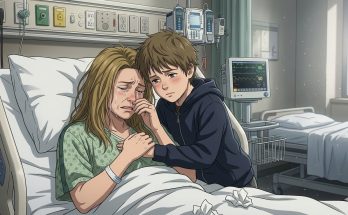
I immediately recognized the expression.
Emma had it too.
That hurt differently.
Grant asked what he had missed.
I could have listed everything.
Five first steps.
Five first words.
Five first days of school.
Birthdays.
Fevers.
Broken bones.
Nightmares.
Christmas mornings.
Instead, I gave him the truth that mattered most.
“You missed being ordinary with them.”
He looked confused.
“You didn’t miss five dramatic milestones.”
I stirred my coffee.
“You missed thousands of mornings when nothing important happened.”
Grant looked down.
That sentence seemed to hurt him more than any accusation I had made.
Good.
Because that was the loss.
Not a photograph.
Not a birth certificate.
A life.
Grant asked whether he could see the children.
“I already told them the choice is theirs.”
He nodded.
“What did they say?”
“Different things.”
Ethan wanted answers but did not want a relationship yet.
Noah was curious.
Luke said he needed time.
Rose wanted to know why Grant had never looked for us.
Emma asked whether he was still friends with “the mean lady from the funeral.”
Grant almost smiled.
Then he stopped himself.
“That’s fair.”
I told him he could write each child a letter.
No promises.
No pressure.
No asking them to respond.
He agreed.
A week later, five envelopes arrived at the hotel.
Each had one child’s name written by hand.
Grant had not used the word “Dad” anywhere on the outside.
That was important.
I handed them out and said nothing.
Ethan took his letter into another room.
Noah opened his immediately.
Luke left his on the dresser for two days.
Rose read hers twice.
Emma asked me to read hers with her.
Grant did not excuse himself in the letters.
He told each child that he had failed to ask the right questions ten years earlier.
He admitted that he should have known about them.
He said he was sorry for the years that were gone.
Then he wrote the same final sentence to all five.
You do not owe me forgiveness, a relationship, or even a reply. If you ever want to know me, I will be here.
I did not tell the children how to react.
Ethan never answered.
Not then.
Noah sent one question.
Do you really hate camping?
I laughed when I saw it.
Grant replied that he hated sleeping on the ground but would probably survive.
That became the first conversation.
Not about divorce.
Not about paternity.
Camping.
Exactly the kind of ordinary thing I had told Grant he missed.
Luke eventually asked whether Grant knew anything about old engines.
Rose wanted photographs of William.
Emma asked for a picture of Grant when he was ten.
Grant answered everything.
He never pushed.
Months passed.
The children agreed to meet him together.
We chose a public park.
I stayed nearby but did not sit at the same table.
Grant arrived carrying no gifts.
That was smart.
He greeted them by name.
No hugs.
No “I’m your father.”
No emotional speech.
He simply said:
“Thank you for coming.”
The first ten minutes were painfully awkward.
Then Noah asked him whether the Whitmore family really owned the old fishing cabin near the lake.
Grant laughed.
Apparently they did.
Luke asked whether the boat still worked.
Rose wanted to know if William liked dogs.
Emma asked why Grant looked exactly like Ethan when he frowned.
Ethan finally spoke.
“Why didn’t you believe Mom?”
The entire table went quiet.
Grant looked toward me.
I did not rescue him.
He turned back to Ethan.
“Because I was angry, insecure, and proud.”
Ethan waited.
Grant continued.
“I let someone tell me a story I already feared might be true.”
He swallowed.
“And when your mom tried to explain, I treated her defense like proof she was lying.”
Ethan looked at him.
“That sounds stupid.”
Grant nodded.
“It was.”
I almost smiled.
Ethan did not.
Then he asked the harder question.
“If Vanessa never deleted Mom’s message, would you have come looking for us?”
Grant went still.
I watched him search for an answer.
Then he chose honesty.
“I don’t know.”
Ethan’s face changed.
Grant continued before he could look away.
“I want to say yes.”
He shook his head.
“But ten years ago, I was still angry enough that I might have doubted that too.”
That answer hurt.
It was also probably the most important thing Grant said that day.
He did not rewrite himself into a better man because the truth had finally come out.
He admitted that Vanessa’s deception explained part of what happened.
It did not erase his responsibility.
Ethan nodded once.
The conversation moved on.
Slowly.
Awkwardly.
Like real relationships usually do.
Over the next year, Grant became part of the children’s lives in small ways.
Not as a replacement for the father they never had.
Not as someone entitled to instant closeness.
He attended one of Noah’s games.
Helped Luke repair an old lawn mower.
Took Rose to visit William’s favorite hiking trail.
Sent Emma a photograph of himself at ten.
Ethan took the longest.
I expected that.
My oldest son understood the history better than the others.
He also remembered all the nights I worked double shifts.
The moves.
The deployments.
The times I came home exhausted and still made breakfast.
He was not interested in allowing Grant’s regret to erase what I had done alone.
Neither was I.
One evening, more than a year after William’s funeral, Ethan asked me whether Grant could attend his school ceremony.
I looked at him carefully.
“Are you sure?”
“He asked if he could.”
“That isn’t what I asked.”
Ethan thought for a moment.
Then he nodded.
“I want him there.”
So Grant came.
He sat several rows behind us.
He did not try to stand with the family afterward.
Ethan walked over to him on his own.
They talked for a few minutes.
Then Ethan allowed Grant to take a photograph with him.
That picture meant more than the paternity report ever did.
Because DNA had answered what Grant was.
Time was answering whether he could become someone worth knowing.
My relationship with Grant remained different.
People sometimes assumed that once the truth came out, we would find our way back to each other.
We did not.
Too much had happened.
I had also become someone who no longer needed my old marriage restored in order to feel like my life had been repaired.
Grant once asked me about it.
We were standing beside our cars after one of Rose’s school events.
“Do you ever wonder what would have happened if I had listened?”
“Of course.”
He looked at me.
“Do you think we would still be married?”
I considered lying.
Instead, I said:
“I think we might have had a chance.”
His eyes lowered.
“But that woman doesn’t exist anymore.”
He looked back at me.
“Neither does the man who left her.”
That was true.
It just did not mean those two new people belonged together.
We learned how to be respectful.
Then cooperative.
Eventually, even friendly.
That was enough.
Vanessa disappeared from my life almost completely.
Grant ended their relationship for good.
Some Whitmore relatives eventually reached out to apologize.
Others never did.
I stopped caring who believed what once the people most affected by the truth finally had access to it.
The children slowly became part of William’s extended family.
Not everyone earned a place.
Some did.
Grant’s aunt sent Rose boxes of old photographs.
One cousin taught Noah the family fishing spots.
Luke discovered he shared William’s obsession with repairing broken radios.
Emma found an old picture of William holding Grant as a baby and carried it around for an entire afternoon.
Those were the moments that made returning to the funeral worthwhile.
Not Vanessa’s face.
Not Grant’s shock.
Not even the documents.
The children had been given a history that belonged to them.
Two years after William died, we returned to the cemetery.
This time, there were no whispers.
No military uniform.
No sealed envelope.
Just me, five children, and eventually Grant walking several steps behind us.
Rose carried flowers.
Ethan had driven part of the way.
Noah complained about the weather.
Luke had forgotten where he put his phone.
Emma talked almost the entire walk.
When we reached William’s grave, the children placed their flowers beside the headstone.
Grant stood quietly nearby.
Then Emma asked:
“Do you think Grandpa William would have liked us?”
Grant’s face changed.
“Yes.”
His voice broke slightly.
“He would have loved all five of you.”
Emma nodded as though that settled the matter.
I looked down at William’s name.
For years, I believed returning to the Whitmores would mean going backward.
It did not.
I had not returned to recover the life they took from me.
That life was gone.
I returned so my children would never have to inherit a lie simply because the adults who created it were too ashamed to correct it.
Grant lost ten years because he chose suspicion over trust.
Vanessa helped make that loss larger.
I lost things too.
But standing there beside five children who knew exactly where they came from, I no longer measured my life by what the Whitmores had taken.
The truth had not restored my marriage.
It had not turned strangers into an instant family.
It had not erased ten years.
It simply gave everyone the chance to stop living inside a lie.
And sometimes that is the only kind of second chance the past can honestly give us.