Part 1

“What on earth did my son do to make you end up living like this?”
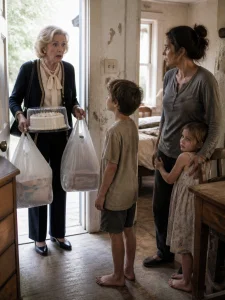
Evelyn said those words standing in the doorway of a cramped, second-floor apartment in a run-down neighborhood, holding two heavy grocery bags in one hand and a tres leches cake in the other. Beside her stood Edward, her ex-husband—a retired military engineer who hadn’t cracked a smile since they climbed the dimly lit, creaky stairs of the building.
They had driven all the way from Boston to New York to surprise their grandchildren. Andrew, their son, had sworn to them for eight months that Clara and the kids were living separately only because “the house was undergoing a complete renovation.” He had spent months lying to them about blueprints, contractors, water damage, and delayed city permits.
But this place didn’t smell like a renovation.
It smelled like old moisture, reheated soup, and bone-deep exhaustion.
Evelyn looked down the narrow hallway. On the cheap shoe rack lay only a pair of worn-out sneakers belonging to thirteen-year-old Toby, a pair of tiny pink shoes belonging to seven-year-old Sophia, and Clara’s black work heels, scuffed badly at the toes.
“Andrew doesn’t live here,” Clara said, her voice barely a whisper. “He left eight months ago.”
Evelyn clutched the cake box against her chest as if it had suddenly turned to lead.
Behind Clara, the living room was little more than a single space divided by a hanging curtain. There was a folding plastic table, a stove that only lit when it felt like it, and a peeling wall where Sophia had taped a crayon drawing.
In the drawing, there was a big house, Clara wearing a bright red dress, Toby drawn tall, and Sophia with two long pigtails. Off in the far corner, completely separated from everyone else, was their dad—drawn only in faint, colorless pencil.
That single detail shattered the quiet room.
Clara stepped aside to let her former in-laws in and put a pot of water on the stove for coffee, though she only had cheap instant grounds left. As Evelyn set the groceries on the table, Edward inspected every inch of the apartment without uttering a word. He had spent his entire life analyzing structures, blueprints, load-bearing beams, and foundations. That afternoon, he understood that a family could collapse just as quietly as a rot-hollowed house.
Clara worked from eight to five as an accountant at a small firm in Queens. At night, she filed tax returns for private clients, reviewed invoices, and filled out spreadsheets until her eyes burned. She paid rent, tuition, groceries, subway passes, and medical bills. She slept little. She cried even less.
“Andrew didn’t just leave for another woman,” Clara finally said. “He calculated everything for nearly a year.”
Evelyn looked up, her face pale.
The other woman was named Brenda—a twenty-eight-year-old assistant at the corporate law firm where Andrew worked as an associate. Clara had found out too late. By then, he had already moved assets around as if his fifteen-year marriage were just a case file waiting to be closed.
The family home in upstate New York, bought shortly after their wedding, had been re-titled with a forged deed dated prior to their marriage. The lakeside cabin, built over four years with money they had both earned, had been legally “gifted” to Brenda’s mother. The family SUV, valued at over forty thousand dollars, had been sold to one of Andrew’s fraternity brothers for a mere five thousand on paper.
“He placed everything out of reach of our marital estate,” Clara explained flatly. “Or so he thought.”
Evelyn sank into a plastic chair. She didn’t touch her coffee.
Every Sunday, Andrew called his parents to talk about holiday plans, fake home repairs, and how well the kids were doing. He never mentioned a divorce. He never confessed that Clara was living in a borrowed apartment out of sheer desperation. He never admitted that he was paying a pittance in child support and had skipped Toby’s thirteenth birthday after promising he’d be there.
“Why didn’t you tell us?” Evelyn asked, her voice cracking.
Clara took a slow breath. “Because he’s your son. It was his job to tell you the truth.”
At eleven that night, a heavy knock echoed against the thin front door.
Toby emerged from the bedroom, looking alert and wary. Sophia hid behind the hanging curtain.
It was Edward. He had gone down to move his car earlier and returned with a thick leather binder tucked under his arm. Evelyn looked at her ex-husband in surprise.
“I didn’t just come to deliver birthday gifts,” Edward said quietly. “I came because something hasn’t added up for months.”
When Clara finished showing him the timeline, Edward didn’t yell. He didn’t slam his fist on the table. He simply asked for documents.
He went through bank statements, canceled checks, text logs from contractors, furniture invoices, lease agreements, and copies of property deeds. Then he walked into the small room where his grandchildren slept. He stood there staring at Toby, who was pretending to be asleep while clutching his fists tight beneath the blanket.
Edward returned to the kitchen, pulled out his phone, and dialed his son.
“Tomorrow morning at ten o’clock, you are going to be sitting at this kitchen table,” Edward commanded into the receiver.
“Dad, look, let me explain—”
“Ten o’clock sharp, Andrew.”
He hung up.
Clara watched Evelyn close her eyes, as though the reality that she had been lied to by her own son for eight months was finally crushing her.
And none of them had any idea what Andrew was going to bring with him the next morning.
Part 2
By six in the morning, Evelyn was already in the small kitchen making pancakes with the flour she had bought the night before. Sophia chatted nonstop about her school, a girl in her class who wore massive hair bows, and a teacher who smelled like vanilla. Toby, on the other hand, barely picked at his plate.
He knew his father was coming.
And it made his stomach churn.
For months, the thirteen-year-old had swallowed his anger in silence to avoid burdening his mother. He took refuge in chess, old library books, and never asking for anything new. At his age, Toby already understood far too well the difference between a busy father and a father who chooses to abandon his family.
Before ten, Clara spread everything across the table: bank statements, wire transfer receipts, lumber and material invoices for the cabin, text exchanges with local builders, furniture receipts, overdue private school tuition bills, and a notarized document proving her grandmother had given her seventy-five thousand dollars for the down payment on their marital home.
But one vital piece was still missing.
That money had initially passed through an account in Andrew’s name alone. The account was now closed, and the bank had refused to release historic records without a formal court order.
Edward picked up the copy of the property deed and pointed to the down payment line item.
“It says here the down payment was one hundred and fifteen thousand dollars.”
“Seventy-five thousand came directly from my grandmother’s estate,” Clara answered. “Andrew told me the remaining forty thousand came from our personal joint savings.”
Evelyn went deathly pale. “It didn’t come from your savings.”
Clara looked at her. “What?”
“We gave him forty thousand dollars,” Evelyn said, her voice shaking. “Your father-in-law sold a small parcel of land in Massachusetts. Andrew told us he needed it to complete the down payment on your family home.”
Edward set the deed down on the table with a terrifyingly calm expression. “And I made him sign a written receipt.”
A heavy silence descended over the room.
Edward unzipped his leather binder and pulled out an old piece of paper. It was a copy of a handwritten receipt signed by Andrew, dated two months after their wedding day. Tucked right behind it was the official bank wire confirmation with the memo line reading: Financial support for marital home down payment.
Clara felt the air rush back into her lungs.
If that money had been transferred after the marriage, the house could not possibly have been purchased prior to the wedding as a sole-property asset. The date on the official property deed was either forged or fraudulently altered. That wasn’t just a bitter divorce maneuver anymore. That was felony real estate fraud.
At 10:12 AM, Andrew knocked on the door.
He walked in wearing an expensive charcoal suit, polished Italian shoes, and the practiced, arrogant smile of a lawyer who had won too many arguments before they even started.
“I assume Clara has already given you her dramatic version of events,” he said smoothly, barely glancing around the small apartment.
Evelyn didn’t get up to greet him. “It’s not a ‘version,’ Andrew. You altered dates, hid marital property, and left your children living in a place we didn’t even know existed.”
Andrew let out a dry, condescending laugh. “Everything I did was entirely within the law. Clara always overreacts.”
“How curious,” Clara said calmly. “Because I have construction invoices for the cabin paid directly from my account, text messages between you and the builder, and a deed transfer to Brenda’s mother that was executed right after you retained a divorce lawyer.”
Andrew’s smile stiffened. “None of that proves where the original down payment for the main house came from.”
Edward unlocked his phone and shoved the screen directly in front of his son’s face.
There was the receipt.
In Andrew’s own handwriting.
With Andrew’s signature.
And the date that completely ruined his legal defense.
For the first time, the corporate attorney lost every drop of color in his face.
“When you passed the bar exam,” Edward said quietly, “I told you the law could be used to build something honorable or to destroy people. Look at what you chose to do with it.”
Andrew stared down at the floor, unable to meet his father’s eyes.
Then he reached into his coat pocket and pulled out a folded piece of paper.
He offered to hand over a small portion of the assets, increase monthly child support slightly, and sign a quick settlement to avoid going to trial. Clara didn’t even reach for it.
“Why now, Andrew?” she asked. “For eight months you told me the case was closed and I had no rights.”
Andrew clenched his jaw. He glanced toward the hallway, where the door to Toby’s room was cracked open.
“Brenda left me three weeks ago,” he confessed quietly. “But that’s not the worst part.”
Evelyn stood up slowly. “What else did you do, Andrew?”
Andrew swallowed hard, as if the words were tearing at his throat. “There’s something I found out recently… something none of you know.”
Just as he opened his mouth to explain, the bedroom door swung open, and Toby stepped into the room.
Part 3
Toby stood straight in the doorway, his sweater sleeves pulled over his hands, his back rigid.
Andrew looked at his son, and whatever smug composure he had left completely shattered.
“Go back to your room, Toby. This is an adult conversation.”
“No,” the thirteen-year-old replied steadily. “You’re talking about my house, my sister, and my life.”
No one corrected him.
Clara felt a sharp pang in her chest. Her son was only thirteen, but he spoke with the quiet, weary resolve of someone who had been forced to grow up far too fast.
Andrew lowered his head.
“Brenda left me when she realized my firm’s managing partners were opening an internal ethics review,” Andrew admitted. “Her mother was listed as the owner of the cabin, and Brenda was terrified it would ruin her own career. She told me I had dragged too many people into a mess I created.”
“How convenient for her,” Evelyn muttered bitterly.
“I’m not asking for pity,” Andrew continued, looking at Clara. “I’m here because I finally realized something I should have understood months ago.”
A month prior, he had stopped by Sophia’s elementary school. He had promised her that soon “everything would go back to normal.” The seven-year-old had simply murmured, “Okay,” without a trace of joy or belief, as if she already knew her father’s promises were completely hollow.
Afterward, Andrew had driven to this apartment building and parked across the street. He had watched Clara get off the bus carrying heavy grocery bags, with Sophia’s school backpack slung over her shoulder and the little girl fast asleep against her chest. Until that day, he had convinced himself that Clara was just being dramatic to squeeze more alimony out of him.
But there was no acting in those scuffed, worn-out work shoes.
There was no legal strategy in a mother counting quarters at a corner bodega just to buy bread.
Toby’s birthday had been the final straw. Andrew had canceled an hour before dinner, claiming he had an unmovable client meeting. That night, his mother had sent him a video of Toby blowing out his birthday candles without looking toward the front door even once.
“I didn’t just strip away your home,” Andrew said, staring at Clara. “I stripped away my children’s ability to ever believe a word I say.”
Toby offered no response.
Clara did. “Understanding the damage you caused doesn’t erase what you did, Andrew.”
“I know,” he whispered.
He set a new, thick document on the table. Under the new proposal, the main house would be placed into a trust: twenty-five percent for Toby, twenty-five percent for Sophia, with Clara retaining exclusive, lifelong occupancy rights. The lakeside cabin would be fully re-titled into Clara’s name alone, with Andrew covering all legal fees to reverse the fraudulent transfer to Brenda’s mother. Furthermore, he agreed to triple the monthly child support, cover all private school tuition and medical expenses separately, and sign a strict, court-monitored visitation schedule with severe financial penalties for any missed visits.
“I don’t want empty promises,” Clara said coldly. “I want deeds, wire confirmations, ironclad clauses, and a judge’s signature.”
“I agree,” Andrew said immediately.
“And you won’t show up whenever it happens to be convenient for you,” she added. “If you say you’re coming on a Saturday, you show up. If you can’t make it, you give advanced notice. My son will never wait by a window on his birthday again.”
Andrew closed his eyes. “I agree to that, too.”
Edward took the draft and began reviewing it with surgical precision, marking edits with a red pen. Evelyn insisted that all medical, psychological, and extracurricular expenses be excluded from the base alimony calculations. Clara added an explicit clause preventing any future sale or refinancing of the kids’ trust without a formal court order.
Andrew didn’t object to a single edit.
Toby remained standing near the doorway. Suddenly, he looked at his father and asked, “Do you actually know how to play chess?”
Andrew looked up, caught completely off guard. “A little.”
“’A little’ usually means you’re terrible at it,” Toby said, the ghost of a smirk crossing his face. “I can teach you, but I’m not going to let you win.”
“I wouldn’t ask you to.”
“Saturday,” Toby decided. “If you actually show up.”
It wasn’t forgiveness. It was a crack in the door.
And Andrew knew he had no right to ask for anything more.
At noon, Clara went to pick up Sophia from her weekend art workshop. The little girl ran into the apartment, threw her arms around her grandparents, and stopped dead in her tracks when she saw her father sitting near the kitchen table.
“Are you leaving again?” she asked quietly.
Andrew knelt down so he was at eye level with her. “Yes, for today. But I’m coming back on Saturday to see you and Toby.”
Sophia looked at him with a gravity far beyond her seven years. “Are you really coming back?”
“I promise.”
“Okay,” she whispered softly.
She didn’t hug him. Instead, she walked over to Evelyn to show her a new box of colored pencils. Andrew watched his daughter walk away, and Clara saw the pain in his eyes—a distance that hurt him far more than any legal threat ever could.
Two days later, Edward sent the original handwritten receipt via certified mail and connected Clara with a top family law attorney in town. With that evidence, Clara could have dragged Andrew through a public trial and likely stripped him of everything. But she also knew a bitter legal war would consume another year of her life, her finances, and her children’s emotional well-being.
She didn’t accept the settlement out of pity for Andrew. She accepted it because it secured her children’s future immediately.
Their first meeting took place at a law office downtown. Brenda’s mother was already there, stiff and furious. She agreed to sign the papers rescinding the cabin transfer provided her legal fees were covered.
“Andrew pays for that,” Clara said firmly. “I won’t spend a single dollar recovering what was stolen from me.”
“I’ll cover it,” Andrew replied without hesitation.
Clara read every single page. She struck out vague phrasing, demanded land registry certificates, and verified title guarantees. She refused to sign until the county clerk confirmed the cabin was officially registered in her name alone.
The rest of the agreements were signed in family court: revised alimony, full health coverage, a binding visitation schedule with default fines, and the children’s equity trust for the main house. As they stepped out onto the courthouse steps, Andrew paused.
“I thought I was building a new life,” he said softly. “Instead, I destroyed the only one that mattered.”
“Yes,” Clara said. “You did.”
“I know it’s too late for us.”
“For our marriage, yes,” she replied. “For your kids, that depends entirely on what you do starting today.”
Andrew didn’t ask for another chance as a husband.
On Saturday, he arrived at 10:00 AM sharp carrying a wooden chess set and a book on opening strategies. Toby beat him in twenty-seven minutes.
“I warned you,” the boy said, almost smiling.
“Another game,” Andrew requested.
They played three. Andrew lost all three.
Sophia sat on the rug drawing. Before her father left, she handed him a piece of paper with a drawing of a bright blue cat.
“So you don’t forget to come back next week,” she said.
Andrew folded the drawing with extreme care and tucked it into his jacket pocket.
The months that followed were far from perfect. Some visits were filled with small moments of laughter; others were tense and quiet. Sometimes Toby barely spoke. Sometimes Sophia hid behind Clara before saying hello. But Andrew stopped demanding immediate affection and focused on the one thing he could control: showing up.
One Thursday afternoon in November, he called two hours early to explain that an emergency court hearing had run late. Clara felt an immediate flash of anger.
“Tell Toby yourself,” she said, handing her son the phone.
Andrew explained the delay without offering dramatic excuses. Toby listened quietly.
“Next time, don’t make promises you can’t keep,” the boy said before hanging up.
Andrew arrived late that evening, but he brought dinner. He sat in the kitchen until Toby finished his homework, and they played a single game of chess. When Andrew left, Toby didn’t offer a warm goodbye, but he left his bedroom door cracked open.
Clara realized then that rebuilding a family wasn’t about pretending the past never happened. It was about standing amidst the rubble, acknowledging the wreckage, and taking one small step forward at a time.
She also began speaking more frequently with her own mother, who lived in Pennsylvania. When Clara finally told her the whole story, her mother wept softly over the phone.
“I couldn’t fix it for you,” her mother said, “but it breaks my heart knowing you carried that burden all by yourself for so long.”
From then on, they spoke every Wednesday about ordinary things: recipes, homework, school uniforms, Toby’s middle-school chess tournaments, and Sophia’s chaotic artwork.
In December, the final registry documents for the main house were finalized. Half of the property was legally owned by the children’s trust. When Clara explained it to Toby, he frowned thoughtfully.
“Does that mean Sophia is going to try to paint half the house pink?”
Clara let out a genuine laugh—her first real laugh in a very long time. “That’s why we’re not telling her just yet,” she teased.
Before Christmas, Sophia made another drawing. The main house was in the center. Clara wore her red dress. Toby was drawn tall. Evelyn and Edward stood near a Christmas tree. Andrew was still off to the side, but he wasn’t drawn in faint pencil anymore. This time, he was filled in with bright colors.
“Dad lives in a different apartment,” Sophia explained, “but he’s still part of our drawing.”
Clara taped the picture to the refrigerator.
On New Year’s Eve, Evelyn and Edward returned with armfuls of food, gifts, and a box of fresh oranges. Andrew joined them in the afternoon with Clara’s permission. He made clay figures with Sophia, lost two rapid chess matches to Toby, and said his goodbyes at ten o’clock.
“I’ll pick you guys up tomorrow at noon,” he told the kids.
“Noon,” Toby repeated, looking his father dead in the eye.
Before leaving, Andrew turned to Clara. “Thank you for letting me be here tonight.”
“I did it for them, Andrew. Not for you.”
“I know.”
At midnight, Sophia raised her juice box into the air. “My New Year’s wish is that nobody gets sick, nobody leaves without telling us, and that we get a cat!”
“The cat issue is still open for negotiation,” Clara said with a smile.
Everyone laughed.
Later that night, Edward found Clara washing dishes in the small kitchen.
“I’m only going to say this once, Clara,” he said gently. “I am deeply proud of you. You didn’t let pain turn you into a cruel person.”
Clara set a plate on the drying rack. “Thank you, Edward.”
“Keep moving forward,” he said. “That’s what winning actually looks like.”
In February, the final confirmation arrived: the lakeside cabin was officially registered back under Clara’s name alone. She read the email while boiling water for coffee and forwarded it to Edward.
He texted back almost instantly: “In May, we’re all going up there to inspect the place.”
The word all felt light and warm in her chest.
In March, Clara looked at Sophia’s drawing taped to the refrigerator. She remembered that very first crayon picture where Andrew was just a grey shadow in the corner, almost erased. He was still separated from them, yes, but he had color again.
Clara didn’t get her marriage back. Nor did she erase the months of fear, overdue rent, and sleepless nights. But she got her home back, her children’s security, and a brand-new certainty: standing firm doesn’t mean becoming cold.
She opened a fresh notebook and began writing down a packing list for their upcoming trip to the cabin. It was no longer a list for survival. It was a list for the future.
Outside, a gentle rain fell over the city skyline. Clara brewed her morning coffee and listened to her children debating in the living room over what name to give the cat they hadn’t even adopted yet.
And for the first time in a very long time, she understood that losing everything isn’t always the end of a family—sometimes, it’s the exact moment you discover who is truly willing to stay.