PART 1

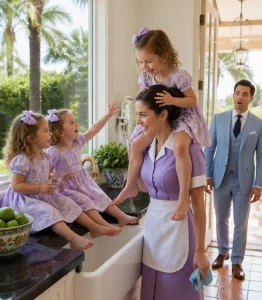
“Take off that uniform and get out of my house. Starting today, you don’t go anywhere near my daughters ever again.”
Julian Sterling’s order slammed through the sunlit kitchen like a heavy door shutting.
Rachel slowly helped six-year-old Lily down from her shoulders, while Maya and Chloe froze, their wooden spoons halting mid-air against a stainless-steel mixing bowl. In a single heartbeat, the triplets’ laughter evaporated into terrified silence.
Julian had returned unannounced from an executive trip to Chicago. As the owner of a luxury boutique hotel chain based in Austin, Texas, he was accustomed to making decisions without hesitation or pushback. But inside his sprawling home in Westlake Hills, there was a crisis that neither his vast wealth, nor top-tier specialists, nor high-society connections could fix.
His six-year-old triplets hadn’t uttered a single word since their mother, Victoria, passed away sixteen months ago from sudden post-surgical complications.
Before her death, Maya used to weave endless, imaginative stories; Chloe asked endless questions until she fell asleep; and Lily made up little songs about everything she saw. But after the funeral, all three girls went completely silent. They communicated only through sketches, gestures, and solemn glances. Julian hired world-renowned child psychologists, redecorated their rooms, bought a golden retriever, and even built a sprawling indoor playroom shaped like a fairytale castle.
Nothing worked.
Eventually, Julian did the only thing he knew how to do when overwhelmed by pain: he threw himself into work until he felt completely numb.
Rachel Vance had come highly recommended by Mrs. Miller, the family’s longtime housekeeper. At twenty-nine, Rachel lived in nearby East Austin and attended weekend classes for a degree in special education. Having raised her younger brother after their father fell ill, she knew the subtle difference between truly caring for a child and forcing them to be okay.
She never pressured the girls to speak.
She washed their school clothes, organized their toys, and quietly hummed soft acoustic melodies while working. If the girls sat near her, Rachel carried on with her chores. If they walked away, she let them have their space.
One afternoon, Lily left a crayon drawing on the kitchen island showing four women holding hands. Without asking a single question, Rachel simply taped it onto the refrigerator.
A week later, Chloe stood next to her and whispered, “The one in the blue dress is Mommy.”
Rachel didn’t gasp, cheer, or call for the housekeeper. She just looked at the picture and softly replied, “I can tell she loved you girls so very much.”
From that moment on, words began to return. It started with faint murmurs, then short sentences, and finally, the bright, joyful laughter that the house had long forgotten.
Julian knew nothing of this progress because he rarely ate breakfast with them and usually came home long after they were asleep.
That afternoon, he walked in to find them singing and baking, flour dusting their cheeks, with Rachel wearing a bedsheet draped over her shoulders like a superhero cape. For a brief second, Julian felt an overwhelming wave of relief. But then he saw Lily throw her arms around Rachel’s waist in a tight hug, and something dark and ugly twisted in his chest.
It wasn’t anger. It was shame.
A woman he barely acknowledged had accomplished what he, their father, could not.
“You were hired to work here, not to play mother,” he snapped coldly.
Rachel went pale. “Mr. Sterling, I would never try to take her place—”
“I don’t want explanations. You’re fired.”
Mrs. Miller, the chauffeur, and the child therapist who had just arrived for an appointment witnessed the entire scene. Rachel quietly set her apron on the table, picked up her bag, and walked out without defending herself.
The girls stared at their father. Julian waited for them to cry out, to protest, to say anything at all.
They said nothing.
That night, all three girls retreated back into the exact same suffocating silence that had gripped them sixteen months ago.
The next morning, Julian found a folded piece of paper slipped beneath his bedroom door, written in dark purple crayon.
When he read the first line, the floor seemed to give way beneath him.
PART 2
The handwriting consisted of large, wobbly letters, with several words crossed out and rewritten.
Daddy: We did want to talk. But when Mommy died, you screamed that you couldn’t stand hearing us cry anymore. We thought our voices hurt you. Rachel told us that having feelings wasn’t being bad. Yesterday you made her cry because she made us happy. That’s why it’s better if we stay quiet again.
At the bottom were three small signatures and a drawing: Julian standing on one side, the three girls in the middle, and Rachel on the outside of a closed front door.
Julian sank onto the edge of his bed, breathless.
A memory flashed in his mind—a night just days after the funeral. The girls were sobbing uncontrollably, asking when their mother was coming home. Exhausted after forty-eight straight hours without sleep, Julian had slammed his hand on the dining table and yelled, “I can’t take any more crying in this house!” before locking himself in his office.
To him, it had been a desperate breakdown. To three grieving six-year-olds, it had been a command.
For sixteen long months, he assumed their silence was purely grief. He had never realized his daughters were trying to protect him from the sound of their own pain.
Mrs. Miller walked into the hallway and saw the paper trembling in his hands.
“Rachel knew by the second week,” Mrs. Miller said softly. “Chloe drew it for her.”
Julian looked up, his eyes bloodshot. “Why didn’t anyone tell me?”
“Because you never asked, sir. And whenever someone tried to talk to you about the girls, you answered with money.”
Julian asked for Rachel’s address and immediately drove to a modest, charming house in East Austin. Rachel opened the door dressed in casual clothes, her eyes still puffy. Standing behind her was her fifteen-year-old brother, Leo, glaring at Julian with deep suspicion.
“I came to apologize,” Julian said, his voice raw.
“Your apology doesn’t change the fact that you humiliated me in front of them,” Rachel replied quietly.
“I know.”
“And it doesn’t change what you taught your daughters: that if they care about someone, you can just throw that person away.”
Julian lowered his gaze. “I need you to come back.”
Rachel let out a bitter, quiet laugh. “You don’t need me, Mr. Sterling. You need to stop running.”
Julian started to mention his twelve hotel properties, his eight hundred employees, and an upcoming multi-million-dollar expansion project. But for the first time in his life, he realized how utterly hollow it sounded.
“I don’t know how to be the father they need,” he admitted softly.
“Then learn,” Rachel said firmly. “But don’t use me as a temporary bandage while you keep living out of airport terminals.”
She closed the door gently.
Julian drove home alone. He canceled his afternoon meetings and sat cross-legged on the floor of the play castle. The triplets were huddled under a small table, surrounded by throw pillows.
“I read your letter,” Julian said, his voice breaking. “I made you think your voices bothered me. It wasn’t true, but I know that’s what I taught you.”
None of them replied.
“I also hurt Rachel because I was jealous. She was here for you when I refused to be. That wasn’t your fault, and it wasn’t hers.”
That night, he sat in the hallway outside their bedroom and read them a bedtime story through the cracked door because they wouldn’t let him inside.
The next morning, he tried to make them scrambled eggs and accidentally burned the entire skillet. Lily took a tiny bite and wrote on a paper napkin: Tastes gross.
“Yeah,” Julian admitted with a sad smile. “Honestly, it’s terrible.”
Maya almost smiled.
For five days, Julian focused on the smallest promises: he drove them to school himself, came home exactly when he said he would, and switched his cell phone off during dinner.
On the sixth day, his business partner, Marcus, called.
“The lead investor for the new resort can only meet tomorrow in New York, man. We’re talking tens of millions here.”
Julian looked over at his daughters quietly putting together a floor puzzle in the living room.
“I already lost the most important thing in my life because I thought work couldn’t wait,” Julian said smoothly. “Count me out.”
He hung up.
During their next family therapy session, the psychologist asked the girls how they felt when their father raised his voice. Maya drew a closed door, Chloe drew an airplane, and Lily drew a face with a red ‘X’ over the mouth.
“Does the door mean you want to run away?” Julian asked carefully.
Maya shook her head, looked up at him, and whispered, “It means you’re leaving.”
It was the very first sentence she had spoken directly to him since he fired Rachel. Julian wanted so badly to reach out and hold her, but he forced himself to wait patiently until she took a small step closer on her own.
That afternoon, they found a cardboard box left on the front porch. Inside was Rachel’s folded apron, several storybooks, and a note the girls had secretly written her weeks before she was let go:
Rachel: With you, we remembered what Mommy sounded like when she laughed.
Julian finally understood. Rachel had never been trying to replace Victoria. She was simply helping his daughters remember their mother without feeling like they were betraying anyone.
He went back to East Austin. This time, he didn’t bring flowers or a lucrative contract. He brought the purple crayon letter.
“I wanted you to come back before so everything would be easy again,” Julian said quietly on her porch. “Now I realize it won’t be easy, and it shouldn’t be.”
Rachel looked at him intently. “What changed?”
“I canceled my travel schedule, started seeing a therapist, and handed over daily operations to my management team. If my company collapses because I stay home with my kids, then I built a terrible company.”
“That sounds nice, Mr. Sterling.”
“I’m not asking you to take my word for it,” Julian said softly. “I’m asking you to watch and see.”
Rachel agreed to visit the girls—not to resume her job immediately, but to visit.
When she walked up the driveway two days later, the triplets were standing right at the window. Lily saw her first.
“Rachel!”
All three rushed out the front door and threw their arms around her.
“We thought you didn’t love us anymore,” Chloe cried.
“I love you girls so much,” Rachel whispered, hugging them tight.
“Daddy said he hurt you,” Maya added, looking at her father.
Julian didn’t make excuses for himself. “I did. And I’m trying to fix what I broke, without forcing her to forgive me.”
Lily took Rachel’s hand, then grabbed her father’s, but she kept her hands slightly apart.
“Not yet,” Lily whispered.
“That’s okay, sweetie,” Julian said. “Whenever you’re ready.”
That moment convinced Rachel more than any speech ever could. She agreed to return for a three-month transition period with defined hours, a professional salary, clear boundaries, and mandatory attendance at family therapy sessions.
“I can guide them,” Rachel told him cleanly. “But you have to be the one who stays.”
PART 3
The first real test came when Julian’s wealthy, status-obsessed mother, Evelyn, came to visit. Upon finding Rachel sitting at the dining room table having lunch with the family, Evelyn scoffed aloud.
“Since when does the domestic staff dine with the family?”
The girls froze instantly, their spoons hovering over their plates.
“Since I realized that respect isn’t determined by who signs the payroll checks,” Julian answered calmly.
Evelyn’s face hardened. “She’s taking advantage of your guilt, Julian. Victoria would never have tolerated this.”
Julian stood up slowly. “Do not use my late wife’s name to degrade the woman who cared for your granddaughters when I didn’t have the courage to step up.”
Evelyn snatched her handbag and walked out in a huff. Two days later, however, she returned—without her usual sharp commentary or expensive gifts.
“I was cruel,” Evelyn admitted privately to Rachel. “I hid behind my pride because I didn’t know how to process my own grief over Victoria.”
Rachel accepted her acknowledgment gracefully, though she didn’t pretend the insult hadn’t happened. For the triplets, seeing an adult make a mistake, apologize, and change without demanding instant forgiveness was a vital lesson.
The following months still brought difficult nights. Sometimes the girls woke up crying out for their mother. Other times, they lashed out at Julian over memories of his past long-distance trips.
He stopped responding by trying to buy their affection with toys. Instead, he simply sat beside them and listened.
During a severe thunderstorm one evening, a sudden crack of thunder made Chloe scream in fear. Julian ran into the room, but Lily immediately shrank back, hiding behind Rachel.
“Please don’t get mad because we made noise,” Lily sobbed.
Julian sat down on the hardwood floor several feet away from them.
“You can make all the noise you need to,” Julian said gently. “I’m right here, and I’m not going anywhere.”
He stayed seated there on the floor for over an hour without forcing himself onto them. Slowly, Maya walked over and sat beside him. Then Chloe asked him to close the window blind. Finally, Lily drifted over and rested her sleepy head against his shoulder.
It wasn’t instant healing. It was trust returning in quiet, steady steps.
At the six-month mark, Rachel completed her degree and opened a community counseling center for children who had lost a parent. Julian funded part of the launch under one strict condition set by Rachel: his family name would not appear anywhere on the sign or building.
The triplets were singing again. There were still moments of quiet sadness, but never again out of fear that their voices were a burden.
During their final family therapy check-in of the year, the counselor asked the girls what they needed to feel safe moving forward.
“For Daddy to tell us before he leaves the house,” Maya said thoughtfully.
“For him to come home when he promises he will,” Chloe added.
Lily looked right at her father. “For him not to fire people when he gets jealous.”
Julian nodded earnestly. “I’ll hold onto that lesson for the rest of my life.”
A few weeks later, they planted sunflowers in the backyard—Victoria’s favorite flower. Rachel explained to the girls that they had to water and care for the seeds even when nothing visible was growing under the soil yet.
“Even when it rains?” Chloe asked.
“Especially when it rains,” Rachel smiled.
A bright yellow butterfly fluttered down and landed gently on Lily’s small plastic shovel.
“It’s Mommy,” the little girl whispered softly.
Julian felt a natural urge to gently correct her, but he stopped himself.
“Maybe she came to see that none of us are lonely anymore,” Julian said gently.
Maya reached over and took his hand. “Are you going to stay right here, Daddy?”
Julian looked over at his cell phone—lying completely powered down on an patio chair—and then at Rachel, who had soil smeared across her knees.
“Yes,” Julian said clearly. “Not because I’ll never make another mistake, but because I’m never going to run away and hide when I do.”
Lily took Rachel’s hand, reached for her father’s, and finally pulled them together, interlocking their fingers.
Months later, the sunflowers bloomed into vibrant gold. Julian was in the middle of a video conference with international partners when Chloe burst into his home office.
“Daddy! They opened!”
Months ago, he would have asked for five minutes to wrap up the call. This time, he simply closed his laptop lid without a second thought.
He walked barefoot out into the warm afternoon grass and found his three daughters laughing and playing around the tall yellow flowers. Rachel sat watching them comfortably from the patio steps.
Julian had built high-rise hotels, acquired valuable real estate, and been featured on business magazine covers. But he knew his true wealth had nothing to do with buildings that bore his last name.
It was in keeping his promises, respecting boundaries, apologizing without trying to buy forgiveness, and standing firm when pain made a lot of noise.
Rachel had never replaced Victoria. She had simply unlocked a door so three little girls could understand that loving the mother they lost didn’t mean they weren’t allowed to love the people who stayed.
And Julian had finally learned the lesson that no amount of money could ever buy:
A family doesn’t start talking again because someone demands answers.
They start talking when they finally feel safe enough to be heard.