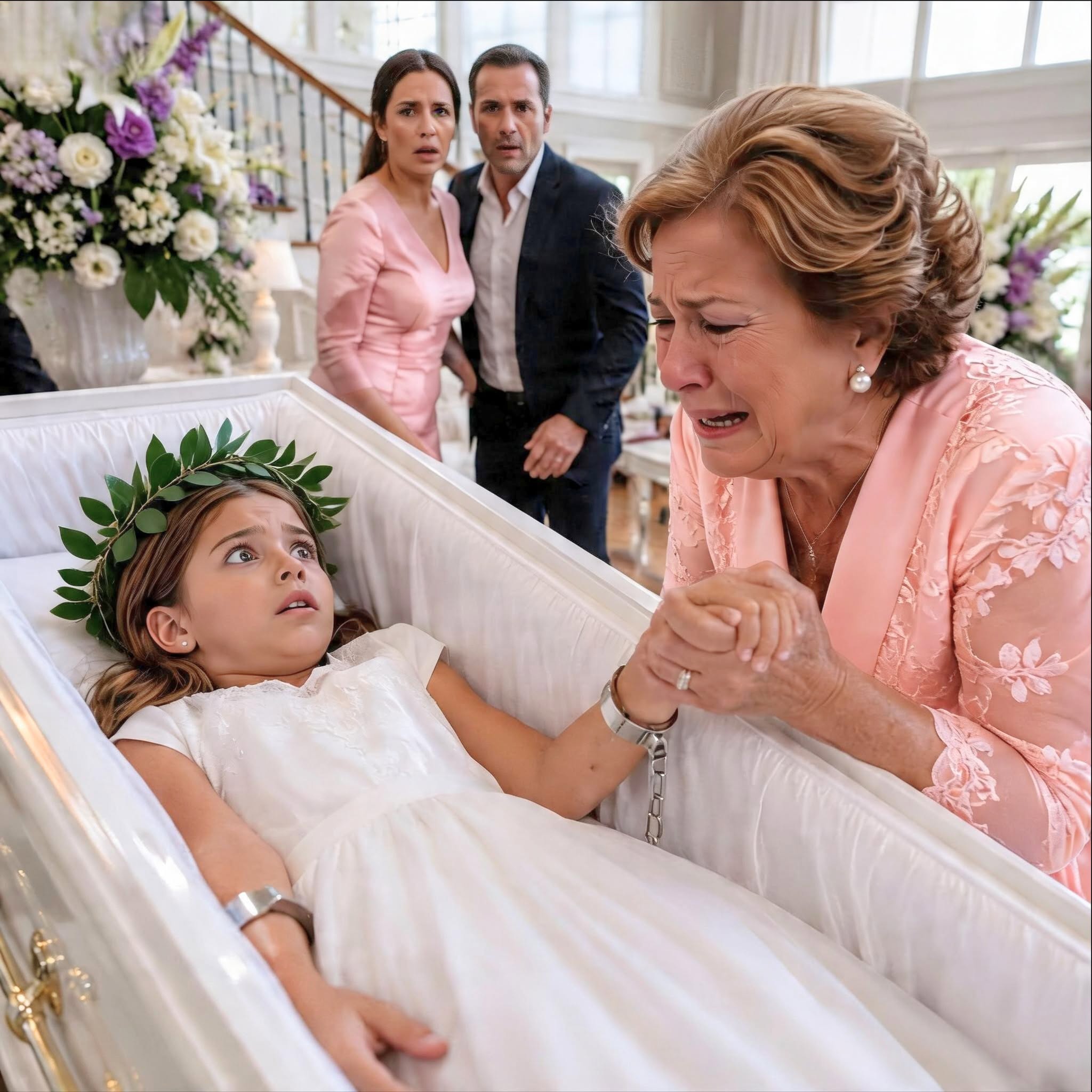
“Don’t close the casket… Chloe is still breathing.”
Mrs. Eleanor Vance didn’t know if she had genuinely heard her granddaughter’s voice or if grief was playing a cruel trick on her mind. It was nearly eleven at night. The grand suburban home of her son in a quiet neighborhood near Chicago was dead silent. In the middle of the living room, a small white wooden casket sat surrounded by lilies, burning candles, and floral wreaths sent by acquaintances who barely knew the child.
Her son, Julian, and his wife, Victoria, had gone upstairs to rest. They claimed they hadn’t slept in two days ever since six-year-old Chloe reportedly “passed away” from a sudden respiratory infection. The funeral was scheduled for the following morning. Eleanor had stayed behind in the quiet living room because she couldn’t bear to leave without stroking her granddaughter’s hair one last time.
She walked over to the casket and lifted the heavy lid.
Chloe opened her eyes.
It wasn’t a sudden movement—just a faint flutter of her eyelids and a weak trembling of her lips. But her chest rose and fell beneath her white dress. She was alive. She was pale, burning with fever, and her wrists were bound by two metal brackets secured directly into the inner lining of the casket.
“Grandma…” she whispered weakly. “I was good. I didn’t scream.”
Something broke inside Eleanor.
She frantically tried to lift the girl, but the brackets were locked shut with tiny padlocks. This was no medical mistake, nor was it a blunder by a funeral home. Someone had deliberately restrained the child to keep her from escaping.
Eleanor searched desperately through the interior padding, feeling along the fabric edge. Taped beneath the lining, her fingers caught on a small metallic key.
As her trembling hands unlocked the padlocks, every excuse her son and daughter-in-law had given over the past several months flashed through her mind: “Chloe is sleeping.” “The doctor said no visitors.” “She gets too anxious around you.” “You need to respect our parenting style.” Eleanor had assumed Victoria was simply overcontrolling, and that Julian, true to form, preferred to avoid conflict. She had never imagined anything like this.
Chloe didn’t cry when her grandmother lifted her out. She clung to Eleanor’s neck with desperate strength.
“Daddy said if I woke up, I’d ruin everything.”
Eleanor felt her knees buckle, but she forced herself to move. Wrapping the little girl in her black knit shawl, she hurried toward the back service hallway. Her purse and cell phone were in the main living room, out of reach. Then she remembered the landline installed in the laundry room.
With shaking fingers, she dialed 911.
“There is a child here who was declared dead, but she is alive,” Eleanor told the dispatcher, her voice tight with panic. “She is injured, heavily sedated, and I just unlocked her from inside a casket.”
Above her, a door clicked open at the top of the stairs.
“Mom?” Julian’s voice echoed down the hall.
Eleanor slammed the laundry room door shut and turned the lock. Chloe began to tremble violently in her arms.
“Don’t let them take me back, Grandma.”
The door handle rattled aggressively from the outside.
“Open the door, Mom!” Julian demanded. “You don’t understand what you’re doing!”
“The police are already on their way!” Eleanor shouted back.
A cold, calculating silence fell over the hallway.
Then Victoria’s panicked voice echoed outside the door. “Did she take her out? Is she out of the casket?”
Julian tried to hush his wife, but Victoria lost control. “She wasn’t supposed to wake up!”
In the distance, sirens blared, growing louder as they approached the house.
Chloe raised her feverish face, her eyes glazed, and whispered a sentence that turned Eleanor’s fear into horrifying certainty:
“I’m not normally sleepy, Grandma… I have needle sleep.”
PART 2
Police cruisers arrived at the residence before Julian could break down the laundry room door.
When officers burst through the back hallway, they found Eleanor cradling Chloe on the floor. Victoria was screaming that it was all part of a “specialized holistic treatment,” while Julian repeatedly insisted to officers that his grieving mother was confused and delusional.
No one believed them.
The angry red indentations on the girl’s wrists, her scorching fever, the deep bruising around her ankles, and the open casket in the living room told an undeniable story. Paramedics rushed the child onto a gurney. When Julian tried to step toward her, Chloe hid her face in Eleanor’s coat and began to weep silently.
At the children’s hospital, doctors discovered severe dehydration, acute anemia, malnutrition, and heavy traces of prescription sedatives in her system. These were not medications given once—she had been systematically drugged for weeks.
“Who was giving you the shots, sweetie?” the pediatrician asked gently.
Chloe looked up at Eleanor before answering. “Mommy did. Sometimes Daddy held me down so I wouldn’t wiggle.”
Police took both parents into custody that very night.
By daybreak, investigators executed a search warrant on the property. In the master bathroom, they recovered illicit vials of sedatives, used syringes, and a journal in which Victoria meticulously tracked dosage times with notes like “Slept seven hours” and “Didn’t make noise during the contractor’s visit.” On Julian’s laptop, detectives uncovered a forged death certificate. The physician listed on the document swore under oath that he had never treated Chloe.
Investigators also learned that the private funeral service provider had accepted the body without proper verification because Julian had paid upfront in cash, demanding an expedited, private service with no embalming.
The most damning piece of evidence was found on Victoria’s phone.
In a text thread with her sister, she had written:
“With Chloe’s issues, we’ll never have a normal life.”
“Leo needs our full attention.”
“When this is over, everyone will just think it was respiratory failure.”
Leo was their two-year-old son. Since his birth, Chloe had been quietly erased from family photos. On social media, Victoria posted dozens of pictures of the baby boy, while recent photos of her daughter were non-existent.
Eleanor remembered the canceled visits, the unreturned calls, and a comment Julian had made months earlier: “Victoria is just exhausted from dealing with such a difficult child.”
Chloe wasn’t difficult. She was a sick, terrified child who had been rendered physically helpless because her own parents kept her drugged.
The lead detective called Eleanor into the station and set down evidence photos showing the casket, the padlocks, and the hidden key.
“I have a difficult question for you, Mrs. Vance,” the detective said quietly. “Do you believe they knew she was still alive when they put her in there?”
Eleanor thought about the rush to hold the service, the forged death certificate, and Victoria’s panicked shout in the hallway.
“Yes,” Eleanor said.
The detective gave a somber nod. “That’s our conclusion as well.”
A social worker then entered the room with a flash drive containing recovered home security footage from the hallway.
In the brief seventeen-second clip, Julian was seen carrying an unconscious Chloe toward the living room. Victoria followed directly behind him, holding the small key to the padlocks in her hand.
Before the audio cut out, Julian’s voice could be heard saying clearly:
“Tomorrow, once she’s buried, no one can ask us any questions.”
And beneath his arm, the unconscious child was still visibly breathing.
PART 3
For forty-eight hours, local news headlines covered the shocking story of the child who woke up inside her own casket.
Eleanor tuned it all out.
She stayed by her granddaughter’s hospital bed, learning the child’s quiet signs of trauma. Chloe would jump whenever a nurse pulled a privacy curtain, sobbed at the sight of a syringe, and tried to hide crackers under her pillow. She asked for permission to drink water. She asked for permission to speak. She even asked for permission to use the bathroom.
The child psychologist explained that the trauma hadn’t started with the casket.
“The casket was simply the culmination of prolonged abuse,” the therapist explained. “Preceded by isolation, neglect, drugging, and total control.”
Eleanor grieved over the subtle warning signs she had missed. She remembered a holiday where Chloe didn’t come down for dinner because she was “napping.” She remembered a summer visit when the girl had a deep bruise on her arm, and Victoria claimed she had fallen off her bike. She remembered how Julian always avoided eye contact whenever she asked why Chloe looked so frail.
Child Protective Services temporarily placed little Leo with a foster family while the situation was investigated. Eleanor requested legal custody of both children, but authorities noted that Chloe’s recovery and stability had to come first.
In the hospital room, Chloe asked about her baby brother.
“Is Leo okay?”
“Yes, sweetheart,” Eleanor reassured her. “He’s safe.”
Chloe closed her eyes softly. “He’s not bad. He didn’t do anything wrong.”
The comment revealed a heartbreaking truth. Chloe bore no resentment toward the toddler who had drawn their parents’ attention away from her. In fact, she had often tried to comfort him when Victoria was absent and Julian was buried in his work—singing to him and picking up his toys.
The criminal investigation proceeded rapidly. Prosecutors reconstructed the past year using medical records, text logs, and financial transactions.
Julian, a high-earning financial analyst, had maintained an image of respectability. Privately, he deferred to Victoria’s extreme demands to avoid domestic conflict, even when he knew her actions endangered his daughter. Victoria, obsessed with presenting a picture-perfect image online, frequented fringe internet forums advocating unvetted, dangerous home remedies. However, her actions went far beyond negligence; she had deliberately acquired prescription sedatives and forged medical excuses to keep Chloe hidden from the world.
When Chloe developed a genuine lung infection, Victoria refused to seek emergency care, fearing doctors would notice the child’s severe weight loss and physical marks. Instead, she administered improper doses of antibiotics and heavy sedatives at home.
When Chloe’s condition deteriorated and she became unresponsive, Julian realized what was happening. But instead of dialing 911, he conspired to cover up the abuse to protect his career and avoid prosecution.
He used altered corporate documents to forge a death certificate, paid a struggling independent funeral director in cash, and arranged an immediate, closed-casket service.
During police interrogations, Victoria claimed they only locked Chloe’s wrists to prevent “post-mortem muscle spasms.” Forensic experts proved the metal brackets were custom-installed specifically to prevent a living person from pushing open the lid.
The key taped beneath the lining was perhaps the most calculated detail: Julian had hidden it there intending to unlock the restraints secretly right before burial, ensuring no marks would be discovered if the casket was ever exhumed. He had never anticipated his mother opening the casket the night before.
An audio file automatically captured by a smart speaker in their home sealed their case:
“What if she wakes up during the viewing?” Victoria’s recorded voice asked.
“We give her another dose,” Julian replied.
“What if someone notices something?”
“My mother is getting old. We’ll just say she’s confused.”
Eleanor listened to the recording at the prosecutor’s office. She didn’t cry. She sat staring at the wall, struggling to reconcile the voice on the recording with the son she had raised, supported, and loved.
Blood ties could not erase the monstrous truth.
A week later, Julian requested a visitation meeting with his mother from the county jail. Eleanor refused twice, but agreed on the third request, needing to see if any trace of humanity remained in him.
They sat separated by thick security glass.
Julian was pale and unshaven.
“Mom, everything got out of control,” he stammered into the phone handset. “I never wanted Chloe to die.”
Eleanor stared at him in silence.
“Victoria was hysterical. She said they’d arrest us and take Leo away. I thought Chloe was already too far gone…”
“You locked her inside a casket, Julian.”
“I was terrified—”
“She was six years old.”
Julian looked down, avoiding her eyes. “I need you to tell the court that I was always a good father. That Victoria made all the decisions.”
A cold calm washed over Eleanor. Until that moment, a small part of her had hoped for a genuine confession or remorse. But her son hadn’t asked how Chloe was doing. He hadn’t asked if she was eating, if her fever was gone, or if she was okay.
He was only trying to reduce his sentence.
“I am not going to lie for you,” Eleanor said quietly.
“I’m your son!”
“And she is my granddaughter. But above all, she was a helpless child you were supposed to protect.”
Julian slammed his hand against the counter. “You’re going to ruin my life!”
Eleanor held the phone steadily. “No, Julian. You ruined your life the moment you chose a casket instead of an ambulance.”
She hung up the receiver and walked away without looking back.
Chloe remained hospitalized for three weeks. When she was finally discharged into Eleanor’s custody, she left carrying a stuffed rabbit, a prescription regimen, and a deep fear of enclosed spaces.
Eleanor’s home in suburban Chicago was modest: a cozy two-bedroom house with a sunlit backyard. Once quiet, it quickly filled with children’s books, art supplies, and new clothes.
The early months were challenging.
Chloe insisted on sleeping with her bedroom door fully open and a nightlight on. If she heard a car door shut outside, she would hide. One afternoon, Eleanor found her sitting under the kitchen table, clutching a small piece of bread in her pocket.
“You don’t have to hide food, sweetie,” Eleanor said softly.
Chloe squeezed the bread tightly. “What if there isn’t any tomorrow?”
Eleanor sat on the floor beside her. “There will always be food tomorrow. I promise.”
With the help of a child psychologist, they established a comforting daily routine: breakfast at the same time, home tutoring, short walks in the yard, and a bedtime story every night.
Every evening, Eleanor reminded her: “You are safe. You are home. I am right here.”
Over time, Chloe began to believe it.
The criminal trial took place the following spring.
Victoria’s defense tried to present her as a mother suffering from severe mental illness, while Julian’s attorneys argued he was an intimidated husband incapable of standing up to his wife. But the overwhelming evidence left no room for leniency: illicit prescriptions, digital recordings, the forged death certificate, cash receipts, the physical marks on Chloe’s wrists, and Chloe’s own recorded deposition.
Chloe gave her testimony through a closed-circuit video system, accompanied by a child advocate, without having to see her parents.
She described how her mother gave her injections whenever she cried, and how her father held her down, promising that if she stayed quiet, it would all be over soon. She recalled waking up in the dark interior of the casket, believing she had done something terrible simply by being alive.
The jury returned guilty verdicts for both defendants on charges of attempted first-degree murder, kidnapping, severe child abuse, and forgery. Both received maximum prison sentences. The funeral operator involved was also prosecuted and stripped of his license.
Months later, little Leo was officially placed in Eleanor’s permanent legal custody as well, reuniting the siblings. At first, Chloe was nervous whenever the toddler cried, fearing she would be blamed. But Eleanor consistently reassured her:
“You are his sister, Chloe. It’s my job to take care of both of you.”
Years passed.
By age eight, Chloe had returned to elementary school and discovered a passion for drawing. By age ten, she no longer needed a nightlight to sleep. The faint scars on her wrists faded into thin, barely visible lines.
Eleanor never hid the truth from her, but shared details appropriately as Chloe grew older. She also firmly protected her granddaughter’s privacy, refusing media requests and documentary offers.
“You are not defined by what happened in that room,” Eleanor would tell her. “You are Chloe. What they did is part of your past, but it is not who you are.”
On the tenth anniversary of that night, sixteen-year-old Chloe was in the backyard planting yellow marigolds with her twelve-year-old brother, Leo. When they finished, she sat on the porch steps beside her grandmother.
“I still remember the smell of the lilies,” Chloe said softly. “And how dark it was. I thought the dark was never going to end.”
Eleanor took her hand. “It ended.”
“Because you opened the casket.”
“Because you kept breathing, sweetie.”
Chloe smiled, her eyes glistening. “Sometimes I wonder what would have happened if you hadn’t come back down to say goodbye that night.”
“I wonder about that too,” Eleanor admitted quietly.
“Do you ever blame yourself for not realizing what was happening sooner?”
Eleanor looked out at the garden. “Every single day,” she answered honestly. “But I learned that regret is only useful if it teaches us how to protect the people we love moving forward.”
Chloe leaned her head against her grandmother’s shoulder.
Nearby, Leo was tossing a baseball into the air, and the scent of fresh earth filled the afternoon breeze. It was an ordinary, quiet day—and because of that, it was beautiful.
Those who had tried to bury Chloe believed that silence would hide their crime forever.
They were wrong.
Chloe grew up, reclaimed her voice, and realized that surviving wasn’t a mistake—it was the very beginning of her life. And Eleanor remained by her side, ensuring she knew the truth she should have known all along: no child ever has to earn the right to be loved.