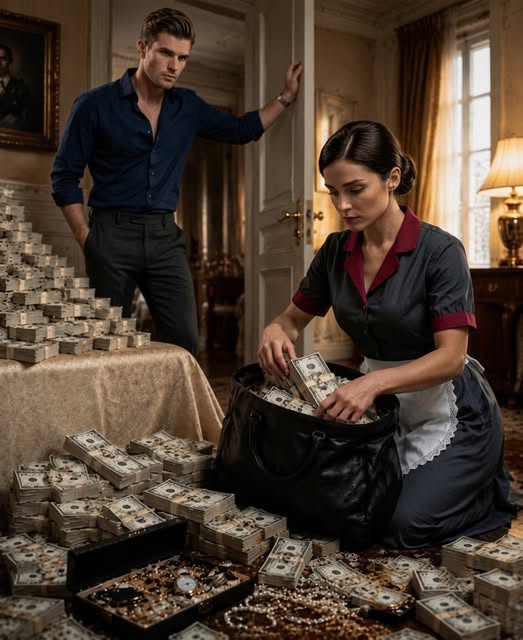
For one frozen second, all I heard was the rain.
It struck the windows in thin, nervous fingers. It hissed through the palms outside. It tapped against the roof of a mansion that no longer felt like mine.
Then the police sirens rose louder.
Red and blue light smeared across the guest room walls, over the cash, over Rosa’s pale face, over the folder trembling in my hands.
“They know I found it,” she whispered.
I stared at her. “Who knows?”
Rosa’s eyes moved toward the window.
At the end of my driveway, three police cruisers had stopped behind the iron gate. Their doors opened. Men stepped out into the rain. Uniformed officers first. Then two men in dark coats.
Detectives.
My stomach turned.
“Rosa,” I said slowly, “what did you do?”
She removed her gloves with care, as if we had all the time in the world.
“I did what you were too broken to do,” she said. “I looked.”
Before I could answer, pounding shook the front door.
“Miami-Dade Police! Edward Calloway, open the door!”
My knees weakened.
The cash on the bed looked suddenly poisonous. Not evidence of innocence. Evidence of guilt. My guilt. My name was on the lawsuits, the headlines, the bankruptcies, the ruined investors. And now the police had arrived to find millions of dollars hidden inside my own mansion.
I turned on Rosa.
“You brought this here?”
“No,” she said. “I brought it back.”
“That does not help me!”
Another blow hit the door downstairs.
Rosa crossed the room and took the folder from my hands. “Listen carefully. They are not here to protect you. They are here to finish the story your wife began.”
“My wife?” The word tasted strange. “Vanessa did this?”
Rosa opened the folder and pulled out photographs.
Vanessa outside a private bank in the Cayman Islands.
Vanessa seated beside Harold Bennett in a restaurant I had never seen.
Vanessa signing documents under a different name.
Vanessa smiling.
That smile broke something in me.
“She never left because I failed,” I said.
“No,” Rosa answered. “She left because she was done stealing.”
The pounding continued.
“Mr. Calloway!” a voice shouted. “Open the door now!”
I backed away from the window. “We have to explain.”
Rosa’s hand closed around my wrist with surprising strength.
“No,” she said. “You have to survive the next ten minutes.”
I looked at her then, truly looked.
For fifteen years, Rosa Martinez had moved through my home like a shadow. She had dusted expensive paintings. Folded linen napkins. Made coffee. Scrubbed floors after parties where men worth half a billion dollars spilled wine and laughed too loudly.
I had known the texture of her work, but not the shape of her life.
Now she stood among boxes of stolen money with the calm of a woman who had walked into danger long before tonight.
“You need to tell me everything,” I said.
“There is no time.”
Glass shattered downstairs.
The police had broken a window.
Rosa grabbed one of the flash drives and pressed it into my palm. “Take this.”
“What is it?”
“Names. Accounts. Transfers. Recordings.”
“Recordings?”
She glanced toward the door. “Your wife talks too much when she thinks servants do not understand English.”
Footsteps thundered below.
I closed my fist around the drive.
“Why didn’t you tell me sooner?” I demanded.
Rosa’s face changed.
For the first time that night, fear touched her.
“Because my son died trying to tell someone.”
The words entered the room quietly, but they struck harder than any siren.
“Your son?”
“Daniel,” she said. “He worked as a junior accountant for one of your subcontractors. He discovered false invoices two years ago. He thought if he gave the records to Mr. Bennett, the truth would come out.”
I felt my throat tighten.
“And then?”
Rosa looked at the money on the bed.
“Then he drove off a bridge.”
I had read about that accident. A young man. Rainy night. No witnesses. The article had mentioned speed, alcohol, tragedy. I had skimmed it over breakfast, barely registering the name.
Daniel Martinez.
Rosa’s son.
The floor seemed to disappear beneath me.
“I didn’t know,” I said.
“No,” she replied. “You did not.”
Footsteps reached the stairs.
Rosa moved quickly now. She crossed to the closet and pulled aside a row of old winter coats. Behind them was a small square panel in the wall.
I stared. “What is that?”
“Your grandfather built this house during Prohibition,” she said, pressing something along the trim. “Rich men always need places to hide things.”
The panel clicked open.
Behind it, a narrow passage dropped into darkness.
I stared at Rosa in disbelief. “You knew about this?”
“I clean everything.”
Men shouted from below.
“Second floor!”
Rosa shoved a small envelope into my jacket pocket. “Do exactly as I say. Go down the passage. It leads to the old laundry exit near the east garden. Take the sedan. Drive to St. Agnes Church on Flagler. Ask for Father Miguel.”
“I’m not leaving you here.”
“You are.”
“No.”
Her expression hardened. “Mr. Calloway, all your life people followed your orders because you had money. Tonight you have none. So listen to someone who still has a plan.”
The guest room door slammed open.
Two uniformed officers entered first, weapons raised. Behind them came a tall detective with silver hair and cold eyes.
“Edward Calloway,” he said, “put your hands where I can see them.”
I froze.
Rosa stepped in front of me.
“Detective Marlowe,” she said.
The detective’s gaze shifted to her.
His face did not change, but something in his eyes sharpened.
“Mrs. Martinez,” he said. “You have been busy.”
That was when I understood.
He knew her.
Rosa’s shoulders squared. “You were faster than I expected.”
Marlowe smiled without warmth. “Your son had the same problem. Always thought he had more time.”
A sound escaped Rosa, small and wounded.
I lunged before thinking. “You son of a—”
An officer slammed me against the wall. Pain exploded through my shoulder.
Marlowe walked into the room slowly, surveying the cash, the boxes, the documents.
“Well,” he said, “this is unfortunate.”
“For you,” Rosa said.
“For everyone.” He lifted a stack of cash with gloved fingers. “A bankrupt developer. Millions hidden in his house. A desperate housekeeper. Stolen bank records. It tells itself.”
“You killed Daniel,” Rosa whispered.
Marlowe’s eyes moved back to her. “Daniel killed himself with curiosity.”
The officer holding me tightened his grip.
Marlowe turned to me. “Mr. Calloway, you are under arrest for money laundering, fraud, obstruction of justice, and conspiracy.”
“This money was stolen from me,” I said.
“Of course it was.” He nodded toward the cash. “That is exactly what guilty men say when they are caught.”
Rosa’s eyes flicked toward my hand.
The flash drive was still hidden in my fist.
Marlowe noticed the glance.
“Search him.”
One officer reached for me.
Rosa moved.
She seized a brass lamp from the table and swung it with both hands. It crashed into the officer’s wrist. His gun clattered to the floor. The other officer shouted. Marlowe reached inside his coat.
Rosa screamed, “Run!”
I dove toward the closet.
A gunshot cracked through the room.
The mirror behind me exploded.
I stumbled into the hidden passage as Rosa slammed the panel shut behind me. Darkness swallowed me whole.
For a moment, I could not move.
I heard shouting through the wall. Furniture breaking. Rosa’s voice. Marlowe’s voice. Another gunshot.
Then silence.
I pressed my hand against the panel.
“Rosa,” I whispered.
No answer came.
The passage smelled of damp wood and dust. I forced myself forward, shoulders scraping both sides, one hand sliding along the wall. Behind me, men were tearing apart the closet.
I moved faster.
The passage sloped downward, then turned sharply. I almost fell twice. My breath came in broken bursts. I had built towers that touched the clouds, yet now I crawled through my own walls like a rat fleeing poison.
At the bottom, a rusted latch resisted me until I shoved it with my shoulder. It gave way into a narrow storage room behind the old laundry.
I slipped outside into the storm.
Rain soaked me instantly.
The garden was black except for flashes of lightning. I saw police lights at the front of the house, but the east driveway remained empty. Rosa had parked the sedan there earlier, facing the service road.
Of course she had.
She had prepared everything.
I ran.
My shoes slid in the mud. Branches whipped my face. Behind me, someone shouted. A beam of light swept across the garden wall.
I reached the car, yanked open the door, and collapsed inside.
The engine coughed twice before starting.
As I sped down the service road, a police cruiser appeared in the mirror.
Then another.
The old sedan screamed as I pushed it harder than it had gone in years. Rain blurred the windshield. My hands shook so badly I nearly missed the turn onto Biscayne. Horns blared. Tires skidded. Somewhere behind me, sirens wailed.
I drove like a man already dead.
At a red light, I reached into my pocket and found the envelope Rosa had given me.
Inside was a key, a photograph, and a note written in her careful hand.
Mr. Calloway,
If you are reading this, then they came sooner than I hoped.
Trust Father Miguel. Trust no one from your old life.
The money in the room is only what I could recover quickly. The rest is hidden in places Vanessa believes are safe.
Daniel found the first door.
I found the second.
You must find the third.
Under the note was the photograph.
It showed Rosa years earlier, younger, smiling beside a tall young man with kind eyes.
Daniel.
Standing beside him was another person.
Me.
I stared at the photograph, confused at first. Then memory stirred.
A charity event. Ten years earlier. Scholarships for children of employees and contractors. I had stood beside dozens of students that day, shaking hands, posing for photographs, thinking more about a zoning problem than the young faces in front of me.
Daniel had received one of my company scholarships.
Rosa had been there.
Proud. Quiet. Invisible even then.
The light changed. A horn blasted behind me.
I drove on.
St. Agnes Church stood wedged between a pawn shop and an old bakery, its stone walls dark with rain. I parked behind the rectory and stumbled toward the side door.
Before I could knock, it opened.
An elderly priest with tired eyes looked at me.
“Edward Calloway?”
“Yes.”
He stepped aside. “Rosa said you would come wet, frightened, and too proud to ask for help.”
I almost laughed. Instead, I collapsed into the nearest chair.
Father Miguel locked the door and led me to a small office smelling of candle wax and old books. He gave me a towel, then set a cheap cellphone on the desk.
“Use this only when necessary,” he said. “Not your phone. Not your email. Not your credit cards.”
“My credit cards are gone.”
“Then that is one problem solved.”
I looked up at him. “They may have killed Rosa.”
His face tightened. “Rosa knew the risk.”
“That doesn’t make it better.”
“No,” he said. “It makes it real.”
I opened my fist. The flash drive rested in my palm like a black tooth.
Father Miguel looked at it but did not touch it.
“Daniel gave me one too,” he said.
I went still. “You knew Daniel?”
“He came to confession, though not always to confess. Sometimes the young come because they need one adult to say they are not crazy.”
“What did he find?”
Father Miguel sat across from me.
“A system,” he said. “Your partners were stealing from you, yes. But they were also moving money for people far more dangerous than businessmen.”
I swallowed. “Who?”
“Judges. city officials, police commanders, foreign investors. Men who use clean buildings to wash dirty money.”
The room seemed to grow colder.
“And Vanessa?”
“She was not merely involved,” he said. “She was essential.”
I thought of her in silk gowns, complaining about charity dinners, kissing my cheek before photographers, whispering that I worked too much.
“She handled the social side,” Father Miguel continued. “Introductions. Private dinners. Offshore accounts under harmless names. She made corruption look elegant.”
“And Harold?”
“Harold Bennett opened doors in government. Detective Marlowe closed mouths.”
I put my face in my hands.
All those years, I had thought myself powerful. I had thought I understood greed because I had benefited from it. I had thought betrayal was a dramatic word used by weaker men.
Now betrayal had names, signatures, bank codes.
And Rosa, who had cleaned my wine glasses, had understood more than I ever had.
“What is the third door?” I asked.
Father Miguel did not answer immediately.
Instead, he unlocked a drawer and removed a small metal box. Inside were papers, another flash drive, and a newspaper clipping about Daniel’s death.
“Daniel believed there were three levels,” the priest said. “The first was the theft from your company. The second was the money hidden through Vanessa. The third was something he never fully identified.”
He handed me one sheet.
It was a list of payments. Most were coded. One name appeared again and again.
M.C.
“Who is M.C.?” I asked.
“That,” Father Miguel said, “is why Rosa stayed in your house.”
Before I could speak, the cheap phone on the desk vibrated.
Father Miguel and I looked at it.
No one should have had that number.
The screen showed a blocked caller.
The priest’s hand hovered over the phone. Then he answered and placed it on speaker.
For three seconds, there was only static.
Then Rosa’s voice filled the room.
“Edward.”
I shot upright. “Rosa! Where are you?”
Her breathing was shallow.
“Listen. I don’t have long.”
“Are you hurt?”
“Listen,” she repeated.
Behind her, I heard movement. A door. A distant voice.
“Marlowe took the cash. He wants you running because a running man looks guilty. He will say you attacked officers and fled with evidence.”
“Where are you?”
“Vanessa’s house.”
My blood chilled.
“What?”
“They brought me here because they think fear makes old women talk.” A faint, bitter laugh escaped her. “They never understand old women.”
Father Miguel closed his eyes.
Rosa continued. “Edward, the third door is not a bank.”
“What is it?”
“A person.”
The line crackled.
“Rosa, who?”
She breathed my name again, softer this time.
“Your daughter.”
I stopped breathing.
“My daughter is dead,” I said.
Father Miguel looked at me sharply.
Rosa was silent.
Then she whispered, “No, Mr. Calloway. Vanessa told you she was dead.”
The office spun around me.
Twenty-six years earlier, before the towers, before the fortune, before Vanessa became Mrs. Calloway in every society magazine in Miami, there had been a baby girl.
Charlotte.
She had been born too early. Too fragile. I had been young, ambitious, terrified. Vanessa had cried for three days. Doctors had come and gone. Then one morning, Vanessa told me the baby had not survived the night.
I remembered a small white coffin.
A funeral in rain.
My hand crushing Vanessa’s hand as she trembled beside me.
No.
No.
“That’s impossible,” I whispered.
Rosa’s voice broke. “Daniel found payments to a private school in Switzerland. Then medical trusts. Then security transfers. All under M.C. He thought it was money laundering. I thought so too, until I saw the birth certificate.”
My fingers dug into the desk.
“M.C.,” I said. “Maria Calloway.”
“Maria Charlotte Calloway,” Rosa whispered. “Your daughter.”
Father Miguel made the sign of the cross.
I could not move.
All the money, all the fraud, all the ruined reputation, all the years of grief I had carried like a stone inside my chest—it shifted. Beneath it was something worse.
Vanessa had not only stolen my fortune.
She had stolen my child.
“Where is she?” I asked.
“I don’t know,” Rosa said. “But Vanessa does.”
A muffled sound came through the phone. Rosa gasped.
Then another voice entered the line.
Smooth. Familiar. Beautiful even through static.
“Hello, Edward.”
My body went rigid.
Vanessa.
I had imagined hearing her voice again many times. In court. In anger. In dreams where I demanded explanations and she dissolved into smoke.
But now she sounded amused.
Like I had arrived late to a party thrown in my own honor.
“Vanessa,” I said.
“You sound terrible,” she replied. “Rosa, darling, you really should have let him change clothes before sending him into the rain.”
“Where is my daughter?”
A pause.
Then she laughed softly.
“My God. She told you.”
I gripped the phone until plastic creaked. “Is Charlotte alive?”
“Charlotte died,” Vanessa said. “That name died with your usefulness as a father.”
I closed my eyes.
“What did you do?”
“I saved her from becoming another monument to Edward Calloway’s ego.”
“You buried an empty coffin.”
“I buried a story,” she said. “People mourn stories very sincerely when the lighting is right.”
Father Miguel’s face had gone pale.
I leaned toward the phone. “Where is she?”
“Safe.”
“From whom?”
“Tonight? From you.”
“Vanessa—”
“No. Now you listen.” Her voice sharpened. “By sunrise, every station in Florida will have footage of police discovering millions in cash inside your mansion. They will say you fled arrest. They will say your housekeeper helped you. They may even say poor Rosa killed herself from shame.”
Rosa made a small sound in the background.
My heart slammed against my ribs.
Vanessa continued, “You have two choices. Run and be hunted, or surrender and spend the rest of your life trying to prove a truth nobody wants to hear.”
“What do you want?”
Another pause.
When Vanessa spoke again, her voice was lower.
“The drive Rosa gave you.”
I looked at Father Miguel.
He slowly shook his head.
Vanessa said, “Bring it to the old Calloway Tower site tomorrow at midnight. Come alone. Give me the drive, and I will give you one thing no court, priest, or dead accountant can offer.”
“What?”
“Her location.”
I almost answered yes.
The word rose in me instantly, violently.
Father Miguel grabbed my wrist.
Vanessa heard the silence and smiled through it.
“There he is,” she said. “The great Edward Calloway, finally understanding what something is worth.”
The line shifted. I heard Rosa breathing.
Then Rosa spoke quickly, urgently.
“Do not trust—”
A slap cracked through the phone.
I stood so fast the chair fell behind me.
“Touch her again and I swear—”
“You swear what?” Vanessa asked. “You have no company, no money, no wife, no police, no friends, and until ten minutes ago, you didn’t even have a child.”
Her words cut with surgical care.
Then her tone softened.
“Midnight tomorrow, Edward. Bring the drive.”
The call ended.
For a long moment, neither Father Miguel nor I spoke.
Rain pressed against the church windows.
Somewhere outside, a siren passed and faded.
I stared at the dead phone.
My daughter was alive.
Rosa was captive.
My wife had become a stranger wearing the face of the woman I once loved.
And I was a fugitive.
Father Miguel bent down, picked up the fallen chair, and set it upright.
“You cannot go,” he said.
I looked at him.
“I have to.”
“She will kill you.”
“Maybe.”
“She may not even know where your daughter is.”
“She knows enough.”
The priest’s eyes narrowed. “And if the drive is the only proof?”
I opened my hand.
The flash drive lay there, still slick with rain and sweat.
Then I remembered the second drive in his metal box.
And Rosa’s words.
Old women.
Servants.
People who listened.
I turned slowly toward Father Miguel. “Daniel gave you one too.”
“Yes.”
“Does Vanessa know?”
“I do not think so.”
“Then we don’t give her the real one.”
Father Miguel studied me for a long moment. Then, very faintly, he smiled.
For the first time in a year, something moved inside me that was not shame.
It was not hope exactly.
Hope was too clean a word.
It was hunger.
At dawn, every television in Miami showed my mansion.
Helicopter footage. Police tape. Reporters beneath umbrellas. My old neighbors pretending shock behind gated windows.
Edward Calloway, once one of Florida’s most powerful developers, is now the subject of a statewide manhunt after authorities discovered what sources describe as a large hidden cash reserve inside his residence late last night.
They showed my old photograph from better days.
Tanned. Smiling. Rich.
Then they showed Rosa’s.
Housekeeper suspected of assisting Calloway in concealing evidence.
I watched from the church basement on a dusty television while Father Miguel stood beside me.
The reporter continued.
Detective Alan Marlowe stated that Calloway should be considered dangerous.
Dangerous.
I almost laughed.
I had spent a year unable to open mail without shaking.
Now I was dangerous because I knew the truth.
The broadcast shifted to an interview outside a courthouse. Harold Bennett stood under a black umbrella, face arranged into grief.
“Edward was my friend,” Harold said. “But financial ruin changes people. I pray he gets help before anyone else is hurt.”
I stepped closer to the screen.
Harold looked directly into the camera.
And winked.
It lasted less than a second.
No one else would have noticed.
But I did.
The old Edward Calloway would have smashed the television.
The new one simply watched.
By nightfall, Father Miguel and I had made our plan.
It was not a good plan. Good plans belonged to men with lawyers, bodyguards, bank accounts, and time.
We had none.
We copied files from Daniel’s drive onto three devices. One stayed hidden beneath the church altar. One went to a retired journalist Father Miguel trusted. One I carried.
The drive Vanessa wanted, we filled with corrupted documents and enough real information to look valuable at first glance.
At 11:40 p.m., I walked toward the old Calloway Tower site wearing borrowed clothes and a baseball cap pulled low over my face.
The tower had never been finished.
It stood skeletal against the Miami skyline, a half-built luxury monument abandoned after my collapse. Concrete floors. Exposed steel. Black windows without glass. A dead dream rising forty stories into the humid night.
At midnight exactly, a black car rolled through the construction gate.
Vanessa stepped out.
She wore white.
Even now.
Behind her stood Detective Marlowe with one hand inside his jacket.
And between them, bruised but upright, was Rosa.
Her hands were bound.
My chest tightened.
Vanessa smiled when she saw me.
“Edward,” she said. “You look almost humble.”
I ignored her and looked at Rosa. “Are you all right?”
Rosa nodded once.
Vanessa sighed. “Still sentimental. After everything.”
“The drive,” Marlowe said.
I raised it between two fingers.
Vanessa’s eyes followed it.
“First,” I said, “tell me where my daughter is.”
Vanessa tilted her head. “Our daughter.”
“You lost the right to say that.”
She laughed. “Rights are for people with leverage.”
I took one step back. “Then no deal.”
Marlowe drew his gun and pressed it against Rosa’s side.
Vanessa’s smile vanished. “Do not test me tonight.”
Rosa looked at me.
There was no fear in her eyes now.
Only command.
Do not give in.
Vanessa saw the exchange and rolled her eyes. “This loyalty is touching. Truly. But misplaced.”
Then she reached into her purse and removed a photograph.
She tossed it at my feet.
I bent slowly and picked it up.
A young woman stood on a balcony overlooking a gray sea. Dark hair. Serious eyes. A faint scar above her eyebrow.
My heart knew before my mind did.
Charlotte.
Maria.
My daughter.
On the back of the photograph was written one word.
Lisbon.
My hands shook.
Vanessa watched me carefully. “There. Proof of life. Now the drive.”
I looked at the photograph again.
For twenty-six years, I had mourned a ghost.
Now a living stranger stared back from glossy paper.
I stepped forward and held out the drive.
Vanessa reached for it.
At that exact moment, Rosa moved.
She drove her heel down onto Marlowe’s foot and twisted away. His gun fired into the concrete. The sound cracked through the empty tower.
I lunged at Vanessa.
She stumbled back, but not before snatching the drive from my hand.
Marlowe recovered fast. Too fast. He struck Rosa across the face and raised the gun toward me.
Then headlights flooded the construction site.
Not police headlights.
News vans.
Three of them.
Then six.
Then more.
Cameras emerged like insects.
Harold Bennett ran from behind one of the concrete pillars, waving his arms.
“No! Cut the lights! Cut the—”
His voice died when he saw me staring at him.
Behind the news crews came two federal SUVs.
Men in tactical vests poured out.
“Federal agents!” someone shouted. “Weapons down!”
Marlowe swung toward them.
A dozen guns answered.
He froze.
Vanessa did not.
She bolted toward the black car.
I ran after her.
She reached the driver’s door, but I caught her wrist. For a moment we struggled in the glare of headlights, husband and wife, ruined king and vanished queen.
“What did you do?” she hissed.
“I learned from the help,” I said.
Her face twisted.
Then she smiled.
Not defeated.
Not afraid.
Triumphant.
“You still don’t understand,” she whispered.
Before I could ask what she meant, she opened her hand.
The flash drive was gone.
I looked past her.
The black car’s rear window lowered.
A young woman sat inside.
Dark hair.
Serious eyes.
A faint scar above her eyebrow.
My daughter looked at me once.
Then she raised the real flash drive between two fingers.
My blood turned cold.
Vanessa leaned close to my ear.
“Part three begins with her,” she whispered.
The car shot backward, tires screaming, then tore through the side gate into the night.
I stood in the rain, surrounded by agents, cameras, sirens, and betrayal, holding only the photograph of the daughter who had just stolen the truth from my hand.
The Night the Truth Arrived in Handcuffs
The first officer burst into the guest room with his pistol raised, and for one terrible second, all I saw was my ruin reflected in polished black steel.
“Hands where I can see them!”
Rosa did not flinch.
She lifted both hands slowly, the latex gloves still clinging to her fingers. I stood frozen beside the bed, surrounded by more cash than I had seen since before my life became a headline.
Then Detective Paul Grady stepped through the door.
I knew him from television interviews. He had called me “a person of interest” with the bored confidence of a man sharpening a knife.
“Well,” Grady said, glancing around the room, “isn’t this convenient?”
“This money was planted,” Rosa said.
Grady smiled. “By the housekeeper?”
Her eyes hardened. “By people who knew Mr. Calloway would be out tonight.”
I turned to her. “Rosa…”
She kept looking at the detective. “A white delivery van arrived at seven-twelve. Two men carried the boxes upstairs. They used the service entrance. I recorded them.”
For the first time, Grady’s smile twitched.
“Recorded them where?”
Rosa said nothing.
Grady stepped closer. “Mrs. Martinez, you are standing in a room full of stolen cash.”
“No,” Rosa replied. “I am standing in a trap before it closes.”
The words struck something deep in me.
A trap.
Harold’s invitation. The note. The lights off. The silence waiting for me at home.
I felt suddenly sick.
Grady turned to me. “Edward Calloway, you are under arrest on suspicion of concealing embezzled funds, obstruction, and conspiracy to defraud investors.”
My knees nearly buckled.
Rosa moved as if to step between us, but two officers grabbed her arms.
“Don’t touch her!” I shouted.
The nearest officer shoved me against the wall. My cheek hit cold plaster. Handcuffs snapped around my wrists.
And there I was.
Edward Calloway, once welcomed into rooms by governors and billionaires, pressed against his own wall like a thief in his own house.
As they dragged Rosa toward the hallway, she twisted just enough to meet my eyes.
“Mr. Calloway,” she said, her voice low but clear, “remember the red ledger.”
“What red ledger?”
She looked toward the bed.
Beneath a stack of contracts lay a thin crimson book with worn corners.
Grady saw my glance.
His head turned sharply.
“Bag everything,” he ordered.
Rosa’s face changed then—not fear, but disappointment.
“You always were too eager, Detective,” she said.
Grady walked toward her slowly. “What did you say?”
Rosa raised her chin. “I said you arrived before your friends could remove what mattered.”
For one moment, the room went silent.
Then downstairs, another voice called out, “Federal agents! Nobody moves!”
Grady froze.
So did every officer.
A woman in a navy suit appeared in the doorway with two men behind her. She held up a badge.
“Special Agent Miriam Vale, Financial Crimes Division.” Her gaze swept over the money, the files, then Rosa. “Mrs. Martinez?”
Rosa exhaled once.
“Yes.”
Agent Vale looked at Grady. “Detective, step away from the evidence.”
Grady’s face drained of color.
And that was the first moment I understood: Rosa had not been caught. She had been waiting.
Part 4 — The Housekeeper Who Had Been Fighting a War
They took all of us downtown, but not in the same cars.
Grady rode in silence, jaw tight, while Agent Vale sat beside me in the back of a federal SUV. My wrists were still cuffed, but her voice was calm.
“Mr. Calloway, do not answer questions until your attorney arrives.”
“I don’t have an attorney anymore.”
“You do now.”
At the federal building, they placed me in a small interview room with a metal table and a humming fluorescent light. I sat there feeling older than fifty-eight, emptier than bankrupt.
Then the door opened.
A tall man in a charcoal suit stepped inside.
“Edward Calloway?” he asked.
“Yes.”
“I’m Felix Ortega. I’ll be representing you.”
I stared at him. “I can’t pay you.”
His expression softened.
“My mother already did.”
Before I could speak, Rosa entered behind him.
My breath caught. “Your mother?”
Felix glanced at her. “Rosa Martinez Ortega.”
Rosa folded her hands in front of her, looking suddenly less like my housekeeper and more like a woman who had been carrying a secret too heavy for one body.
“You never told me,” I whispered.
“You never asked about my family,” she said gently.
The words cut deeper because they were true.
Felix set a folder on the table. “My mother has spent the last eight months documenting the theft of your company.”
“Eight months?”
Rosa nodded. “After Mrs. Calloway left, I cleaned her dressing room. Behind a false panel in her vanity, I found bank statements under names that should not have existed.”
“She used fake accounts?”
“Not fake,” Felix said. “Shell companies. Some connected to your partners. Some connected to Harold Bennett. Some connected to Detective Grady through his brother-in-law.”
I leaned back, stunned.
Rosa placed a hand on the folder. “At first, I thought it was only your partners. Then I saw Vanessa’s signature. Then I saw Harold’s.”
The name hit like glass in my throat.
Harold had known me since college. He had stood beside me when my father died. He had toasted me at my wedding.
And all this time, he had been helping dig my grave.
“Why didn’t you tell me?” I asked.
Rosa’s eyes filled, but her voice stayed steady. “Because you were broken. And because whoever stole your money wanted you desperate enough to make a mistake.”
Felix opened the folder.
Inside were photographs, delivery logs, copied checks, emails, bank transfers, property deeds, and grainy security images of men carrying boxes.
“The cash in your guest room,” Felix said, “was meant to be found by local police after an anonymous tip. Detective Grady would arrest you, seize the records, lose the documents that implicated Harold and Vanessa, and let the cash convict you in public before a trial ever began.”
I covered my face with both hands.
“So tonight was supposed to finish me.”
Rosa stepped closer.
“No,” she said. “Tonight was supposed to bury you. But they did not know I had already called the gravediggers.”
For the first time in a year, something moved inside my chest that was not despair.
It was anger.
Not wild. Not blind.
A clean, cold flame.
“What is the red ledger?” I asked.
Rosa looked at Felix.
Felix hesitated, then slid the crimson book across the table.
Rosa rested her fingertips on it.
“This,” she said, “is the reason your father never trusted Harold Bennett.”
My father.
I had not heard his name spoken in that tone in years.
Rosa opened the ledger to the first page.
There, in my father’s handwriting, was one sentence:
If Edward ever loses everything, begin with the people who still smile at him.
Part 5 — The Dead Man’s Warning
I stared at the handwriting until the letters blurred.
“My father wrote this?”
Rosa nodded. “Three months before he died.”
“My father trusted Harold.”
“No,” she said. “Your father tolerated Harold.”
Felix turned the ledger toward me. Inside were names, dates, company structures, old partnership agreements, and notes written in my father’s firm, slanted hand. Some names I knew. Some I had forgotten. Some belonged to men now accused of stealing from me.
One page was circled in red.
Harold Bennett — charming, ambitious, no loyalty. Never give signing authority.
I laughed once, bitterly.
“I gave him signing authority six years ago.”
Rosa lowered her eyes.
“My father gave this to you?” I asked.
“Not directly.” Her voice softened. “He left it locked in the old pantry safe. He told me, before his last surgery, that if there was ever a day when your house became quiet, I should open it.”
The room seemed to shrink around us.
“My house became quiet,” I said.
“Yes.”
Everyone had left.
Vanessa. Harold. My partners. My investors. My friends.
Only Rosa had remained—and then, while I drank cold coffee and stared at unpaid bills, she had opened the safe my father left behind and started searching through the ruins.
Agent Vale entered then, carrying a tablet.
“We recovered the guest room surveillance device Mrs. Martinez hid behind the curtain rod,” she said. “It shows two men unloading boxes at 7:12 p.m. Their van is registered to a warehouse leased by Bennett Holdings.”
Felix smiled grimly. “Good.”
Agent Vale looked at me. “We also intercepted a message from Harold Bennett to Detective Grady sent at 8:03 p.m.”
She tapped the screen.
The message appeared.
Cash is in place. Wife confirms Calloway is on way back. Make it loud.
My stomach turned.
“Wife,” I repeated.
Vanessa.
I had expected greed from her. Cruelty, perhaps. Vanity, certainly.
But this was different.
She had not simply abandoned me. She had tried to lock the door from the outside and burn the house down with me inside.
Agent Vale continued. “We need more than messages. We need the original server from your company’s old private backup system. Our records show it was removed before your bankruptcy filing.”
I frowned. “That system was destroyed.”
Rosa shook her head.
“No. Mrs. Calloway had it moved.”
“Where?”
Rosa looked at me carefully.
“In the mansion.”
I nearly laughed. “The mansion has been searched by creditors, investigators, appraisers—”
“Not everywhere,” she said.
The answer waited between us like a ghost.
“My father’s wine cellar,” I whispered.
Rosa nodded.
Two hours later, under federal escort, I returned to my own home—not as a suspect, not quite as a free man, but as something in between.
The mansion looked different at dawn.
Less like a monument to failure.
More like a witness.
Rosa led us to the wine cellar, past empty racks and dust-coated bottles I had once bought to impress men who never cared about wine. At the back wall, she pressed two bricks inward.
A panel opened.
Behind it stood a narrow steel door.
I stared at it. “I never knew this existed.”
“Your father did not tell many people many things,” Rosa said.
Inside was a hidden service room with old electrical panels, sealed boxes, and a black server tower wrapped in plastic.
Agent Vale’s technician crouched beside it.
“This could be everything,” he said.
Then Rosa noticed something on the floor.
A fresh footprint in the dust.
We all turned.
From upstairs came the faint sound of breaking glass.
Someone else was in the house.
Part 6 — Vanessa Came Back for the Last Secret
Agent Vale lifted one finger to her lips.
The technician unplugged the server with shaking hands. Felix stepped in front of Rosa, but she pushed him aside.
“This is still my house to clean,” she whispered.
We moved quietly upstairs.
The sound came from my office.
My office—the room where I had cried after midnight while Rosa pretended not to hear.
The door stood open.
Inside, Vanessa was tearing through drawers.
She looked flawless, of course. Cream silk blouse. Diamond earrings. Hair arranged like betrayal had a stylist. Harold stood beside her, holding a small flashlight and a pistol.
Seeing them together did not surprise me.
Seeing them desperate did.
Vanessa froze when she saw us.
For one heartbeat, nobody moved.
Then she smiled.
“Edward,” she said softly. “You look awful.”
Harold raised the gun.
Agent Vale’s agents raised theirs faster.
“Drop it,” she ordered.
Harold’s face twisted. “This is private property.”
“It’s a federal crime scene,” Agent Vale said. “Weapon down.”
His hand trembled.
Vanessa glanced at him with cold irritation. “Harold.”
He lowered the pistol.
Rosa stepped into the doorway.
Vanessa’s eyes went to her, and for the first time in all the years I had known my wife, I saw fear pass across her beautiful face.
“You,” Vanessa whispered.
Rosa said nothing.
Vanessa laughed, but the sound cracked. “A maid. We were beaten by a maid.”
Rosa’s face remained calm. “No. You were beaten by your own handwriting.”
Agent Vale nodded to an agent, who took Harold’s gun.
Felix opened a small evidence bag and removed a folded page.
“The red ledger gave us the old partnership map,” he said. “The server gave us transfers. But this gave us motive.”
He placed the page on my desk.
It was a draft of my revised will.
I remembered it then.
Two years earlier, after a hurricane destroyed a workers’ housing project in Homestead, I had asked my attorney to prepare changes. I wanted a foundation created from company profits—homes for retired laborers, scholarships for their children, emergency medical funds.
Vanessa had called it sentimental nonsense.
I never signed it.
Or so I thought.
Felix pointed to the bottom.
There was my signature.
Forged.
Vanessa’s face hardened.
“You were going to give away everything,” she snapped at me. “Everything I tolerated you for.”
The room went still.
Her mask was gone.
No charm. No softness. No performance.
Only hunger.
Harold tried to speak. “Vanessa, stop.”
But she was looking at me now, years of contempt pouring out at once.
“You built towers for strangers and expected me to smile in that museum of a marriage. Harold understood ambition. Your partners understood money. You only understood guilt.”
I should have felt crushed.
Instead, I felt strangely clear.
“You framed me because I wanted to help people?”
Vanessa smiled thinly. “No, Edward. We framed you because you made it easy.”
Rosa stepped closer.
“Not easy enough.”
Vanessa turned on her. “You should have taken your salary and disappeared.”
Rosa’s voice was quiet. “He paid my son’s hospital bill fifteen years ago when no one else would. He never told anyone. He forgot. I did not.”
I looked at Rosa.
She had never mentioned it.
I remembered only fragments: a worker’s cousin, a sick child, an invoice sent quietly to my office. I had signed the payment between meetings.
To me, it had been one small act.
To Rosa, it had been a debt written on the heart.
Agent Vale moved forward.
“Vanessa Calloway, Harold Bennett, you are under arrest.”
As they cuffed them, Vanessa looked back at me with one final smile.
“You still lose,” she said. “Even cleared, you owe more than you own.”
Then Rosa reached into her apron pocket and removed a small brass key.
“No,” she said.
And somehow, Vanessa went pale again.
Part 7 — The Account No Thief Could Touch
Rosa held the brass key as if it weighed more than all the cash upstairs.
“What is that?” I asked.
“The last thing your father left,” she said.
Vanessa struggled against the agent holding her. “That key opens nothing.”
Rosa looked at her. “Then why did you come back for it?”
Harold closed his eyes.
That was answer enough.
We went to the old library, a room nobody used anymore. My father had loved it. I had avoided it after his death because it still smelled faintly of cigar smoke and leather polish.
Rosa knelt beside the fireplace and pressed the brass key into a narrow slot hidden beneath the mantel.
A panel clicked open.
Inside was a metal box.
Not large. Not dramatic. Just a box.
But Vanessa watched it as if it were a coffin opening.
Rosa handed it to me.
My hands shook as I lifted the lid.
Inside were documents sealed in oilcloth: trust papers, property deeds, banking authorizations, and a letter addressed in my father’s handwriting.
Edward,
If you are reading this, then I failed to teach you the difference between friends and guests.
I swallowed hard.
Rosa touched my arm. “Read the rest.”
The letter explained what my father had done before he died. He had suspected that certain partners were positioning themselves to control the company after him. He had created a private asset-protection trust, dormant unless fraud, insolvency, or criminal mismanagement threatened the family company.
The trustee was not a banker.
Not a lawyer.
Not Harold.
It was Rosa Martinez Ortega.
I looked up slowly.
“You?”
Rosa nodded. “Your father trusted people who noticed what others missed.”
Felix took over, voice tight with emotion.
“When your partners began stealing, they unknowingly transferred several assets through entities already flagged in the trust documents. Under the clawback provisions, once fraud is proven, those transfers revert to the trust beneficiary.”
“Who is the beneficiary?” I asked.
Felix looked at me.
“You.”
I could not speak.
Agent Vale scanned the papers, then looked at Harold and Vanessa.
“This is why you needed the key.”
Harold sagged.
Vanessa’s rage returned. “That trust is dead. It was never activated.”
Rosa looked at her calmly.
“It activated the day Edward’s accounts were frozen.”
Felix opened another document.
“And Mrs. Martinez filed notice eight months ago.”
I turned toward Rosa.
Eight months.
While I believed she was dusting shelves, washing dishes, and mending old suits, Rosa had been fighting billionaires, bankers, lawyers, and thieves with nothing but patience and paperwork.
“You saved everything,” I whispered.
“No,” she said. “I saved what could be proven. The rest depends on what kind of man you choose to be now.”
That sentence stayed with me through the months that followed.
The arrests became national news.
Grady confessed first. Harold tried to trade information. Vanessa refused to speak until the federal indictments included conspiracy, obstruction, fraud, and attempted evidence tampering. My former partners were caught in the Cayman Islands after one of them used a company card to buy champagne.
The court unfroze assets.
The trust recovered properties, accounts, and insurance settlements.
Creditors were paid.
Employees received back wages.
Investors recovered more than anyone expected.
And one rainy morning, nearly a year after I had told Rosa I could not pay her anymore, Felix arrived at the mansion carrying a single envelope.
Inside was a certified statement.
Recovered assets after restitution: $47,300,000.
I sat down hard.
Rosa poured coffee.
For a long while, neither of us spoke.
Then she placed another paper beside the statement.
Her unpaid wages.
Fifteen months.
Carefully calculated.
No interest.
I laughed until I cried.
“Rosa,” I said, “you just handed me forty-seven million dollars and billed me like we’re arguing over groceries.”
She gave me the same look she used when I tracked mud across marble.
“A debt is a debt, Mr. Calloway.”
So I wrote the check.
Then I wrote another.
She tried to refuse it.
I folded it into her hand anyway.
For the first time in years, I was not paying someone to stay. I was thanking the only person who never left.
Part 8 — The Millionaire Who Finally Came Home
People expected me to rebuild the empire exactly as it had been.
They expected towers. Resorts. Cars. Interviews. Champagne poured over my resurrection like holy water.
For a while, I expected it too.
Then I walked through one of my old construction sites and saw the faces of men who had lost pensions, savings, and years because I had trusted the wrong people at the top and ignored the quiet warnings below.
That night, I returned to the mansion and found Rosa in the kitchen making soup.
“You’re thinking too loudly,” she said without turning around.
“I don’t want the old life back.”
She stirred the pot. “Good.”
I smiled. “That’s all?”
“What else should I say?”
“I thought you might be surprised.”
Rosa set down the spoon and faced me.
“Mr. Calloway, the old life is what made room for people like Harold and Vanessa. Why bring ghosts back into a clean house?”
So I did the one thing nobody predicted.
I sold the mansion.
Not because I had to.
Because I wanted to.
The newspapers called it shocking. Former friends called it foolish. Investors called with voices sweetened by opportunity, offering to help me “return to form.”
I ignored them all.
With part of the recovered fortune, I created the Calloway-Martinez Foundation, not as a memorial, not as public relations, but as a working company that built storm-resistant homes for retired laborers, single parents, and families who had been priced out of the cities they helped construct.
Rosa became chairwoman.
She hated the title.
Felix loved it.
At the first board meeting, she arrived in her faded blue dress, hair pinned neatly back, and stared down six attorneys until every one of them stopped using words nobody needed.
“Say it plainly,” she told them. “Money should not need a translator.”
Six months later, we opened our first housing community outside Homestead.
At the ribbon cutting, a little girl handed Rosa a paper flower. Rosa took it like it was made of gold.
I stood beside her, watching families step into homes with fresh paint, strong roofs, and keys that belonged to them.
A reporter approached me.
“Mr. Calloway, after everything you lost and recovered, do you consider yourself a millionaire again?”
I looked at Rosa.
She arched one eyebrow.
Careful.
I laughed.
“No,” I said. “I consider myself a man who was returned to himself.”
That night, after the ceremony, Rosa and I sat on the porch of the modest house I had bought near the water. Not a mansion. Not a monument. Just a house with warm lights and a kitchen large enough for soup.
She handed me an envelope.
“What is this?” I asked.
“Your final inheritance.”
I frowned. “There’s more?”
“Not money.”
Inside was a photograph.
My father, much younger, standing in front of the old mansion. Beside him stood Rosa, also younger, holding a little boy’s hand.
Felix.
On the back, my father had written:
Family is sometimes the person who stays after the music stops.
My throat tightened.
“Why didn’t he tell me?”
Rosa looked out at the dark water.
“Because your father was proud. Because I was proud. Because life is sometimes foolish with important things.”
I studied the photograph.
Then I looked at the woman who had cleaned my floors, guarded my secrets, saved my name, buried my enemies in evidence, and handed me back a future.
“You were never just my housekeeper,” I said.
Rosa smiled faintly.
“No,” she said. “But that was the only job in your house where a person could hear the truth.”
Years later, people still told the story wrong.
They said a bankrupt millionaire came home and found his housekeeper surrounded by stolen cash.
They said she uncovered a fortune.
They said she exposed his wife, his best friend, his partners, and a crooked detective.
All of that was true.
But it was not the whole truth.
The real story was this:
I came home expecting humiliation and found loyalty.
I thought I had lost every dollar, but Rosa had saved more than money.
She saved my name.
She saved my father’s warning.
She saved the part of me wealth had nearly buried.
And in the end, the most shocking thing was not that the cash belonged to me.
It was that after losing everything, I finally understood what was worth keeping.