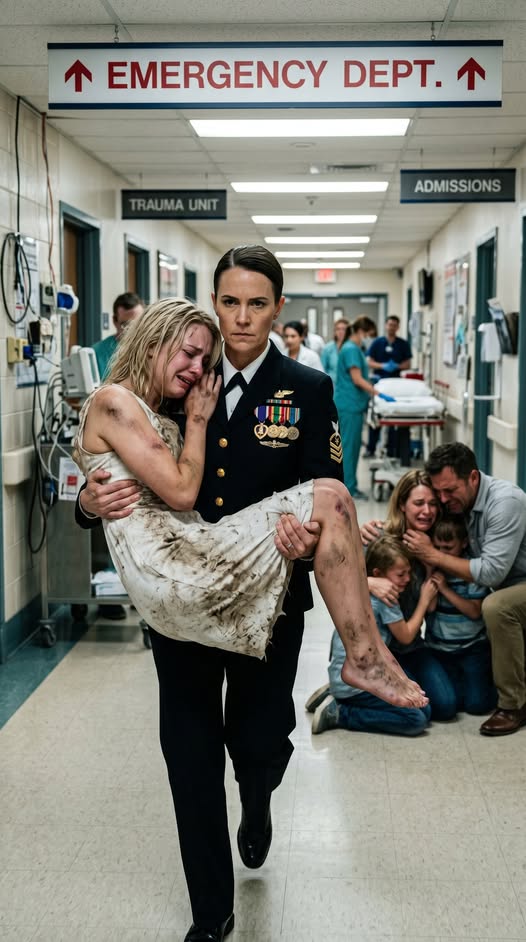
“Mom… please come get me. My husband’s family beat me…”
The voice on the other end of the line was a fragile, trembling thing, fracturing the quiet hum of my office. It was my daughter, Eleanor. Then, a sharp, sudden crack echoed through the speaker, followed by the hollow, endless tone of a dead line.
For three agonizing seconds, I forgot the fundamental mechanics of how to breathe. The air in my office at Fort Marshall grew instantly heavy, pressing against my ribs like a physical weight. The world narrowed to the plastic receiver clutched in my hand.
Then, two decades of military training violently took the wheel. The mother in me wanted to scream, to fall to the floor and shatter. The soldier in me shut the mother in a dark box and locked the door. Panic is a luxury you cannot afford when you are under fire. And make no mistake, my bloodline was under fire.
I was still in my Class A uniform when I breached the perimeter of the base. Black jacket. A chest heavy with ribbons and medals earned in sand, dirt, and blood. My nameplate—COLONEL KATHERINE STERLING—caught the harsh, unforgiving glare of the fluorescent lights when I stormed through the double doors of St. Jude’s Emergency Room.
The air smelled of antiseptic, stale coffee, and institutional fear. A triage nurse, a young man with exhausted eyes, stepped into my path, his hand raised. “Ma’am, I’m sorry, but you can’t just—”
“My daughter,” I said. The voice didn’t even sound like my own. It was a low, seismic rumble, stripped of all civilian politeness. “Eleanor Kensington. Where is she?”
The nurse looked at my face. I don’t know what he saw in my eyes—perhaps the ghosts of Baghdad, perhaps a mother’s absolute, terrifying clarity—but his hand dropped. He swallowed hard and silently pointed down the west corridor.
I found Eleanor in Treatment Room 4. It was a small, windowless box at the far end of the hall. She was curled into a tight, defensive ball beneath a paper-thin hospital blanket. One side of her face was a landscape of swelling, colored in angry purples and unnatural yellows. Her lower lip was split, a thin trail of dried blood tracking down her chin. The pristine, white sundress she had worn to brunch that morning was now stained with dirt, torn at the shoulder, and stamped with the unmistakable, dark smudges of a man’s violent grip.
My beautiful girl. The child who once called me every single night from college just to describe the exact, shifting colors of the sunset, could now barely lift her head from the thin pillow.
“Mom,” she whispered. The word barely had the strength to leave her lips.
I crossed the linoleum floor in two strides, abandoning every ounce of military protocol, and gathered her broken frame into my arms. She felt impossibly small, her bones like a bird’s beneath my hands. She shook violently, a deep, foundational tremor of pure terror.
I should never have let her marry into that house, a voice screamed in my head. I knew. I smelled the rot beneath the money.
Behind me, breaking the sacred quiet of that room, someone chuckled. It was a dry, amused sound.
“Dramatic, isn’t she? Always has been.”
I turned, lowering Eleanor gently back to the pillow.
Preston Kensington stood in the doorway. Behind him flanked his mother, Victoria, and his older brother, Harrison. They looked as though they had just stepped out of a boardroom meeting. Tailored Italian suits. Polished, handmade shoes. Faces completely devoid of empathy, filled instead with centuries of generational wealth and a deeply ingrained, poisonous arrogance. Victoria wore a string of South Sea pearls and a smile sharp enough to slice through bone.
“Colonel Sterling,” Victoria purred, stepping smoothly into the stark lighting of the room. Her voice was like oiled silk. “I’m afraid Eleanor had a rather severe emotional episode this afternoon. She became hysterical. She fell down the terrace stairs.”
Eleanor’s fingers clamped onto my uniform sleeve with sudden, desperate strength. “No, Mom,” she rasped, her chest heaving. “They locked me in the east guesthouse. Preston took my phone. They said if I tried to leave, they’d ruin me. They’d say I was crazy. He… he hit me when I tried the door.”
Preston sighed, rolling his eyes as he adjusted his platinum cuffs. “She’s completely unstable, Katherine. We tried to warn you before the wedding. Some girls simply marry above their station and find they can’t handle the psychological pressure of our world.”
I stood up. I didn’t rush. I moved with deliberate, practiced slowness. I smoothed the front of my jacket.
Victoria stepped forward, her posture rigid with an entitlement that had never been challenged. “Let’s not make this ugly for your sake, Colonel. Our family owns half the judges in this city. We sit on the board of this very hospital. We own the newspapers. Your little military title might impress the grunts on your base, but it won’t scare us. You are out of your depth.”
Harrison smirked, leaning against the doorframe, checking his watch as if this assault were merely a delay in his schedule. “Take your damaged daughter home, Colonel. Be grateful we’re not pressing charges against her for the defamation she’s spouting.”
I looked at Preston. I looked at Harrison. I looked at Victoria. Calmly. Carefully. I cataloged their stances, their breathing, the exact nature of their hubris.
They mistook my silence for submission. They thought they were watching a mother realize she had lost.
That was their first tactical error.
I had commanded Special Operations task forces in active war zones. I had sat across folding tables and negotiated with warlords who held entire villages hostage. I had watched professional liars sweat and break under interrogation lights.
The Kensingtons were not truly powerful. They were merely wealthy. And because of their wealth, they had become profoundly, fatally careless.
Victoria leaned in close, the scent of her custom perfume clashing with the sterile room. “You can’t touch us, Katherine,” she whispered, savoring every syllable.
I finally smiled. It wasn’t a warm expression. It was the baring of teeth.
“No,” I said softly, my voice dropping to a register that made Preston blink. “I won’t lay a finger on you.”
Victoria’s triumphant smile widened.
I looked down at my weeping daughter, stroking her tangled hair, and then locked my eyes dead onto Victoria’s.
“I’m going to scorch your earth. And I’m going to do it legally.”
Preston scoffed, turning to his mother. “She’s delusional. Let’s go. Dr. Evans is waiting upstairs to sign the psychiatric hold.”
My blood ran to ice. They weren’t just covering up an assault; they were planning to institutionalize my daughter to silence her. I reached for my encrypted phone, but before I could dial, two city police officers appeared behind the Kensingtons.
“Colonel Sterling?” the lead officer asked, holding a piece of paper. “We have a magistrate’s order. We need you to step away from the patient.”
The hospital corridor suddenly felt like a narrowing canyon. The two city cops looked uncomfortable but resolute. The Kensingtons had mobilized their political machinery with terrifying speed.
“A magistrate’s order?” I asked, keeping my voice perfectly level. Assess the threat. Control the breathing. “On what grounds?”
“Involuntary psychiatric commitment,” Harrison said lazily from the doorway. “Signed by Judge Aris. Eleanor is a danger to herself. We’re simply getting her the medical help she clearly needs. You, however, are interfering with a medical procedure.”
Eleanor began to hyperventilate behind me, the heart monitor beside her bed spiking into a frantic, erratic rhythm. “Mom! Please! Don’t let them take me back! They’ll drug me. Preston said he’d make me a ghost!”
“Nobody is taking you anywhere, Ellie,” I said, never taking my eyes off the officers. I memorized their badge numbers. “Officers, you are looking at a victim of domestic battery. The perpetrators are standing right beside you.”
The lead officer sighed, shifting his weight. “Ma’am, with all due respect, we have a signed order from a superior court judge. Mr. Kensington is her legal husband and medical proxy. If you don’t step aside, we will have to remove you from the premises. Forcibly, if necessary.”
Victoria offered a look of mock pity. “Go back to your little army base, Katherine. We’ll take wonderful care of her.”
They believed hospitals were quiet, compliant places where billionaires could make their ugly problems evaporate. They believed the law was a menu they could order from.
Time to change the battlefield.
I stepped forward, putting my body entirely between the officers and Eleanor’s bed. I reached into my breast pocket. The cops tensed, hands dropping toward their belts.
“Relax, gentlemen,” I said coldly. “It’s a phone.”
I hit a speed dial number I used only for maximum-level crises. It rang once.
“Vance,” a sharp, gravelly voice answered.
“Thomas,” I said. “I need you at St. Jude’s. Bring the armor.”
Major Thomas Vance was the head of Military Legal Assistance, a former federal prosecutor who had rejoined the JAG Corps because he found civilian courtrooms “too gentle.” He was a man who breathed injunctions and bled legal precedent.
His voice tightened instantly. “Colonel, is this a personal matter or an operational one?”
“Both.”
“Give me the sit-rep.”
“Hostile actors are attempting a forced psychiatric hold on a civilian dependent using a corrupt municipal magistrate. There is evidence of severe physical battery and unlawful confinement. The perpetrators are the Kensington family.”
A pause on the line. Even Vance knew the name Kensington. It meant money, and money meant a bloodbath. “I’ll be there in twenty minutes. I’m bringing coffee and federal warrants.”
I hung up the phone and looked back at the city cops. “In twenty minutes, federal military lawyers are going to walk through those doors. If you lay a hand on my daughter before they arrive, I will personally see to it that the Department of Justice investigates your precinct for civil rights violations under the color of law. Are you willing to lose your pensions for a family that doesn’t even know your first names?”
The officers exchanged a nervous glance. The bravado began to leak out of the room.
Preston lost his temper. The polished veneer cracked, revealing the vicious, spoiled child underneath. He lunged into the room, pointing a manicured finger at my face. “You listen to me, you dried-up military hack. She is my wife. She belongs in my house. You think anyone is going to believe her over us? She signed an ironclad prenuptial agreement. She took our gifts, she lived in our mansions, she knew the rules of the game!”
I didn’t flinch. I let him yell. I let him put his aggression on display in front of the two officers, who were suddenly looking much less eager to assist him.
From the bed, a small, broken voice cut through Preston’s tirade.
“I recorded them.”
The room went dead silent. The kind of silence that precedes a shockwave.
Preston froze. The color drained from his aristocratic face, leaving him looking like a wax mannequin. Victoria’s sharp smile vanished entirely.
“What did you say, you little liar?” Harrison spat, stepping forward.
Eleanor lifted her shaking, bruised right hand. She fumbled with the delicate silver chain around her neck. A nurse, who had been quietly standing in the corner terrified, stepped forward and gently helped Eleanor unclasp it.
Eleanor placed the silver pendant into my palm. It was the heavy, antique locket I had given her on her wedding day. A family heirloom.
But as I popped the tiny silver latch with my thumbnail, it didn’t reveal a photograph.
Inside the hollowed-out casing was a high-grade, military-issue micro-audio recorder.
I closed my fingers around the warm silver, feeling something ancient, primal, and utterly furious rise in the center of my chest. It was the feeling of drawing a sword.
Victoria recovered first, her mind calculating at lightspeed. “That is an illegal, wiretapped recording. It’s inadmissible in any court in this state. It’s a felony just to possess it.”
“Actually,” a voice boomed from the hallway.
Major Thomas Vance stepped into the room. He was a towering figure in a tailored navy suit, carrying a thick leather briefcase and wearing the deeply satisfied, dangerous smile of a man about to ruin someone’s life.
“Not when it captures immediate threats to life, assault, unlawful confinement, and extortion,” Vance said, stepping past the Kensingtons as if they were furniture. “And certainly not in a one-party consent state, which, unfortunately for you, Mrs. Kensington, this happens to be.”
Victoria’s eyes narrowed into slits. “Who the hell are you?”
“I’m the man,” Vance said, opening his briefcase and pulling out a stack of documents, “who just watched your private security team attempt to remotely delete the east guesthouse security footage from a hospital laptop in the VIP parking garage.”
Harrison snapped, his voice pitching higher in panic. “That’s a blatant lie! You have no proof of that!”
Vance tapped a freshly printed piece of paper. “Your encrypted cloud backup, which my cyber division just subpoenaed and mirrored three minutes ago, firmly disagrees with you, son.”
For the first time in perhaps their entire lives, nobody in the Kensington family had anything to say.
The trap they had built for my daughter had just slammed shut on their own throats. But as Vance moved to officially secure Eleanor, Preston pulled out his phone, his thumb hovering over a contact named ‘Senator Hayes’.
“You haven’t won,” Preston whispered, his eyes dark and hollow. “You have a toy recorder. I have the state legislature. By midnight, that evidence will be buried, and so will you.”
The hospital room had transformed from a medical facility into a strategic command center. Once Vance laid down the federal paperwork, the city police officers practically tripped over themselves retreating to the elevators.
Within the hour, I had Eleanor transferred to the secure military wing of a federal hospital an hour outside the city limits. She was logged under a classified patient code. To the outside world, and to the Kensingtons’ vast network of paid informants, Eleanor Sterling had ceased to exist.
The ensuing forensic exam was an agony I will carry to my grave. I stood in the corner of the sterile room, my hands clasped tightly behind my back, watching a specialized military doctor document the wreckage of my daughter. They photographed the contusions on her ribs, the defensive lacerations on her forearms, the specific, finger-shaped bruises biting into her delicate collarbone. Every flash of the camera was a mortar shell detonating in my heart.
I will dismantle them, I promised myself, watching Eleanor flinch as the doctor touched a swollen cheek. Brick by gilded brick.
By 2300 hours, I was sitting across from Major Vance in a secure briefing room on base. The air was thick with the smell of cheap black coffee and ozone from the humming servers.
Between us sat the silver locket, hooked up to a laptop via a microscopic wire.
“Are you ready for this, Colonel?” Vance asked gently. “Once I hit play, it becomes official DOJ evidence. And… it’s not going to be easy to hear.”
“Play it, Thomas,” I commanded.
He clicked the mouse.
The audio was horrifyingly crisp. First, there was the sound of a heavy wooden door slamming. The click of a deadbolt. Then, Eleanor’s voice, tight with panic.
“Preston, please open the door. You’re scaring me.”
A muffled laugh, distinctly Harrison’s. “She’s so dramatic. Just leave her in there to cool off.”
Then, Preston’s voice. Cold, measured, entirely devoid of the charm he weaponized in public. “You leave this house when we say you leave, Eleanor. You speak to your mother when we allow it. You are a Kensington now. You belong to the estate.”
“I’m calling the police,” Eleanor sobbed.
The sound of a scuffle. A sharp, sickening smack of flesh hitting flesh. A cry of pain from my daughter that made me grip the edges of the table so hard my knuckles turned white.
Then Victoria’s voice floated through the audio, as calm as if she were ordering tea. “Not the face, Preston. We have the charity gala on Saturday. Hit where the dress covers.”
Vance paused the recording. He looked physically ill. He took off his glasses and rubbed his eyes. “Jesus Christ, Kate.”
“Keep going,” I ordered, my voice hollow.
We spent three hours cataloging the nightmare. It wasn’t just the physical abuse. It was a masterclass in psychological warfare and extortion. We listened to them meticulously plan to forge medical notes from a private physician on their payroll. We heard Victoria instruct Harrison to wire a hundred thousand dollars to an offshore account controlled by the municipal police chief. We heard them discuss, in chilling detail, how they would manipulate a judge into transferring Eleanor’s modest personal inheritance—money left by her late father—into a trust controlled entirely by Preston.
They had planned every contingency. The servants had been paid off or threatened with deportation. The local headlines were already being drafted by their PR firm: Tragic Breakdown: Military Heiress Attacks Respected Family in Paranoiac Episode.
But arrogance breeds a very specific kind of laziness. Because they believed they were untouchable, they had been sloppy. They used their own phones to coordinate the cover-up. They used the family’s primary servers to attempt the deletion of the security footage. They discussed their bribes openly within the walls of their own home, believing the thick stone walls of the estate kept out the laws of men.
And they had fundamentally underestimated the quiet, observant girl they had brought into their home. Eleanor had survived just long enough to gather the intelligence necessary to call down an airstrike.
At 0200 hours, the perimeter security at Fort Marshall called my office.
“Colonel, there is a civilian at the main gate requesting a parley. She says her name is Victoria Kensington.”
I looked at Vance. He raised an eyebrow. “She’s coming to the lion’s den?”
“Send her to Interrogation Room B,” I told the guard. “Do not offer her a chair.”
When I walked into the concrete-walled room ten minutes later, Victoria looked slightly diminished. The pearls were gone. The designer jacket was replaced by a more subdued cashmere wrap. But the entitlement still radiated from her pores.
“Katherine,” she said, attempting a tone of shared, maternal exhaustion. “Let’s end this theater. Name your price.”
I stood by the steel door, my arms crossed. “My price for what?”
Victoria sighed, waving a hand dismissively. “For the divorce. For the silence. We can offer a very generous settlement. Seven figures. A house on the coast, perhaps? We can craft a mutual statement. We’ll say Preston lost his temper during a stressful corporate merger. He goes to a luxury rehab in Switzerland for a month, Eleanor gets her freedom and a massive bank account. Everybody wins. There is absolutely no need to destroy generations of civic work and philanthropy over a domestic squabble.”
I walked slowly to the center of the room, stopping inches from her. She had to tilt her head up to meet my eyes.
“Did she beg, Victoria?” I asked. My voice was a whisper, but it echoed off the concrete.
Victoria blinked, momentarily losing her footing. “What?”
“When your son was breaking her ribs. When you locked her in a room like an animal. When she asked just to use the phone to call her mother. Did my daughter beg?”
Victoria’s mouth tightened into a thin, bloodless line. She looked away, staring at the blank gray wall.
That was answer enough.
I nodded once, stepping back. “I want you to hold onto that memory. The sound of her begging.”
“Colonel—”
“Because,” I interrupted, my voice dropping an octave, “when the federal marshals kick in the mahogany doors of your estate tomorrow morning, and they put you in handcuffs in front of your country club friends… you should start practicing how it sounds.”
Victoria sneered, her mask falling away. “You’re bluffing. A local dispute over a slap won’t trigger federal marshals. You don’t have the jurisdiction.”
I pulled a second business card from my pocket and flicked it onto the metal table between us. It wasn’t the standard military card with my rank and base assignment. It was the other one.
Victoria picked it up. Her eyes tracked the embossed lettering.
Director, Joint Federal Task Force Against Domestic Financial Exploitation & Corruption.
The color vanished from her face.
“For the last eighteen months,” I said softly, “I have been quietly working with the DOJ and the FBI, building RICO cases against dynastic families who use their wealth, forced marriages, and systemic bribery to traffic, trap, and exploit vulnerable women. You aren’t just facing an assault charge, Victoria. You’re facing a federal racketeering indictment.”
I turned to the door.
“Wait!” Victoria shouted, panic finally cracking her voice.
But I was already walking out, leaving her alone in the cold room, as a shadow fell across the threshold. Major Vance stepped inside, flanked by two federal agents holding zip-ties.
“Victoria Kensington,” Vance said, his smile looking like a row of knives. “You have the right to remain silent. I highly suggest you use it.”
The federal courthouse in downtown Boston looked like a Greek temple built to intimidate the weak. Huge marble columns, sweeping granite steps, and an air of absolute, unyielding judgment.
The Kensingtons arrived three months later for the preliminary evidentiary hearing like deposed royalty being forced to tour a theater they used to own. Despite the federal indictments hanging over their heads, they still played the part. Victoria wore a severe black dress, a tragic, misunderstood matriarch. Preston wore a navy suit, looking appropriately solemn. Harrison wore aviator sunglasses until the bailiff sharply ordered him to remove them.
Reporters swarmed the courthouse steps. The scandal had detonated across the national press. The Fall of the Kensington Empire. The headlines were relentless. Yet, Victoria still managed to force a tight, martyred smile for the flashing cameras.
Inside the mahogany-paneled courtroom, the air was stifling. As I took my seat behind the prosecution’s table next to Major Vance, Victoria leaned across the wooden partition separating the gallery from the well.
“This is your last chance, Colonel,” she hissed, her eyes darting nervously toward the judge’s chambers. “Drop the federal push. Settle civilly. Do this, and your daughter gets to keep some shred of her dignity instead of having her dirty laundry aired in public.”
I didn’t turn my head. I stared straight at the empty judge’s bench. “You should start worrying about your own dignity, Victoria. I suspect federal prison jumpsuits are terribly tailored.”
The Honorable Judge Marcus Thorne entered the room. He was a man known for his zero-tolerance policy regarding corporate corruption. The Kensingtons hadn’t been able to buy him; they hadn’t even been able to get a phone call through to his clerks.
The hearing began quietly. The defense attorney, a slick, high-priced shark named Sterling Vance (no relation to Thomas, though Thomas found it deeply insulting), began to argue that the evidence was circumstantial, obtained illegally, and that Eleanor was a deeply disturbed young woman seeking a payout.
Then, Thomas Vance stood up. “Your Honor, the prosecution would like to submit Exhibit A into the record. And we would like to play it for the court.”
Judge Thorne nodded. “Proceed.”
Vance pressed a button on his laptop connected to the courtroom’s speaker system.
Preston’s arrogant, venomous voice suddenly filled the vast, quiet room.
“You leave this house when we say you leave.”
The sound of Eleanor weeping. The sickening thud.
Harrison’s cruel laughter. “Nobody believes damaged girls. They just look away.”
And then Victoria, her voice ringing out like a cracked bell in the silent courtroom: “Hit where the dress covers.”
A collective gasp echoed from the press gallery.
Judge Thorne’s face hardened into a mask of pure granite. He looked over the top of his glasses directly at Preston, who was now gripping the defense table so hard his knuckles were stark white.
The second recording played. The third. The fourth.
It was an avalanche of their own hubris. The court listened to them openly orchestrating the bribery of the police chief. They heard the plans to forge the medical records. They heard the cold, clinical discussion of moving Eleanor’s inheritance into a hidden shell company.
Victoria shrank into her seat, whispering frantically to her lawyer, “Stop it. Make him stop playing it.”
Sterling Vance stood up, looking pale. “Objection, Your Honor! These recordings are highly prejudicial and were obtained without consent!”
Thomas Vance didn’t miss a beat. “We also submit Exhibits B through F, Your Honor. Which include the hospital medical records matching the dates of the recordings, forensic photographs of the victim’s injuries, financial transfer logs matching the exact dollar amounts discussed in the audio, deleted surveillance footage recovered from their cloud storage showing the assault, and sworn, corroborated testimony from two of their household employees who are now under federal protective orders.”
Harrison jumped out of his chair, completely losing control. “Those servants stole from us! They’re lying rats!”
Judge Thorne slammed his gavel down with the force of a gunshot. “Sit down, Mr. Kensington, or I will hold you in contempt and have you remanded immediately!”
Preston turned to me, his carefully constructed mask completely shattered. His eyes were wild, feral. “You think you’ve won?” he mouthed across the aisle. “You haven’t proven she didn’t provoke it.”
I met his eyes. My expression was perfectly blank. “No, Preston,” I whispered. “I haven’t won. Eleanor has.”
At that moment, the heavy wooden doors at the back of the courtroom opened.
The room fell into a hushed silence as my daughter walked in. She was supported by a cane, a lingering result of the damage to her knee, and walked arm-in-arm with a victim’s advocate. She wore a simple, elegant blue dress. The bruises had faded from her skin, but they had fundamentally changed the architecture of her face. The naive girl who had married into the Kensington family was dead. The woman walking down the aisle possessed a quiet, terrifying strength.
She took the witness stand. She swore the oath. Her voice, when she spoke, did not tremble.
“They told me marriage to a Kensington meant absolute obedience,” Eleanor said, looking directly at the jury box, then shifting her gaze to Preston. “They told me that because my mother was ‘only a soldier,’ her uniform meant nothing in their world of private jets and politicians. They told me nobody would ever come for me.”
She paused, taking a deep breath. She looked at me.
“But they were wrong. My mother taught me that experiencing fear is not the same thing as being weak. I was afraid in that house. I am still afraid of them. But I am here. And they cannot hide behind their money anymore.”
Victoria finally looked away, staring at the floor.
The hearing concluded an hour later. The devastation was absolute.
Judge Thorne denied bail for both Harrison and Preston, citing the overwhelming evidence of witness tampering and the financial means to flee the country. They were handcuffed right there in the courtroom.
As the bailiffs led them away, Victoria stood in the hallway, surrounded by chaos, reporters shouting questions she couldn’t answer. Her empire was burning down around her.
She saw me walking out and broke through the crowd, grabbing my arm. Her fingers were trembling.
“Katherine, please,” she begged, tears ruining her immaculate makeup. “Think of my family. Think of the legacy. We will lose everything. The businesses, the foundation… it’ll all be gone.”
I looked at her hand on my sleeve. Then I looked at her, through the blinding flashes of a dozen cameras documenting her ruin.
“I did think of your family, Victoria,” I said quietly, pulling my arm free. “That’s exactly why I destroyed it.”
But as I turned to walk away with Eleanor, Thomas Vance stepped out of the courtroom, his phone pressed to his ear, his face pale.
“Kate,” Vance said, his voice dropping to a harsh whisper. “We have a problem. The offshore account they used to bribe the police chief… it didn’t just trace back to the Kensingtons.”
I stopped cold. “Who else is on the ledger, Thomas?”
“The magistrate,” Vance breathed. “And the Governor.”
The revelation of the broader conspiracy delayed the final sentencing by three months, pulling the Kensington case out of the realm of local scandal and into the stratosphere of a national political crisis. The Kensingtons hadn’t just been abusing my daughter; they had been acting as the financial clearinghouse for half the corrupt politicians in the state.
But that was a war for the federal prosecutors to fight. My mission was complete. I had extracted the hostage.
Six months after the trial concluded, I found myself standing on the wooden porch of a house overlooking the jagged, beautiful coastline of Maine. The air smelled of salt, pine needles, and cold, clean ocean spray.
From the kitchen, a sound drifted out through the open screen door.
It was Eleanor, laughing.
It wasn’t the careful, measured, polite laugh she used to use to protect the fragile egos of the Kensington men. It was a real laugh. Loud, bright, surprised, and gloriously alive. She was inside arguing playfully with a contractor about the color of the paint for the new guest rooms.
She had bought this coastal house with the massive civil settlement the Kensingtons had desperately fought to hide, and ultimately failed to keep. But she wasn’t just living in it. She was transforming it. She had used the remainder of the funds to launch The Vanguard Foundation—a secure, heavily legally backed sanctuary for abused spouses trapped within high-net-worth, powerful families. Families who used money and influence to build invisible prisons.
Every room of the house was currently overflowing with fresh flowers, sunlight, and women who were finally learning how to leave.
I walked inside and leaned against the doorframe, watching her. She was tracing a blueprint on the kitchen island, her hair pulled back in a messy bun, a streak of white paint on her cheek. The cane was gone. The shadows in her eyes had been replaced by a fierce, driving purpose.
As for the Kensingtons, their reality had fractured completely. Preston and Harrison were currently sitting in a federal penitentiary awaiting trial for racketeering, extortion, and assault, facing mandatory minimums that would keep them in jumpsuits until their hair turned white.
Victoria’s vaunted empire was in ashes. The family businesses were seized and were being liquidated piece by piece by federal receivers to pay the massive restitution owed to the victims she had once confidently called “invisible.” She was under house arrest in a small, rented apartment, her passport confiscated, her country club memberships revoked, abandoned by every politician she had ever bought.
Eleanor looked up from the blueprints and caught me watching her. She smiled, dropping her pencil, and walked over to me. She wrapped her arms around my waist and rested her head on my shoulder.
“It’s going to be a good space, Mom,” she murmured. “We’re going to help a lot of people.”
“You already have, Ellie,” I said, kissing the top of her head. “You stood up. You showed them that dragons can be killed.”
We stood there for a long time, listening to the rhythm of the waves crashing against the rocks below. The war was over. The casualties were accounted for. The earth was scorched, but from the ashes, something strong and beautiful was growing.
Eleanor tightened her grip slightly.
“Mom,” she whispered, her voice thick with emotion. “When I was in that room… when I called you… I thought I was going to die there. But you came for me.”
I held my daughter, feeling the steady, strong beat of her heart against my chest.
“Always,” I said. “Even if I have to burn the world down to find you.”
And for the first time since that terrible, fractured phone call so many months ago, the soldier in my mind finally stood down, and my heart was quiet.
If you want more stories like this, or if you’d like to share your thoughts about what you would have done in my situation, I’d love to hear from you. Your perspective helps these stories reach more people, so don’t be shy about commenting or sharing.