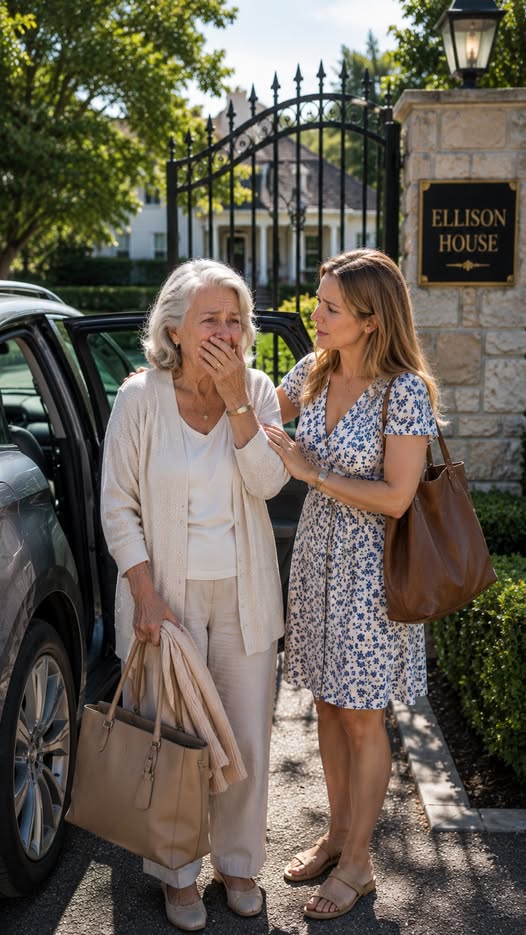
The Drive She Thought Would End Everything
Margaret Ellison held a small overnight bag against her chest as her daughter drove through the rainy streets of Portland, Oregon.
Inside the bag were three sweaters, her medicine bottles, an old photo of her late husband, and a folded adoption certificate she had kept for thirty-one years.
Her hands trembled.
Her daughter, Claire, had not said much since leaving the house.
That silence frightened Margaret more than any words could have.
“Claire,” Margaret whispered, “are you taking me somewhere because I’ve become too much?”
Claire gripped the steering wheel tighter.
She did not answer.
And that was when Margaret’s heart broke.
The Daughter She Chose
Margaret had not given birth to Claire, but she had loved her from the first night they met.
Claire was six years old then, sitting alone in a hospital hallway with a pink backpack beside her feet. Her father, Margaret’s husband, had been gone less than two hours, and the little girl did not yet understand how much her life had changed.
She looked up at Margaret and asked softly, “Who’s going to want me now?”
Margaret knelt in front of her, even though her own world had just fallen apart.
“I will,” she said. “I’ll love you enough for both of us.”
And she meant it.
She packed Claire’s lunches, brushed her hair before school, stayed awake during fevers, sold her wedding bracelet to pay for private tutoring, and worked extra shifts at a neighborhood bakery when money was short.
Claire called her “Mom” for the first time outside a grocery store.
Margaret cried so hard that Claire became embarrassed.
“Mom, people are looking,” Claire had said.
But Margaret did not care.
That one word had given her a reason to keep going.
When Silence Began to Hurt
Years passed.
Claire became a successful architect, moved into a stylish apartment near downtown, and started working with clients Margaret only saw in business magazines.
At first, Claire called every evening.
Then the calls became shorter.
Then visits became rushed.
Then Claire began canceling Sunday dinners.
Margaret told herself her daughter was busy. Grown children had their own lives. That was normal.
But a mother knows when love starts sounding tired.
One rainy Thursday evening, Claire arrived without warning. Her coat was damp, her face pale, and she held a thick folder under one arm.
“Mom,” she said, “pack what you need. Just the essentials.”
Margaret stared at her.
“For what?”
Claire looked away.
“I’ll explain when we get there.”
Those words landed like ice.
Margaret had heard stories from women at the clinic. Elderly parents taken “just for a visit” to quiet facilities where the rooms smelled clean but lonely. Mothers who waited by windows. Fathers whose children stopped calling.
So Margaret asked the question that had already formed inside her.
“Are you putting me in a senior home?”
Claire closed her eyes.
She still did not say no.
The Black Gate

The drive lasted almost an hour.
Rain slid down the windshield. Streetlights blurred into gold and white lines. Margaret kept one hand around the photo of her husband, Daniel, and the other around the adoption certificate.
She whispered, “I’m sorry, Daniel. Maybe I didn’t raise her right.”
Claire turned her head slightly, but she said nothing.
At last, they entered a quiet neighborhood filled with old trees, restored houses, and stone walls covered in ivy.
Margaret’s stomach tightened.
Expensive places did not always look cold. Some of them looked beautiful from the outside.
Claire slowed in front of a tall black gate.
There were warm lights beyond it, a garden path, and a bronze sign partly hidden by rain.
Margaret’s voice cracked.
“Please, Claire. Don’t leave me here. I’ll stop calling so much. I’ll take my pills on time. I won’t be a burden.”
Claire finally looked at her.
Tears filled her eyes.
She reached into the folder and pulled out a new silver key tied with a blue ribbon.
“Mom,” Claire said, her voice shaking, “I didn’t bring you here to leave you.”
The gate opened.
And Margaret saw the words on the bronze sign.
Ellison House.
The House With Her Name
Margaret read the sign again.
Ellison House.
Her last name.
Her breath caught.
Beyond the gate was not a medical facility. It was a large, restored craftsman home with wide windows, a covered porch, flower boxes, and a wheelchair ramp built neatly along the side.
The porch lights glowed softly in the rain.
Claire helped her out of the car.
“Slowly,” Claire said. “I’ve got you.”
Margaret looked around in confusion.
“What is this place?”
Claire took her bag.
“Come inside.”
The front door opened into a warm living room. There were soft chairs, fresh flowers, framed photographs, shelves of books, and the smell of coffee and cinnamon.
On one wall were pictures from Margaret’s life.
Claire at age six with crooked bangs.
Claire at her high school graduation.
Claire in a college cap and gown.
Daniel smiling beside the old family station wagon.
Under the photographs, painted in simple letters, was one sentence:
“For the woman who made a child feel chosen.”
Margaret covered her mouth.
“Claire… what have you done?”
Claire knelt in front of her, just as she had done as a little girl.
“I found what Dad left for you.”
The Secret Daniel Left Behind
Claire opened the folder on Margaret’s lap.
Inside were property records, letters, legal documents, old bank papers, and a handwritten note.
Margaret recognized the handwriting immediately.
Daniel’s.
Her fingers shook as she unfolded the letter.
“My Maggie,
If you are reading this, then I did not get the chance to explain everything myself. I bought a house in your name because I wanted you to have a place where no woman would ever feel unwanted just because she grew older.
My sister knows where the papers are. Do not let her make you feel small. And never let anyone tell Claire she is not your daughter. I chose her. You made her ours.”
Margaret could not finish reading.
For decades, she had believed Daniel left almost nothing behind except a small life insurance payment and a frightened child.
She had worked until her feet ached.
She had counted coins.
She had gone without new clothes so Claire could have school supplies.
And all that time, there had been a house in her name.
Hidden.
Claire touched her hand.
“Aunt Patricia kept everything from you. After she passed away, her son called me about some old boxes. He thought they were junk.”
Margaret’s eyes widened.
“Patricia knew?”
Claire nodded.
“She knew. And she collected rent from parts of this property for years. When I found out, I hired a lawyer. That’s why I’ve been distant. I wasn’t pulling away from you. I was trying to fix this before anyone could take it again.”
Why Claire Was Afraid
Margaret’s voice broke.
“I thought you were tired of me.”
Claire began crying.
“I was afraid to tell you too soon. If the legal fight went wrong, I didn’t want to break your heart twice.”
Then Claire’s face grew serious.
“There’s something else. Your old house wasn’t safe anymore.”
Margaret froze.
“What do you mean?”
“Patricia’s son came by yesterday with a lawyer. They wanted you to sign papers giving up your claim. They were trying to say you were too confused to manage your own decisions.”
Margaret sat very still.
Old.
Forgetful.
Inconvenient.
Words she had used against herself had become tools in someone else’s hands.
“That’s why you told me to pack?”
Claire nodded.
“I needed to get you somewhere protected. Somewhere that was already yours.”
Margaret looked around the warm room, the photographs, the fresh paint, the ramp, the flowers.
She had thought she was being taken to the end of her life.
Instead, her daughter had brought her back to something that had belonged to her all along.
More Than a Home
A woman with silver hair entered carrying a tray of mugs.
“You must be Margaret,” she said kindly. “Claire has talked about you like you invented kindness.”
Margaret blinked.
Claire smiled through tears.
“This is Mrs. Bell. She’s going to help run the kitchen.”
Soon, two other women appeared from the dining room. One carried knitting. Another leaned on a cane and smiled shyly.
Margaret looked at Claire.
“Who are they?”
Claire sat beside her.
“The first members of our day program.”
“Program?”
“Ellison House isn’t a nursing home,” Claire said. “It’s a community care house. Older women can come during the day for meals, company, basic health check-ins, legal guidance, phone classes, laundry help, and a place to feel seen.”
Margaret’s eyes filled again.
She thought about lonely women at clinic benches. Widows eating dinner in front of television sets. Grandmothers caring for everyone while no one asked if they were tired.
“And me?” she asked.
Claire squeezed her hand.
“You can live here if you want. Or we can go back to your old house when everything is settled. But this place is yours. Dad started it with love. You taught me what to do with it.”
Margaret whispered, “What did I teach you?”
Claire smiled softly.
“That a house only matters if someone feels welcome when they walk through the door.”
The Man Who Wanted the House
The next morning, Patricia’s son, Warren, arrived in a dark coat with a woman carrying a leather folder.
He smiled like someone practicing in a mirror.
“Aunt Margaret,” he said, opening his arms. “We were worried about you.”
Margaret did not hug him.
“Funny,” she said. “I don’t remember you worrying before there was property involved.”
His smile tightened.
“Claire removed you from your home without proper notice. That could look concerning.”
A Widowed Mother Cried the Entire Drive Believing Her Successful Daughter Was Leaving Her at a Nursing Home — Until the Black Gate Opened and She Discovered Her Daughter Had Quietly Spent Months Fighting to Protect Her
Claire stepped forward, but Margaret lifted one hand.
“I came willingly.”
The woman with the folder spoke carefully.
“Mrs. Ellison, this property requires maintenance, taxes, and ongoing costs. Selling it may be the most practical choice for your care.”
Margaret looked at her.
“My care?”
Warren sighed.
“At your age, decisions can become difficult.”
The room went quiet.
Then an older attorney entered from the hallway. Claire had hired him months earlier.
“Good morning,” he said calmly. “Mrs. Ellison’s decisions are fully her own. We also have documentation regarding the concealed property records, unauthorized rental income, and the recent attempt to pressure her into signing away her rights.”
Warren’s face changed.
“This is ridiculous.”
The attorney placed copies on the table.
“It is documented.”
Margaret stood slowly.
“Your mother hid my husband’s letter. She let me struggle while this house waited behind locked paper. You will not walk in here and call concern what is really greed dressed in a nice coat.”
Warren looked around the room, then back at Margaret.
“You won’t be able to handle this place.”
Margaret looked at Claire, Mrs. Bell, the women in the dining room, and the photographs on the wall.
“I don’t have to handle it alone.”
Warren left without another word.
A New Beginning
Weeks passed.
The legal process was not simple, but Margaret no longer faced it from a place of fear.
Claire stopped hiding phone calls. Margaret stopped pretending she did not need help. They argued about food, bills, paint colors, and whether Margaret should lift boxes.
It felt strangely wonderful.
Like family returning to its natural shape.
They painted one room pale blue because Margaret said too much white made the house feel like a clinic. They put Daniel’s photograph in the office. They hung wind chimes near the porch. Every Sunday, Margaret cooked chicken soup because she said a real home needed something warm on the stove.
Ellison House opened quietly.
There was no fancy gala, no expensive ribbon, no news cameras.
Just coffee, homemade pies, folding chairs, neighbors, volunteers, and women who had spent too long feeling invisible.
Claire gave a short speech.
“This house exists because one woman chose a child who felt unwanted and taught her that care is not a burden. Care is how we build a better world.”
Margaret cried before Claire finished.
Then Claire handed her the microphone.
Margaret did not want to speak, but she looked at the bronze sign outside the window.
Her name.
Her life.
Her fear turned into a doorway.
“I thought my daughter was bringing me somewhere to be forgotten,” Margaret said. “But she brought me to a place where my name had been waiting for me.”
The room fell silent.
“I was afraid of becoming a burden. But I have learned something here. People do not grow older faster because they need help. They fade faster when they are made to feel alone.”
Claire wiped her eyes.
Margaret looked around the room.
“This house is not here to hide women away. It is here to remind them that needing company is not something to apologize for.”
Where She Finally Belonged
That evening, after everyone left, Claire and Margaret stood on the porch while rain tapped softly against the garden leaves.
Claire rested her head on Margaret’s shoulder.
“Do you want to stay here?”
Margaret looked through the window at the warm living room, the photographs, the coffee cups, and the empty chairs waiting for tomorrow.
“Yes,” she said. “But I have conditions.”
Claire laughed softly.
“Name them.”
“I need a hook by my bedroom door for my blue shawl.”
“Done.”
“I need space in the kitchen for Sunday soup.”
“Also done.”
Margaret turned to her.
“And never again drive me through the rain in silence with one little bag. You nearly scared ten years off my life.”
Claire laughed, then cried.
Margaret held her close.
This time, the tears were not about loss.
They were about coming home.
Because sometimes a daughter’s silence is not abandonment.
Sometimes it is the sound of someone building a safe place before they know how to explain it.
And sometimes a mother must pass through the gate of her deepest fear to discover she was not being taken away from love.
She was being brought back to it.
Sometimes the people who seem quiet are not pulling away from us; they may be carrying a difficult plan, fighting a hidden battle, or trying to protect our hearts until they have something safe to place in our hands.
Growing older should never make a person feel smaller, because a life filled with sacrifice, patience, and love deserves more respect with time, not less.
A true daughter is not only the child born into a family, but the one who remembers who held her when she was afraid and chooses to hold that person back when life changes.
Love is not always loud, dramatic, or easy to understand; sometimes love looks like paperwork, long phone calls with lawyers, sleepless nights, and a key tied with a ribbon.
No parent should ever feel they must apologize for needing help, because the same hands that once carried others also deserve to be supported with gentleness.
A house becomes meaningful not because of its size, price, or beauty, but because someone walks through the door and feels expected, protected, and wanted.
The deepest wounds often come from believing we have become a burden to the people we love, which is why kindness must be spoken clearly before silence creates fear.
Family is proven in the moments when convenience disappears and responsibility remains, when someone chooses loyalty over comfort and truth over easy excuses.
What was hidden for years can still become a blessing when courage, patience, and love bring it back into the light at the right time.
No one reaches the end of their story simply because they grow older; sometimes the most beautiful chapter begins after the moment they thought everything was being taken away.