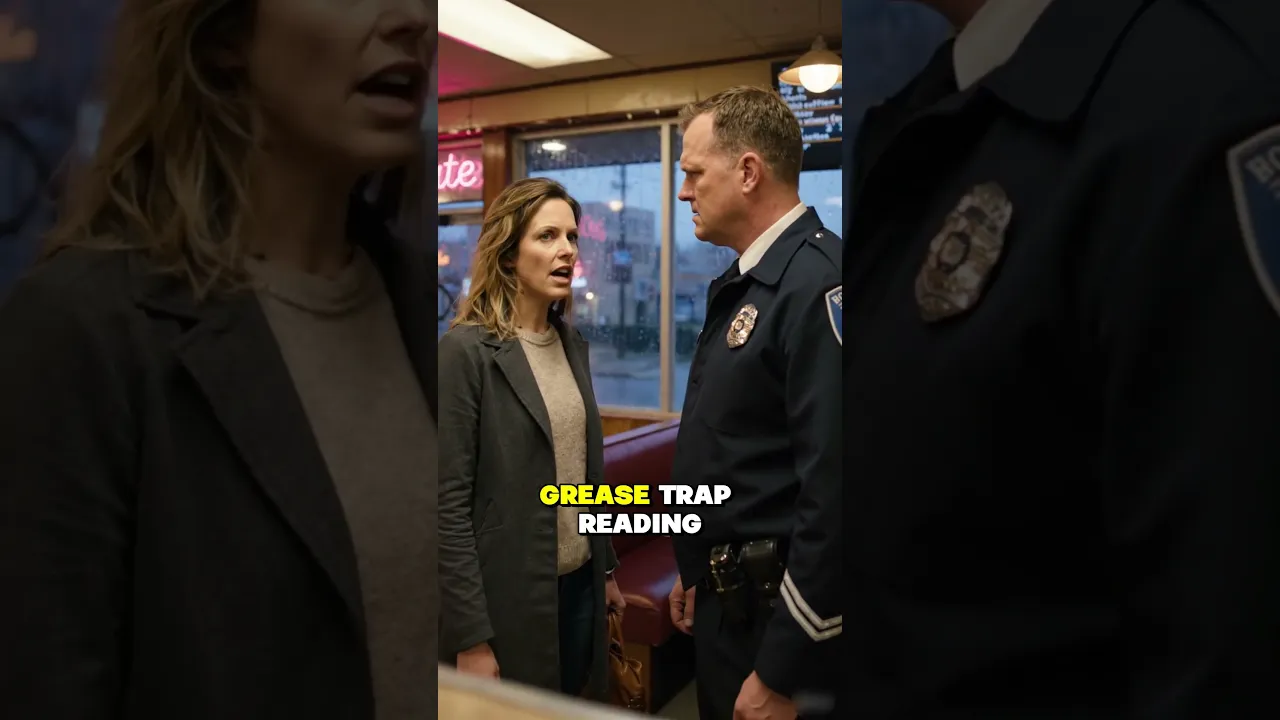
The slap echoed louder than anyone expected.
Not because it was violent—but because it was final.
“You don’t get to walk back in here like nothing happened,” Grace Holloway said, her hand still trembling in the air. Her voice was low, but it cut deeper than a scream.
Her ex-husband, Mark, stood frozen in the doorway of the diner, his expensive coat still dusted with snow. He hadn’t even flinched when she hit him—but now, something in his expression cracked.
“I’m not here to fight,” he said, forcing calm into his voice. “I’m here because the bank called me.”
Grace laughed—a sharp, bitter sound that didn’t belong in a place that once smelled like fresh pancakes and morning hope.
“Of course they did,” she said. “You always show up when there’s something left to take.”
“That’s not fair.”
“Fair?” Grace stepped closer, her eyes blazing. “You left me with the debt, Mark. You left me with this place, the bills, the staff, everything—and now you’re here to tell me what’s fair?”
Mark ran a hand through his hair. “I didn’t leave you with nothing. You chose to keep the diner.”
“Because it’s all I had left!” she snapped. “Because my father built this place with his hands, and I wasn’t about to watch it get turned into another chain coffee shop with fake smiles and overpriced lattes!”
Behind the counter, old Rosie—the night waitress who had seen everything and said little—quietly turned off the coffee machine. She knew when a moment didn’t need witnesses.
“The diner’s failing, Grace,” Mark said softly. “You’re barely keeping the lights on. I can help you—”
“I don’t want your help.”
“You don’t have a choice.”
That landed.
Grace felt it settle in her chest like a stone.
Mark stepped closer, lowering his voice. “The bank is calling in the loan. If you don’t pay what you owe by the end of the month, they’re taking everything. The building. The equipment. Even the sign out front.”
Grace swallowed hard, but she didn’t let it show.
“And what do you get out of this?” she asked.
Mark hesitated. “I can buy it. Keep it running. Keep your father’s name on it.”
Grace stared at him.
“You mean your name,” she said.
“That’s not what I—”
“Don’t,” she cut him off. “Just don’t.”
The silence stretched between them, thick and suffocating.
Finally, Mark sighed. “Think about it,” he said, stepping back toward the door. “I’m giving you a way out.”
Grace didn’t respond.
The bell above the door chimed as he left.
And just like that, the diner felt smaller.
Quieter.
Closer to disappearing.
Grace stood alone in the kitchen long after closing.
The clock ticked louder than it should have. The hum of the refrigerator felt like a reminder that time was running out.
She ran her fingers along the worn edge of the counter—her father’s counter. She could still remember him standing there, flipping burgers, laughing with customers, telling her that this place wasn’t just a business.
“It’s a home,” he used to say. “For anyone who needs one.”
Grace closed her eyes.
“I’m trying, Dad,” she whispered. “I really am.”
The back door creaked open.
Grace turned, startled.
A woman stepped inside, bundled in a thin coat that wasn’t enough for the cold. She looked exhausted—eyes sunken, shoulders slumped—but there was something steady in the way she held herself.
“I’m sorry,” the woman said quickly. “I know you’re closed. I just… I saw the light.”
Grace hesitated. “We’re not serving anymore.”
“I’m not asking for food,” the woman said. “I just… I need a place to cook.”
That caught Grace off guard.
“What?”
The woman shifted uncomfortably. “My car broke down a few miles back. I’ve got my kids sleeping in the backseat, and I promised them I’d make something warm tonight. I have the ingredients—I just don’t have anywhere to cook them.”
Grace studied her.
There was no arrogance. No entitlement.
Just a mother trying not to break.
“It’s just one meal,” the woman added quietly. “I’ll clean everything after. I won’t take anything you don’t offer.”
Grace looked at the kitchen.
At the empty space that once fed dozens of people every night.
At the place her father had called home.
Then she looked back at the woman.
“Come on,” Grace said, stepping aside. “I’ll show you where everything is.”
The woman’s name was Elena.
Her hands moved with quiet confidence as she unpacked a small bag of ingredients—rice, beans, a few vegetables. Nothing fancy. But the way she handled them made it feel like something more.
Grace leaned against the counter, watching.
“You cook like you’ve done this a thousand times,” she said.
Elena smiled faintly. “I have. Just… not always in a kitchen.”
Grace raised an eyebrow.
Elena shrugged. “Life gets complicated.”
Grace nodded. She understood that.
As Elena cooked, the diner slowly filled with warmth again. The smell of simmering spices, the soft clatter of utensils—it was like the place was breathing for the first time in weeks.
“You don’t have to stay,” Elena said. “I’ll lock up when I’m done.”
Grace shook her head. “It’s fine.”
They worked in silence for a while.
Then Elena spoke again.
“Why did you say yes?” she asked.
Grace thought about it.
“I don’t know,” she admitted. “Maybe because someone once said yes to me when I needed it.”
Elena nodded, as if that made perfect sense.
When the food was done, Elena packed it carefully.
“Thank you,” she said, her voice thick with emotion. “You don’t know what this means.”
Grace gave a small smile. “I think I do.”
The next morning, Grace arrived at the diner before sunrise.
She wasn’t expecting anything.
She certainly wasn’t expecting a crowd.
At first, she thought there had been a mistake. Maybe a bus had broken down nearby. Maybe people were waiting for something else.
But as she got closer, she realized…
They were all facing her diner.
Dozens of people.
No—hundreds.
Her heart skipped.
“What is this?” she murmured.
A man stepped forward, holding a clipboard. “Are you Grace Holloway?”
She nodded slowly.
He smiled. “Good. We’ve been waiting.”
“For what?”
He gestured behind him.
Grace followed his hand—and froze.
People stood in clusters, holding tools, supplies, boxes of food. Some wore aprons. Others carried paint cans. A group of teenagers held signs that read Community Build Day.
“I don’t understand,” Grace said.
A familiar voice called out, “She’s here!”
Grace turned.
Elena stepped through the crowd, her face brighter than it had been the night before.
“What… what is this?” Grace asked again.
Elena smiled.
“This is what happens when someone opens a door,” she said. “I told a friend about you. She told her church. They told their friends. It just… spread.”
Grace blinked. “You did all this?”
Elena shook her head. “No. You did. You said yes when you didn’t have to.”
The man with the clipboard stepped forward again. “We heard you’re about to lose this place. We figured… maybe we can help.”
Grace looked around.
At the people.
At the energy.
At the possibility.
“How?” she asked, barely able to speak.
He grinned. “We fix what needs fixing. We clean, we paint, we spread the word. We turn this place into something the community won’t let go of.”
A woman nearby added, “And we brought customers.”
Laughter rippled through the crowd.
Grace felt her chest tighten—but this time, it wasn’t from fear.
It was from something else.
Hope.
The transformation didn’t happen overnight.
It happened in hours.
Paint covered the chipped walls. New lights replaced the flickering ones. The kitchen was deep-cleaned until it shined. A local baker donated fresh pastries. A musician set up in the corner and started playing soft acoustic tunes.
By noon, the diner was full.
By evening, it was overflowing.
People came not just to eat—but to support.
To be part of something.
Grace moved through the chaos in a daze, taking orders, serving plates, laughing in a way she hadn’t in years.
At one point, she caught sight of Mark standing outside, watching.
He didn’t come in.
He didn’t need to.
Because for the first time, Grace didn’t feel like she needed anything from him.
Weeks later, the bank called again.
This time, Grace answered with a steady voice.
“I’ve got the payment,” she said.
There was a pause on the other end.
“Full amount?”
Grace smiled, looking around her bustling diner.
“Every cent.”
Months passed.
The diner became more than a business.
It became a hub.
A place where people gathered, shared stories, helped one another. Elena found steady work there, managing the kitchen. Her kids did homework in the corner booth every afternoon.
And Grace?
Grace found something she thought she had lost.
Not just stability.
But purpose.
One quiet evening, long after closing, Grace stood alone in the diner.
She ran her fingers along the counter—the same one her father had built.
“It’s still a home,” she whispered.
The back door creaked open.
Grace turned.
A young man stood there, nervous, holding a small bag.
“I’m sorry,” he said. “I know you’re closed. I just… I need a place to cook.”
Grace stared at him for a moment.
Then she smiled.
“Come on in,” she said, stepping aside.
Because she knew now—
The smallest kindness doesn’t disappear.
It multiplies.
And sometimes…
It comes back as 200 people standing at your door, ready to remind you that you were never alone to begin with.