Chapter 1: The Ledger and the Livestock
I have spent twelve years running Horizon Travel Arts, a boutique travel consultancy nestled in a quiet, brick-lined corner of Salt Lake City. It is a career that trains you to look past the romance of destination brochures and scrutinize the unvarnished mechanics beneath. My days are consumed by fine print, non-refundable deposit penalties, correcting passenger manifests for clients who inexplicably book transatlantic flights under childhood nicknames, and reasoning with retired couples determined to cram five alpine nations into a seven-day motorcoach tour.
I understand logistical friction. I know what happens when an itinerary is built upon wishful thinking rather than verifiable reality: the traveler is inevitably left stranded on a cold tarmac, waiting for luggage that was rerouted three hubs ago.
Yet, for over a decade, my own family categorized me through an entirely different lens. To them, I was not a woman who worked sixty-hour weeks to cover a mortgage, three growing children, payroll, commercial lease terms, and the sudden, catastrophic demise of a commercial-grade refrigerator. To them, I was simply the wealthy one. In the subtle, passive-aggressive vernacular of our household, being financially self-reliant meant you were an inexhaustible reservoir. You did not panic when an unexpected dental bill landed on the counter, and that singular distinction made you fair game.
My younger sister, Dana, thirty-eight and married to Nate, lived twenty minutes from our childhood home in Provo, while I lived nearly forty miles north. Dana and I were never blood enemies; we had merely drifted into that polite, muted cadence common to adult siblings. We sent generic birthday texts, exchanged curated holiday pleasantries, and allowed our mother to serve as the air-traffic controller of our relationship.
“Your sister had a miserable Tuesday, Margaret—call her, but don’t mention her kitchen remodel.”
“Margaret sounded dismissive on the phone, Dana; you know how stressed she gets with those corporate accounts.”
Our mother, Linda, sixty-seven, possessed a unique gift for domestic diplomacy. She was the family archivist, the distributor of casseroles, the keeper of grudges, and, most crucially, the sole administrator of the household accounts. My father, Richard, seventy, had retired early following open-heart surgery and a series of subsequent health setbacks. Dad had spent forty years deflecting any matter that involved an envelope or a signature. His favorite self-deprecating joke was that if Mom were ever abducted by aliens, he wouldn’t know which branch held their checking account.
That joke lost every shred of humor on the fourth Thursday of November.
The campaign for that particular Thanksgiving began in early October. Mom called my office, her voice saturated with that practiced, quavering cadence designed to bypass reason.
“Your father isn’t getting any younger, Margaret,” she murmured, sighing directly into the receiver. “With his arrhythmia acting up again, we simply don’t know how many more holidays we’ll all be together under one roof.”
Dad was seventy, not terminal, but guilt operates outside the laws of basic arithmetic. I capitulated instantly. I negotiated with my former husband, Mark—with whom I share an amicable, if clinical, co-parenting dynamic—so that I could take our three children for the entire holiday afternoon.
Three weeks before the feast, Mom initiated the procurement phase.
“Sweetheart, could you handle the turkey this year? Money is brutally tight. Your father’s new cardiac maintenance medication wasn’t fully covered by the supplemental tier, and the supplemental insurance deductible reset early.”
“Of course,” I told her. “Send me the details.”
She directed me to a specialty artisanal butcher near her home. I phoned in an order for a bird so colossal it practically required its own agricultural transport permit. It cost an absurd amount. Four days later, an urgent text pinged on my phone: Mom needed $180 for the remaining sides and roasting pans. I sent it via instant transfer. The following week brought a request for another $65 because she had forgotten the candied yams and pecans.
“For sixty-five dollars,” I teased gently over text, “those pecans better include mineral rights to the orchard.”
Her reply was swift, pious, and cold: You know how much this tradition means to your father’s spirits.
I sent the money without another word. I was already sending them $1,100 on the first of every month anyway.
That monthly subsidy had started four years earlier, right after Dad’s coronary bypass. Mom had called in tears, detailing an alarming “temporary income bridge” caused by his unexpected retirement, escalating property taxes, and specialized physical therapy. It began at $600. Then it climbed to $800 to offset dental work. Then it solidified into an even $1,100. Over forty-eight months, the word temporary had quietly dissolved into thin air.
Whenever I considered scaling the payment back, Mom would casually drop a terrifying detail into our weekly call: the furnace had made a sinister clanking noise, or Dad’s blood thinner had jumped in price, followed immediately by her signature phrase: “Don’t worry about us, darling. We’ll find a way to manage.” That single sentence was an emotional shakedown that unfailingly caused me to open my mobile banking app.
Thanksgiving morning arrived crisp and unyielding. My youngest, Ben, nine years old, bounded into my bedroom at seven o’clock, clutching a paper turkey he had meticulously constructed in art class. Each construction-paper feather was inscribed with a crooked child’s declaration of gratitude: Mom, Dad, Legos, Caleb, Sophie, and, on the largest orange plume, Grandma Pie. Not Grandma herself. Grandma Pie.
My teenagers were less reverent. Sophie, fourteen, treated any required family migration as a violation of the Geneva Conventions, while Caleb, eleven, was entirely indifferent to human drama provided there was a guarantee of warm dinner rolls.
At 9:47 AM, Mom texted: Drive safe, honey. The state patrol says the canyon pass might get treacherous later.
At 11:31 AM, as I loaded the kids into our SUV, I texted back: Wheels up. GPS says 4:20 PM arrival, barring any emergency bathroom inspections along I-15.
Mom reacted to my message with a digital heart icon.
The drive was unremarkable—four hours of adolescent squabbling, two roadside fuel stops, and Ben clutching his paper bird like an ambassador bearing a peace treaty. We pulled into the familiar curved driveway of my parents’ suburban house at precisely 4:26 PM.
The driveway was packed bumper-to-bumper. Dana’s crossover was wedged against Nate’s heavy-duty pickup. My parents’ sedan sat parked on the grass. Beside them were two unfamiliar late-model sedans.
The sharp scent of roasted sage, melted butter, and spiced cider hung heavy in the crisp autumn air. Laughter and the clatter of silverware drifted through the front porch siding.
Ben practically launched himself from the backseat, his paper turkey held aloft. We climbed the porch steps together. I pressed the brass doorbell.
Inside, the animated chatter abruptly dropped an octave. It did not stop; it curbed itself into a muffled, sudden hush.
I rang again.
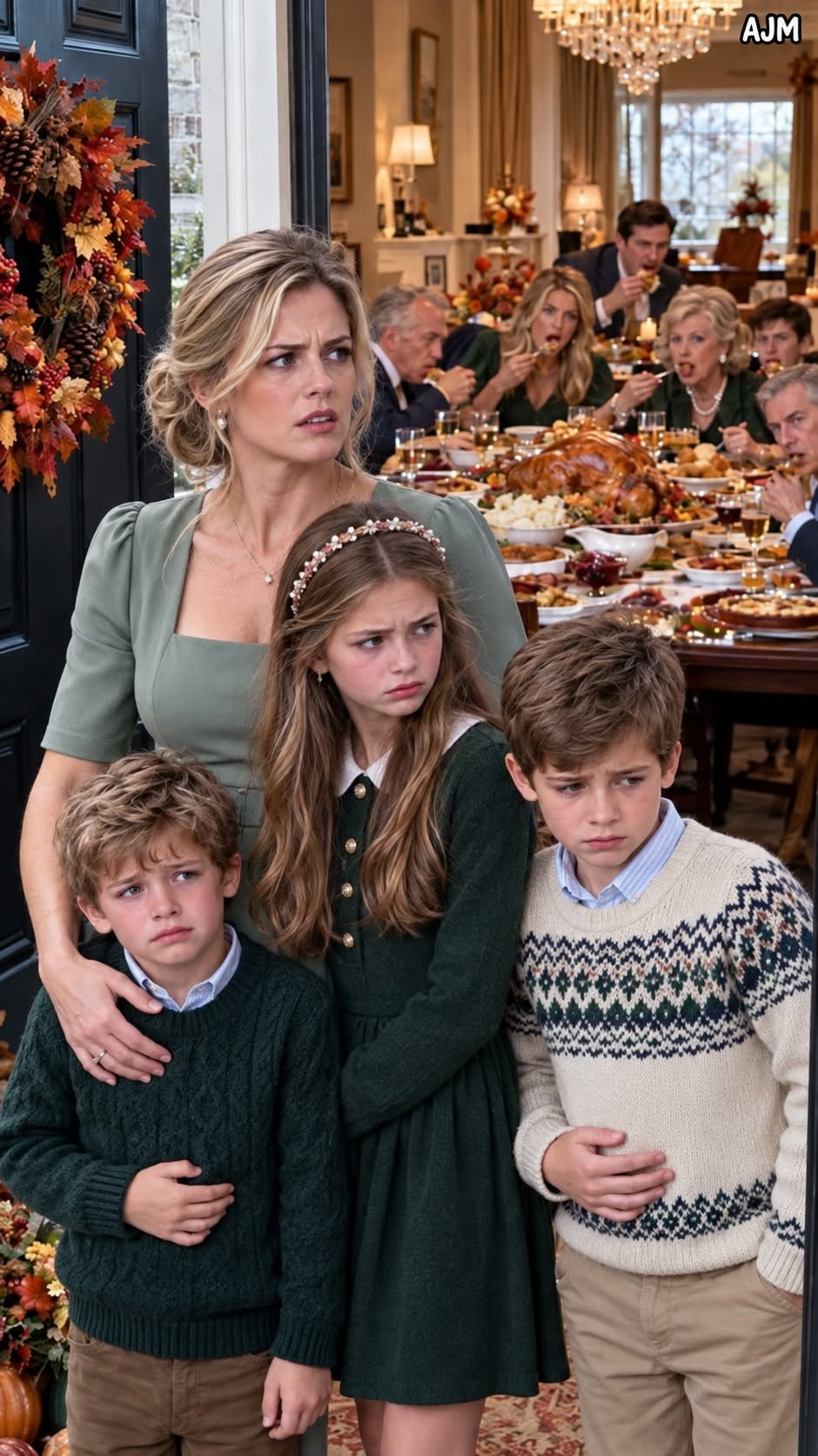
A long, agonizing minute crawled past before the deadbolt clicked. The heavy front door swung inward—not with the wide-armed warmth of a grandmother welcoming her distant kin, but a rigid, guarded crack of barely eight inches.
Mom stood in the opening. Her apron was dusted with flour, her hair pinned back. She looked at me, her eyes darting nervously past my shoulder toward the driveway, then down at the children. There was no smile. There was no embrace.
“Margaret,” she whispered, her hand gripping the edge of the door like a barricade.
“Happy Thanksgiving, Mom,” I said, leaning in instinctively. “We made great time on the canyon road.”
She did not yield an inch. Her voice was flat, hard, and defensive.
“We already ate.”
 We drove four hours for Thanksgiving only to be turned away while my sister’s family was still eating inside. I said nothing, loaded up my kids, and made one quiet decision.