The note from Charles changed everything.
Not because it proved murder.
It did not.
But because it proved fear.
Real fear.
Before Thomas died.
Before the ambulance came.
Before I found my husband lying still in our bed.
Charles had been frightened enough to write down that something might happen.
And frightened people do not usually write warnings without a reason.
Martin contacted the authorities that afternoon.
This time, there was no hesitation.
The old estate fraud.
The forged signatures.
The suspicious transfer.
The withheld recording.
The delayed emergency call.
Everything was handed over.
Every file.
Every email.
Every audio recording.
Every document from Charles’s storage unit.
For the first time in ten years, the story was no longer being controlled by Graham or Paige.
The evidence was.
That mattered.
Two detectives came to speak with me the next morning.
They asked me about Thomas.
His health.
His medication.
Our marriage.
His final months.
They asked the same questions more than once.
I understood why.
Truth should stay the same.
Even when the order changes.
Then they asked about the night Thomas died.
I told them everything I remembered.
Every small detail.
The coffee.
The back door.
The silence upstairs.
The way Thomas’s hand felt when I touched it.
The way I had screamed his name even though some part of me already knew he would not answer.
One detective finally asked:
“Mrs. Mercer, do you believe your son intended to kill your husband?”
I looked at him for a long moment.
“No.”
That answer surprised even me.
“But I believe he made a terrible choice.”
“What choice?”
“He chose fear over help.”
I swallowed.
“And I may never know whether those minutes could have saved Thomas.”
That was the truth I had to live with.
Not certainty.
Possibility.
And possibility can be crueler than certainty.
The investigation moved quickly after that.
Not because the case was simple.
Because the records were strong.
Charles had documented more than anyone realized.
He had saved emails.
Copies.
Drafts.
Dates.
Even notes from meetings.
Apparently guilt had made him cautious.
Years too late.
But not completely useless.
Then Martin received the evidence report from the old recorder.
There was another file on it.
One we had missed because it was badly labeled.
November 3.
The night before Thomas died.
The recording was only seventeen minutes long.
When Martin played it, I heard Charles and Paige arguing.
Charles said:
“You need to stop.”
Paige answered:
“I’m too far in.”
Charles said:
“No.”
“You can undo it.”
“You return the land.”
“You destroy the false forms.”
“You tell Graham.”
Paige laughed.
“He already knows enough.”
Then Charles said something that made my heart pound.
“And Thomas?”
Paige answered:
“Thomas won’t matter after tomorrow.”
Ruth grabbed my arm.
Martin immediately stopped the recording.
The room went silent.
I whispered:
“Play it again.”
He did.
Same words.
Same tone.
Same cold certainty.
But then Charles answered:
“What does that mean?”
Paige said:
“It means he’s meeting an attorney.”
“He’s changing everything.”
“If that happens, Graham gets nothing.”
Charles said:
“That is not your problem.”
Paige replied:
“It becomes my problem when I’ve spent years fixing his family.”
I felt sick.
She had not married into our family with love alone.
Somewhere along the way, she had turned us into a project.
A system.
Something to control.
The recording continued.
Charles asked:
“What are you planning?”
Paige said:
“Nothing.”
Then:
“I’m just saying tomorrow changes everything.”
That was all.
No murder confession.
No explicit threat.
But enough to deepen suspicion.
Enough for investigators to dig harder.
They searched old devices.
Archived accounts.
Backups.
And then, three days later, they found what broke the case open.
An old message from Paige to Graham.
Sent at 6:18 the morning Thomas died.
DAD KNOWS EVERYTHING.
GET THERE BEFORE HE CALLS EVELYN UPSTAIRS.
Another message followed at 6:23.
IF HE TALKS, WE LOSE IT ALL.
Then at 6:37:
LEAVE.
NOW.
I stared at the timestamps.
6:18.
6:23.
6:37.
Graham had not simply gone to see his father.
He had gone because Paige told him to.
And Paige knew Thomas intended to tell me everything.
The detective asked Graham about the messages.
For hours, he denied remembering them.
Then he broke.
He admitted that Paige had told him to go calm Thomas down.
He admitted that Thomas was furious.
He admitted that Thomas threatened to call me upstairs and tell me about every fraudulent document.
Then came the hardest part.
Graham admitted Thomas was still breathing when he moved him.
Not strongly.
But breathing.
I stopped breathing myself when Martin told me.
For years, I had hoped maybe Graham had been mistaken.
Maybe panic had distorted everything.
But no.
He knew.
He knew his father might still be alive.
And he left.
I asked Martin:
“Why?”
He answered carefully.
“Because Graham says he believed an ambulance would expose the fraud.”
There it was again.
Money.
Shame.
Fear.
All greater than courage.
At least for those few minutes.
Graham eventually called me from his attorney’s office.
I almost did not answer.
But I did.
“Mom.”
His voice sounded empty.
Not crying.
Not angry.
Just empty.
“I told them everything.”
I said nothing.
“I should have called 911.”
“Yes.”
“I should have told you everything ten years ago.”
“Yes.”
“I should have stopped Paige.”
“Yes.”
He took a breath.
“I kept thinking I could fix it later.”
That sentence hurt.
Later.
People destroy entire lives with that word.
Later I’ll confess.
Later I’ll apologize.
Later I’ll make it right.
But later does not bring back minutes.
Or fathers.
Or trust.
Graham whispered:
“Can you forgive me?”
I closed my eyes.
“I don’t know.”
He started crying.
I continued:
“I love you.”
“I probably always will.”
“But forgiveness is not the same as pretending.”
“I cannot pretend anymore.”
He was silent.
Then he said:
“I understand.”
For once, I believed him.
Paige did not confess.
Not fully.
She blamed Graham.
She blamed Charles.
She blamed grief.
She blamed confusion.
She even blamed Thomas.
But the documents did not care who she blamed.
The signatures were false.
The property transfer was fraudulent.
The beneficiary change had been manipulated.
The guardianship plan was fabricated.
And the messages showed she had pushed Graham toward Thomas that final morning.
Weeks later, charges were filed.
Not for murder.
The evidence could not prove she caused Thomas’s death.
But fraud.
Forgery.
Conspiracy.
Obstruction.
Evidence-related offenses.
And other charges tied to the property transfers and the events after Thomas collapsed.
Graham faced charges too.
Fewer.
But serious.
His cooperation mattered.
So did the fact that he eventually handed over everything.
But cooperation did not erase what happened.
That was the lesson he had avoided his entire life.
Consequences are not cruelty.
They are simply what remains after choices.
The highway property was frozen.
Then eventually restored to Thomas’s estate.
The false transfer documents were voided.
My ownership remained intact.
The house Graham and Paige had rented was still mine.
Martin asked whether I wanted to proceed with selling it.
I said yes.
Not out of revenge.
I simply did not want my future tied to that house anymore.
Then came one final discovery.
Inside Charles’s storage unit was an envelope we had not opened because it had been tucked inside an old ledger.
On the front were three words.
FOR EVELYN ONLY.
Inside was a letter from Thomas.
Not Charles.
Thomas.
My hands shook when I unfolded it.
Evelyn,
If Charles gives you this, then something has gone badly wrong.
I do not know whether I will have enough time to fix it myself.
My eyes filled.
I kept reading.
I made a mistake by trying to protect you without including you.
You were always stronger than I gave you credit for.
If Graham forgets that, remind him who taught him strength in the first place.
Not me.
You.
I started crying.
Ruth cried too.
The final lines were shorter.
Do not let anyone make you small just because they are afraid of how strong you are.
And if I am not there to say it later:
Choose your own life.
Thomas.
I pressed the letter against my chest.
For ten years, people had tried to reduce me.
Old.
Emotional.
Confused.
Dependent.
A mother.
A widow.
A problem.
Thomas’s final letter gave me back the one thing none of them had managed to take.
Myself.
But there was still one thing left to do.
One final conversation.
With Graham.
PART 11 — FINAL PART — THE LIFE THEY COULD NOT TAKE FROM ME
Three months later, I sat on the front porch of my yellow cottage and watched the roses begin to bloom.
Spring had arrived quietly.
No announcement.
No permission.
Just warmth returning to the world.
I liked that.
Some things do not need permission to begin again.
The legal cases were still moving through the courts.
Slowly.
Methodically.
Paige was no longer living with Graham.
Their marriage had collapsed almost immediately after the investigation widened.
I was not surprised.
A relationship built around secrets rarely survives when the secrets become evidence.
Graham had moved into a small apartment.
Nothing like the house he had once called “our family home.”
He worked.
He attended counseling.
He cooperated with prosecutors.
And for the first time in his adult life, he handled his own consequences without asking me to rescue him.
Then one Saturday morning, he came to see me.
He had asked first.
That mattered.
I opened the door.
He looked older.
Not physically.
Something else.
Humility ages a person differently from stress.
He held no flowers.
No gift.
No envelope.
Just himself.
“Can I come in?”
I stepped aside.
We sat at the oak dining table.
The same one I had bought when this cottage was still a secret.
For a while, neither of us spoke.
Then Graham said:
“I’m not here to ask for money.”
I almost smiled.
“That’s a good beginning.”
“I’m not here to ask you to change your will either.”
“That’s an even better one.”
He nodded.
Then looked down.
“I came to apologize.”
I waited.
Not because I wanted a performance.
Because I wanted to hear whether he finally understood.
He took a slow breath.
“I am sorry I treated your love like something guaranteed.”
My chest tightened.
“I am sorry I let Paige convince me that Dad’s business should matter more than your rights.”
“I am sorry I knew things were wrong and stayed quiet because I thought I might benefit.”
His eyes filled.
“I am sorry I left Dad when he needed help.”
That one broke his voice.
“And I am sorry I left you to find him.”
Tears rolled down his face.
“I have thought about that every day since I told the truth.”
I said nothing.
He continued.
“I kept telling myself I was scared.”
“I was.”
“But fear explains what I did.”
“It does not excuse it.”
There.
That was the sentence I had waited years to hear.
Not I was manipulated.
Not Paige made me.
Not I was grieving.
Responsibility.
His own.
I reached across the table.
Not to forgive everything.
Not yet.
But to take his hand.
He started sobbing.
“I miss Dad.”
“So do I.”
“Do you think he would hate me?”
I looked toward Thomas’s photograph.
“No.”
Graham looked surprised.
“I think he would be furious.”
A weak laugh escaped him through his tears.
“So do I.”
“But your father loved you.”
“Love is not erased by disappointment.”
Graham lowered his head.
“Do you still love me?”
“Yes.”
I answered immediately.
“But we are not going back to what we were.”
“I know.”
“If we build something again, it will be new.”
“I understand.”
“It will take time.”
“I know.”
“And you may never have access to my money.”
He nodded.
“I don’t want it.”
For the first time, I believed him.
Maybe losing everything he thought he deserved had finally taught him what was actually valuable.
Before leaving, Graham stood by the door.
“Can I ask one thing?”
“Yes.”
“Did Dad really write you a letter?”
I nodded.
“Can I read it someday?”
I thought about it.
“Someday.”
He smiled sadly.
“That’s fair.”
After he left, I sat alone for a while.
Not lonely.
Alone.
There is a difference.
Later that afternoon, Owen and Lily visited.
Their educational trusts remained intact.
They had nothing to do with the sins of their parents.
Children should not inherit punishment.
They should inherit truth.
One day, when they were old enough, I would tell them what happened.
Carefully.
Honestly.
Without turning their parents into monsters.
People are more complicated than monsters.
That is what makes betrayal hurt.
Bad people are easy to reject.
But people we love can do terrible things and still remain human.
That is harder.
Paige eventually accepted a plea agreement on several charges.
The investigation did not prove that she physically caused Thomas’s death.
And I refused to claim what could not be proven.
Truth mattered too much by then.
But what was proven was enough.
She had forged documents.
Manipulated ownership.
Fabricated claims about my mental capacity.
Participated in hiding what happened after Thomas collapsed.
And pushed a frightened man to protect money instead of his father.
The court gave its judgment.
I did not attend every hearing.
I did not need to.
Justice did not require my constant presence.
I had spent enough of my life sitting in rooms built around other people’s mistakes.
The house was sold in May.
After taxes and expenses, I placed part of the proceeds into a small foundation.
Not in Graham’s name.
Not in mine.
Thomas’s.
The Thomas Mercer Independence Fund.
It helped older widows obtain independent legal advice before signing property transfers, guardianship documents, or major financial agreements.
Martin laughed when I told him.
“That is very specific.”
“It needed to be.”
Ruth joined the board.
She said somebody had to make sure I did not give away everything.
I told her Thomas had once said I was free to buy a sailboat.
She threatened to resign.
I laughed harder than I had in years.
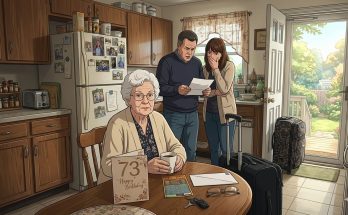
Then, on my seventy-fourth birthday, my family gathered at my cottage.
There was no expensive party.
No grand celebration.
Just dinner.
Ruth.
The grandchildren.
A few friends.
And Graham.
He brought me one small gift.
A scratch-off ticket.
For one terrible second, everyone went silent.
Then Graham looked horrified.
“I didn’t think this through.”
I stared at him.
Then I started laughing.
Ruth laughed.
The children laughed.
Even Graham eventually laughed.
I scratched the ticket at the table.
Nothing.
Not one dollar.
I held it up.
“Well.”
Graham smiled.
“Not even enough for the bus?”
I looked at him.
For a moment, the past stood between us.
Then I smiled too.
“Not even enough for the bus.”
This time, the laughter did not hurt.
That was how I knew something had finally changed.
Not disappeared.
Changed.
Pain does not always leave.
Sometimes it simply loses the power to control the room.
Later that night, after everyone had gone home, I walked onto my porch.
The air smelled like roses.
Thomas’s letter was folded safely inside my desk.
The lottery money was protected.
My home belonged to me.
My decisions belonged to me.
My future belonged to me.
But those were not the things that made me feel wealthy.
Freedom did.
I had spent years believing peace meant keeping everyone else comfortable.
I know better now.
Peace is not silence.
Peace is not surrender.
Peace is not smiling while people decide your life for you.
Peace is being able to look at yourself without wondering when you disappeared.
I did not disappear.
I was still here.
Evelyn Mercer.
Seventy-four years old.
Widow.
Mother.
Grandmother.
Homeowner.
Survivor of other people’s greed.
And finally, the author of my own life.
That ridiculous two-dollar scratch ticket had changed everything.
Not because of the millions hidden beneath the silver coating.
Money had only revealed what was already there.
It showed me who respected me when they thought I had nothing.
Who loved me.
Who used me.
Who underestimated me.
And who I had become after years of putting everyone else first.
If Paige had given me flowers that birthday, perhaps none of this would have happened.
If Graham had asked what I wanted instead of choosing Pine Harbor for me, perhaps I would have kept my secret longer.
But life sometimes opens one door by slamming another shut.
I lost the family I thought I had.
Then I built something more honest from what remained.
As I turned off the porch light, I looked up at the stars.
“Goodnight, Thomas.”
The wind moved softly through the roses.
And for the first time since he died, I did not feel like I was saying goodbye.
I felt like I was keeping my promise.
Choosing my own life.
And living every day of it as though it truly belonged to me.
Because it did.
THE END


One Comment on “PART 10 — (END) THE TRUTH CHARLES TRIED TO LEAVE BEHIND……………For my 73rd birthday, my daughter-in-law handed me a $2 scratch-off ticket”