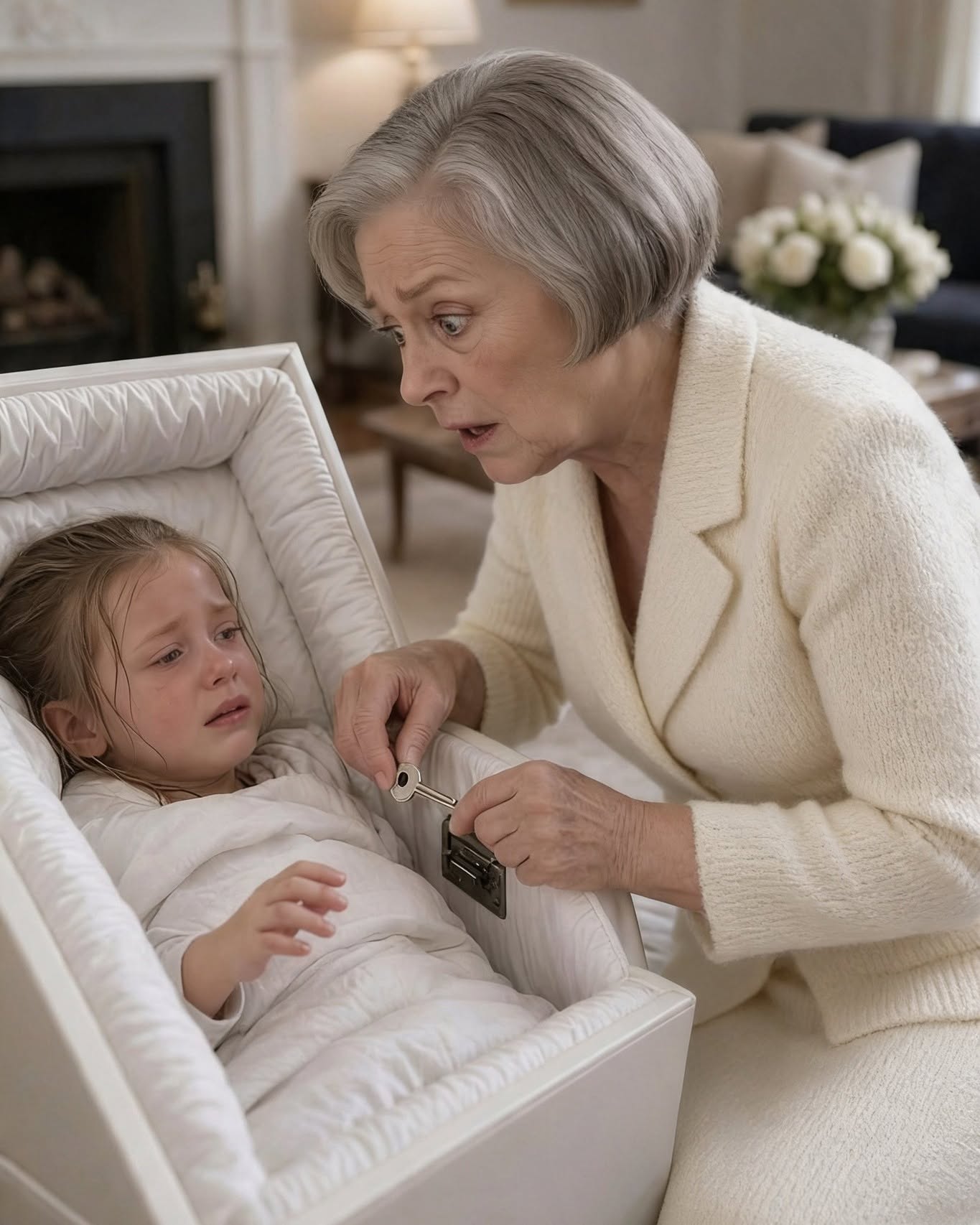
I froze. My son and his wife had told everyone she died from a sudden contagion. I pried the lid open. As I lifted my breathing grandchild, heavy footsteps rushed down the stairs…
PART 1

It was almost eleven o’clock at night. My son Arthur’s elegant home outside Chicago had gone completely quiet, with Jessi’s casket sitting in the middle of the living room among white lilies, candles, and flowers sent by people who believed she had died from a sudden respiratory illness.
Arthur and his wife, Patricia, had already gone upstairs. They said they were exhausted. They said they needed sleep before the funeral the next morning. They said I should go home too.
I couldn’t.
I had stayed because I needed one last goodbye. But when I carefully raised the lid, Jessi’s eyelids moved. I touched her cheek. I watched her chest. I felt a weak breath against my hand.
She was alive.
Her face was pale and hot with fever. Her lips trembled beneath the soft light from the living room, and then I realized something even worse: Jessi had been secured inside the casket in a way that kept her from moving freely.
“Grandma,” she whispered. “I was good. I stayed quiet.”
My hands started shaking so badly I could barely work. I tried to free her, but whatever had been done to keep her in place would not release at first. That was when the truth became impossible to avoid. This was not some terrible mistake at a funeral home. Someone knew Jessi was alive when she was placed there.
I forced myself to stop pulling and search instead. Beneath the padded lining, my fingers brushed something hard and cold. I reached deeper and found a small metal key hidden under the fabric.
The key worked.
I released Jessi and lifted her against my chest. She wrapped her arms weakly around my neck while every excuse Arthur and Patricia had given me during the previous months came rushing back.
“Jessi is sleeping.”
“The doctor says she needs privacy.”
“She becomes anxious around visitors.”
“You need to respect our parenting choices.”
I had believed Patricia was controlling and Arthur hated confrontation. I had told myself I was being the difficult mother-in-law, the worried grandmother who needed to back off.
Now my granddaughter was trembling against me inside the room where everyone expected to mourn her the next morning.
I wrapped Jessi in my black wool shawl and started toward the back hallway. My handbag and phone were still near the living room, but the old telephone in the laundry room was closer. I could feel Jessi’s breathing against my shoulder as I hurried away from the casket.
“Please don’t let them take me,” she whispered.
I got inside the laundry room, locked the door, and called emergency services. I told the dispatcher my granddaughter had been declared dead but was alive, feverish, and had been found inside her casket. I said I believed she might have been given medication.
Before the dispatcher could finish answering, a bedroom door opened upstairs.
“Mom?”
Arthur’s voice carried down the staircase.
I pulled Jessi tighter against me. His footsteps came faster, crossed the hallway, and then Arthur rushed straight toward the locked laundry-room door.
PART 2
Arthur grabbed the handle and pulled hard.
“Open the door!” he shouted. “You don’t understand what you’re doing!”
Jessi buried her face against my shoulder. I could feel her shaking beneath the wool shawl, but I kept my voice steady enough for both Arthur and the dispatcher to hear me.
“The police are already on their way.”
For a moment, Arthur stopped pulling.
Then Patricia’s voice came from behind him.
“Did she find Jessi? Did she take her out?”
Arthur tried to quiet her, but Patricia was already panicking.
“She wasn’t supposed to wake up yet!”
That sentence erased the last possibility of an innocent explanation.
Sirens grew louder outside. Red and blue flashes moved across the windows while Jessi slowly lifted her head from my shoulder.
“I don’t fall asleep by myself, Grandma,” she whispered. “They give me medicine.”
Seconds later, officers and paramedics entered the house, and the first paramedic moved directly toward Jessi.
PART 3
The laundry room door flew open as the paramedics pushed past Arthur, who stood frozen in the hallway like a ghost.
I handed Jessi directly to the lead paramedic. The moment he wrapped a blanket around her, he looked up at the responding police officers and shouted, “She’s alive! She’s hyperthermic, her heart rate is elevated, and her pupils are heavily dilated! We need a toxicology screen at the pediatric ICU right now!”
Patricia let out a shriek, lunging toward the paramedics. “You can’t take her! She’s sick! She’s contagious!”
An officer stepped directly into Patricia’s path, placing his hands flat against her shoulders to block her. “Ma’am, step back! Let the medical team do their job!”
“She’s my daughter!” Patricia screamed hysterically, her eyes wild, her composure completely shattered. “Arthur, do something! Stop them!”
Arthur didn’t move. He stood backed against the laundry room wall, staring at the floor, his face drained of every drop of color.
As the paramedics rushed Jessi out the front door toward the flashing lights of the ambulance, I followed right behind them. Arthur tried to catch my arm as I passed. “Mom, please… listen to me…”
I turned and slapped his hand away with every ounce of strength I had left.
“Don’t you ever call me ‘Mom’ again,” I said, my voice deadpan and icy. “You are a monster.”
Two police officers immediately flanked Arthur and Patricia, instructing them to place their hands behind their backs.
I climbed into the back of the ambulance, sitting beside the gurney, gripping Jessi’s small hand while the paramedics administered oxygen and started an IV line.
At the hospital, the pediatric medical team worked frantically through the night. The toxicology results came back four hours later, confirming the nightmare I had uncovered in that laundry room.
Jessi had been systematically poisoned over eight months with controlled doses of a heavy veterinary sedative and paralytic compound.
The strategy was as calculated as it was sickening. Patricia had forged medical documents from an online clinic, claiming Jessi had a rare, progressive neuro-respiratory disease. They used the heavy sedatives to simulate terminal deterioration in front of friends, relatives, and church members, creating a tragic public narrative of a dying child.
Their motive? A three-million-dollar private supplemental life insurance policy Arthur had quietly underwritten on Jessi six months prior, coupled with over four hundred thousand dollars raised through a viral online charity campaign.
The casket hadn’t been bought from a licensed funeral home. Arthur had purchased it privately online. The plan was to stage a quiet, home-based memorial, bypass official county embalming requirements under the guise of “religious preference,” and bury Jessi alive in a remote family plot before the sedatives completely wore off.
If I hadn’t stayed behind to say goodbye, my six-year-old granddaughter would have suffocated six feet under the earth.
The legal machinery moved with terrifying speed.
Faced with the hospital’s toxicology reports, the electronic paper trail of the insurance policies, and the hidden key I had handed directly to forensic detectives, Arthur broke down during his second interrogation. He confessed to everything, laying the entire blame on Patricia’s obsession with funding their lavish lifestyle and covering his massive corporate embezzlement debts.
Patricia pled guilty to attempted first-degree murder, child abuse, insurance fraud, and criminal conspiracy. She was sentenced to forty-five years in a state maximum-security facility without the possibility of parole.
Arthur pled guilty to attempted murder and corporate fraud, receiving a thirty-five-year sentence.
I formally applied for sole legal and physical custody of Jessi. Surrounded by court-appointed child advocates, medical records, and my own testimony, the family court judge granted my petition within minutes.
EPILOGUE
Two years after the quiet, suffocating night in Chicago when I pulled a breathing child from a satin-lined casket, the autumn sun washed over the wide back porch of my single-story craftsman home in suburban Michigan. The crisp October air smelled of fallen oak leaves, woodsmoke, and fresh-baked apple pie.
On the wooden coffee table sat two warm mugs of chamomile tea, a stack of legal correspondence from the Cook County Prosecutor’s Office, and a heavy, leather-bound photo album.
I took a slow sip of tea, leaning back into the cushions of the porch swing, watching seven-year-old Jessi race across the lawn with her golden retriever, Barnaby. Her laughter—bright, ringing, and completely free of fear—echoed off the tall pine trees bordering our yard.
Her cheeks were flushed a healthy, vibrant pink. Her dark hair, which had been dull and brittle from months of systematic chemical poisoning, had grown back thick, lustrous, and long enough to brush against her shoulders. She wore a bright yellow sweater and denim overalls, kicking a soccer ball toward a small net I had set up near the garden shed.
Looking at her now, it was almost impossible to reconcile the fierce, energetic girl scoring goals on the grass with the fragile, ghost-like child who had whispered, “Daddy said if I woke up, I would ruin everything,” beneath the dim lights of a Chicago living room.
A soft knock sounded against the wooden railing of the porch.
I looked up to see Detective Sarah Miller walking up the steps. She was dressed casually in a brown leather jacket and jeans, carrying a thick manila folder under her arm. Sarah had been the lead detective assigned to the case the night I called 911 from Arthur’s laundry room. Over the past twenty-four months, as the legal machinery ground through indictments, psychiatric evaluations, and sentencing hearings, Sarah had evolved from an officer on a crime scene into a trusted, steady presence in our lives.
“Good afternoon, Margaret,” Sarah smiled warmly, setting her keys on the table. She looked over at the lawn, watching Jessi expertly maneuver the soccer ball past Barnaby. “Look at her go. Her physical therapist said she’s fully cleared for youth sports, right?”
“Fully cleared,” I replied, feeling a deep, weightless pride swell in my chest. “She signed up for the town soccer league last week. She told the coach she wants to be a forward.”
Sarah sat down in the wicker armchair across from me, her expression softening into something quiet and reflective. She placed the manila folder flat on the table between our teacups.
“The final administrative disposition came through from the state Supreme Court this morning, Margaret,” Sarah said quietly. “All post-conviction appeals filed by Patricia’s defense team have been officially dismissed with prejudice. The case is permanently closed. There are no more hearings, no more motions, and no more stay requests.”
I let out a long, slow breath—a breath I felt like I had been holding in my lungs for two full years.
“Dismissed,” I repeated softly.
“Dismissed,” Sarah confirmed. “The state attorney general personally signed off on the order. Patricia and Arthur have exhausted every legal avenue available to them under state and federal law.”
I pulled the manila folder toward me, opening the clasp. Inside lay the certified final judgment entries from the Cook County Circuit Court, complete with the official gold state seals.
The legal fallout from that night had been absolute, stripping away every artificial layer of prestige, wealth, and social standing my son and his wife had spent a decade cultivating.
Patricia Sterling was currently serving her forty-five-year sentence at the Logan Correctional Center in Lincoln, Illinois. The trial had been a national scandal, but inside the courtroom, the evidence had been devastatingly simple. The prosecution had presented the hidden key I found under the casket’s silk lining, the digital logs showing Patricia purchasing veterinary-grade sedatives under a fake online medical LLC, and the recorded emergency dispatch call where her own frantic voice screamed in the background: “She wasn’t supposed to wake up yet!”
The jury had deliberated for less than ninety minutes before returning guilty verdicts on all counts: attempted first-degree murder, aggravated child abuse, criminal healthcare fraud, and conspiracy to commit murder for financial gain.
Under Illinois state sentencing guidelines for attempted murder involving a minor, Patricia was required to serve 85% of her sentence before becoming eligible for parole considerations. She would be well into her seventies before she ever saw the outside of a prison wall.
Arthur’s fate had been equally grim.
My son—the boy I had raised, cooked for, helped with homework, and watched walk across the stage at his college graduation—had broken completely during his second interrogation. When faced with the electronic paper trail of the $3 million supplemental life insurance policy he had placed on Jessi’s life, alongside the $420,000 raised through their fraudulent online charity campaign, Arthur confessed to everything.
In a desperate, pathetic attempt to save himself from a life sentence, he agreed to testify against his wife, laying the primary execution of the poisoning plot at Patricia’s feet. But the judge had shown him zero leniency during sentencing.
“You were her father,” Judge Catherine Evans had declared from the bench, her voice echoing off the courtroom walls during his final hearing. “You held a sacred duty to protect your daughter from the monsters of this world. Instead, you opened the door and welcomed the monster in, trading your child’s life for loan payments and a country club lifestyle. You are a disgrace to the title of parent.”
Arthur was sentenced to thirty-five years at the Pontiac Correctional Center. He was currently serving his time in a medium-security unit, stripped of his law license, his executive position, his home, and his family name.
I looked down at the court documents detailing the financial restitution orders.
The $4.2 million estate in the Chicago suburbs had been sold under a court-ordered foreclosure auction. Every dollar of equity from the sale, along with Arthur’s seized investment accounts and the recovered charity funds, had been consolidated into an irrevocable, court-supervised master trust. I was designated as the sole private trustee.
The money was structured entirely for Jessi. It covered her ongoing trauma therapy, her medical specialists, her private schooling, and an educational trust that would secure her financial independence long after I was gone. Not a single penny could ever be accessed by Arthur, Patricia, or any member of their defense teams.
“Have they tried to make contact?” Sarah asked gently, taking a sip of her tea.
“Arthur’s court-appointed appellate lawyer sent a letter three months ago,” I said, my voice steady and devoid of emotion. “He claimed Arthur was experiencing ‘profound spiritual remorse’ and wanted to write Jessi a letter for her eighth birthday.”
Sarah’s eyes narrowed. “What did you do?”
“I handed the letter to my estate attorney, who filed an immediate motion with the family court,” I replied. “The judge issued a permanent, lifetime order of protection. If Arthur or Patricia ever attempt to write, call, or send a third-party message to Jessi, it constitutes a felony violation of their parole terms.”
I closed the manila folder and set it aside. I didn’t hate my son anymore. Hate required energy, and I refused to waste another ounce of my life’s energy on a man who had chosen greed over his own flesh and blood. What I felt for Arthur now was simply a cold, hollow pity—the kind of feeling you reserve for a tragic stranger who chose to destroy his own soul.
“Grandma! Look!”
Jessi’s voice cut through the afternoon quiet. She came bounding up the wooden porch steps, her face beaming, holding Barnaby tightly by his leash. In her right hand, she held a small, hand-painted wooden sign she had been working on during her weekend art class.
“Show Detective Miller what you made, sweetie,” I smiled, wrapping my arm around her shoulder as she leaned against my chair.
Jessi proudly held up the sign. Painted in bright, colorful acrylic letters were the words: MARGARET & JESSI’S HOME. Surrounding the letters were painted sunflowers, tiny green dinosaurs, and a big red heart.
Sarah gasped softly, her eyes shining with genuine affection. “Jessi, that is absolutely beautiful! Where are you going to hang it?”
“Right next to the front door,” Jessi declared authoritatively, her dark eyes sparkling. “So everyone who comes up the driveway knows whose house this is.”
“I think that’s the perfect spot,” Sarah smiled, standing up and buttoning her jacket. She reached out, gently patting Jessi’s hair, then looked at me. “I should get back to the precinct, Margaret. But I wanted to deliver those final closing papers in person. You’ve done an incredible job.”
“Thank you for everything, Sarah,” I said, shaking her hand firmly. “For that night… and for every day since.”
After Sarah drove down the gravel driveway, Jessi and I walked inside to hang the wooden sign beside the brass front door knocker.
Inside, the house was a sanctuary of light, warmth, and laughter. There were no heavy velvet drapes drawn over the windows to block the sun. There were no white lilies or formal floral arrangements that carried the heavy scent of a funeral parlor. The living room was filled with soft cream couches, overflowing bookshelves, framed drawings Jessi had done in school, and a large piano near the bay window where she took weekly lessons.
In the kitchen, the timer on the oven chimed.
“Pie’s ready!” Jessi cheered, running toward the kitchen island.
“Slow down, wild child,” I laughed, pulling a pair of oven mitts from the drawer.
Together, we carefully lifted the bubbling apple pie out of the oven and set it on a wire cooling rack by the open window. The sweet scent of cinnamon, brown sugar, and warm baked apples filled the entire kitchen.
While the pie cooled, Jessi sat on a high barstool at the counter, swinging her legs back and forth, working on her spelling homework.
I leaned against the counter, watching her small hand guide the pencil across the paper. She was concentrated, her tongue tucked slightly into the corner of her mouth, her brow furrowed in focus.
Over the past two years, under the care of a brilliant pediatric trauma team in Ann Arbor, we had worked through the quiet, terrifying lingering shadows of her past. In the beginning, the recovery had been slow and painstaking. During the first six months, Jessi couldn’t sleep in a dark room. If a door clicked shut too loudly, she would go rigid, her breathing shallow, her eyes wide with phantom panic. For a long time, she refused to drink anything out of a glass she hadn’t seen me pour with my own hands.
I remembered one terrible night four months after we moved to Michigan. A sudden thunderstorm had knocked out the power grid, plunging the house into darkness. Jessi had woken up screaming, hyperventilating, clutching her throat, convinced she was trapped back inside the dark, padded casket.
I had dropped to my knees on her bedroom rug, wrapped her in a heavy cotton blanket, held her close against my heart, and rocked her back and forth in the dark for three hours. I sang her the lullaby my own mother had sung to me, over and over, until her breathing slowed, until her trembling stopped, until she looked up at me in the moonlight and remembered where she was.
“You are in Michigan, sweetie,” I had whispered into her hair that night. “You are in your bedroom. You are breathing fresh air. Grandma is right here, and no one is ever going to hurt you again.”
Gradually, month by month, the shadows had retreated.
The dark rooms stopped terrifying her. The nightmares faded from nightly occurrences to rare, distant echoes. She learned that a locked door in our house was just a way to keep the winter wind out, not a barrier to keep her in. She learned that medicine was something given by a doctor to help you heal, not a bitter liquid hidden in juice to make you sleep.
Most importantly, she had learned that she was loved—not conditionally, not for a charity campaign, and not for an insurance policy—but unconditionally, purely, and forever.
“Grandma?” Jessi’s soft voice broke through my thoughts.
She had set her pencil down on her spelling notebook and was looking up at me, her large brown eyes clear, bright, and thoughtful.
“Yes, my sweet girl?” I asked, walking over to sit on the stool beside her.
“Do you remember the night you found me?” she asked quietly.
My heart took a slight, quiet dip, but I kept my face calm, warm, and steady. We didn’t avoid talking about that night when she brought it up; her pediatric psychologist had taught me that suppressing her questions only gave the memory power.
“I remember every single second of it, Jessi,” I said gently, taking her small hand in mine.
“I used to think…” she hesitated, looking down at her small fingers intertwined with mine. “I used to think I was bad. Because… because they kept telling me that if I woke up or made noise, I was hurting the family. I thought being quiet was the only way to be good.”
I felt a tear burn behind my eyes, but I squeezed her hand tight, looking straight into her eyes with an unshakeable, fierce devotion.
“You were never, ever bad, Jessi,” I said, my voice thick with emotion. “The people who told you those things were broken and cruel. You were a brave, wonderful, perfect little girl who fought to stay alive. And finding you… pulling you out of that dark place and bringing you home… was the greatest blessing God ever gave me in my entire life.”
Jessi looked at me for a long beat. Then, a slow, radiant smile spread across her face—a smile that reached all the way to her eyes.
“I’m glad you stayed behind that night, Grandma,” she whispered softly.
“Me too, sweetie,” I choked out, leaning down to press a long, deep kiss against her forehead. “Me too.”
She reached out, wrapped her arms around my neck, and squeezed me tight. I closed my eyes, resting my cheek against her soft hair, holding my breathing, thriving granddaughter in my arms.
Later that evening, after a dinner of roasted chicken and fresh apple pie, the sun sank below the horizon, painting the Michigan sky in brilliant, breathtaking shades of violet, rose, and molten gold.
Jessi and I sat together on the front porch swing as the first evening stars began to twinkle through the pine trees. Barnaby lay curled at our feet, his tail thumping softly against the wooden floorboards whenever a breeze rustled the leaves.
Jessi leaned her head comfortably against my side, wrapped in a warm wool blanket. She held a cup of warm milk, watching the sky change colors.
In the quiet of the autumn evening, surrounded by the rustle of the trees and the soft hum of crickets, I looked down at the hand-painted wooden sign hanging proudly beside our front door: MARGARET & JESSI’S HOME.
For sixty-eight years, I had believed that my purpose in life was simply to be a quiet observer—a mother who stepped back, a woman who didn’t make waves, a grandmother who respected boundaries even when something felt terribly wrong.
That night in Chicago had destroyed that illusion forever.
It had taught me that love isn’t passive. Love is a shield. Love is a hammer that breaks open a locked door. Love is the courage to stand up in the dark, defy the monsters, and pull a child back into the light.
I looked down at Jessi. Her eyelids were growing heavy, her breathing turning slow, deep, and peaceful as she drifted off to sleep against my shoulder. She wasn’t sleeping from sedatives. She wasn’t sleeping from fear. She was sleeping because she was safe, because she was cherished, and because she knew, with absolute certainty, that she was home.
I wrapped my arm tighter around her, pulling her close against my heart, looking out at the vast, beautiful starry sky above us.
The dark house in Chicago was gone. The casket was dust. The lies had been shattered into pieces.
Here, in the quiet warmth of the Michigan woods, the air was clear, the doors were open, and the future was entirely, beautifully, and unconditionally ours.