I took one slow breath before answering.
“Yes,” I told him. “Ask them to leave.”
The security officer nodded.
“Understood.”
I watched him walk toward the gate.
Michael climbed down so quickly that he nearly slipped.
Jennifer stared at me through the camera.
“Mom, are you serious?”
“Yes.”
“This is Christmas.”
“I know.”
“We’re your children.”
“I know that too.”
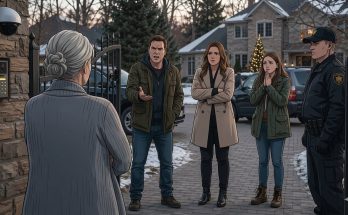
Lisa stepped toward the intercom.
“Mom, please. We drove all the way here.”
I looked at her face on the monitor.
For one brief second, I saw the little girl who used to crawl into my bed after thunderstorms.
Then I remembered the hospital.
The unanswered calls.
The questions about my money.
The way all three of them had told me to figure my own life out.
“I didn’t invite you,” I said.
Jennifer’s voice became sharper.
“You can’t lock your own children out of your house.”
“I can.”
Michael shouted from the gate.
“You’ve lost your mind!”
My security officer remained between him and the entrance.
“Sir, you need to return to your vehicle.”
Michael pointed toward the house.
“That’s my mother!”
“And this is private property.”
Lisa began crying.
Not quietly.
Loud enough for everyone to hear.
“Mom, what happened to you?”
I almost laughed.
What happened to me?
Nothing.
That was the problem.
For seventy-two years, I had been the one expected to change.
The one expected to forgive.
The one expected to understand.
This time, I had simply stopped.
Jennifer wiped her eyes and stepped closer to the camera.
“Mom, can we at least talk?”
I hesitated.
Then I pressed the button.
“Five minutes.”
The gate remained closed.
They were not coming inside.
Jennifer, Michael, and Lisa walked toward the small pedestrian entrance beside the gate, where I had a second camera.
My security officer stood several feet away.
I opened the front door.
Cold December air rushed into the foyer.
They stopped at the bottom of the walkway.
Nobody spoke.
Finally Jennifer said, “Why are you doing this?”
I looked at her.
“You told me to stop calling.”
“That was months ago.”
“It was three months ago.”
“Exactly.”
“You haven’t called me once since.”
She looked uncomfortable.
“That’s not the point.”
“It is to me.”
Michael shoved his hands into his coat pockets.
“We thought you needed space.”
“No. You wanted space.”
He rolled his eyes.
“Mom, we’re not doing this.”
“You already did.”
Lisa sniffed.
“We came for Christmas.”
“No,” I said. “You came because you thought something was waiting for you here.”
Their faces changed.
Jennifer looked at Michael.
Michael looked at Lisa.
That tiny exchange told me more than any confession could have.
I crossed my arms.
“What were you expecting?”
Nobody answered.
So I did.
“My house?”
Silence.
“My accounts?”
Nothing.
“My life insurance?”
Lisa looked down.
There it was.
I felt something inside me become very still.
“I knew it,” I whispered.
Jennifer immediately stepped forward.
“You’re misunderstanding.”
“Then explain it.”
She opened her mouth.
Closed it.
Michael finally spoke.
“We were going to talk to you about getting your affairs organized.”
“They are organized.”
“What does that mean?”
“It means you’re not involved.”
His expression hardened.
“You’re making a huge mistake.”
“No.”
I looked at him.
“I made my mistake when I believed that being your mother meant I had to keep proving my worth.”
Michael shook his head.
“This is unbelievable.”
“You’re right.”
I stepped back.
“It is.”
Then I closed the door.
Behind it, I heard Lisa crying.
I stood in the foyer for several seconds.
My hands were shaking.
Not from fear.
From grief.
I had imagined this moment for three months.
I had thought I would feel powerful.
Instead, I felt like a mother standing behind a locked door while her children stood outside.
That hurt.
But pain didn’t mean I had made the wrong decision.
I walked back into the kitchen.
The Christmas tree lights reflected against the windows.
Richard had always loved Christmas.
He would put the tree up the day after Thanksgiving and complain every year that the lights had somehow become tangled since the previous Christmas.
I smiled at the memory.
Then my phone rang.
Thomas Brennan.
My attorney.
“Thomas?”
“Maggie, I need you to come to my office.”
My stomach tightened.
“Today?”
“Yes.”
“Is something wrong?”
“I don’t want to discuss this over the phone.”
I looked through the window.
My children were still standing outside.
“Does this have something to do with them?”
There was a pause.
“Yes.”
I straightened.
“What did they do?”
“I’ll explain when you get here.”
Twenty minutes later, I was sitting across from Thomas in his office downtown.
A thick folder sat on his desk.
He didn’t open it immediately.
Instead, he studied my face.
“Are you all right?”
“No.”
He nodded.
“That’s understandable.”
“What happened?”
Thomas slid the folder toward me.
“Three weeks ago, someone contacted my office asking questions about your estate.”
“Who?”
“An attorney representing Jennifer.”
I stared at him.
“Jennifer hired a lawyer?”
“Apparently.”
“Why?”
“That is what concerned me.”
I opened the folder.
Inside was a letter.
The words were polite.
Professional.
Cold.
It requested information regarding my capacity to manage my financial affairs.
My fingers tightened around the paper.
“They think I’m incompetent?”
Thomas shook his head.
“They’re trying to establish whether they can challenge decisions you’ve made.”
I looked up.
“Because I changed my will.”
“Yes.”
“And because I changed my beneficiaries.”
“Yes.”
I laughed once.
There was nothing funny about it.
“They told me to figure my life out myself.”
Thomas leaned back.
“And now they’re trying to figure out your estate for you.”
I looked down at the papers again.
“What can they do?”
“Not much if your documents are sound.”
“If?”
Thomas became serious.
“That’s why I asked you to come in.”
He opened another section.
“When we made your changes, you were very clear about your intentions. But your children could argue that you were under emotional distress after the hospital incident.”
“They can say whatever they want.”
“They can.”
He tapped the page.
“But I anticipated that.”
I looked at him.
“What did you do?”
“I arranged for you to undergo an independent capacity evaluation.”
I blinked.
“When?”
“Two months ago.”
I remembered.
Thomas had told me I needed a routine medical appointment for my records.
I hadn’t questioned it.
“The doctor documented that you were fully capable of understanding your finances, property, and estate decisions.”
A strange sense of relief moved through me.
Thomas continued.
“And there’s more.”
He pulled out another document.
“Your children have been making inquiries about the house.”
“I know.”
“No. I don’t think you do.”
He turned the document around.
“This isn’t simply about inheritance.”
I read the page.
Then read it again.
My house had been listed as an asset in a loan application.
My name was not on the application.
But the property address was.
My heart began beating faster.
“Whose loan?”
Thomas pointed to the signature.
“Michael’s.”
I stared at his name.
Michael had used my property as part of a financial application.
Without permission.
“How?”
“He apparently represented that he had an ownership interest or expected inheritance interest in the property.”
I felt sick.
“Expected inheritance?”
Thomas nodded.
“That is what he claimed.”
I leaned back.
“So they didn’t just assume they’d inherit.”
“No.”
“They were already using my house as if it belonged to them.”
“Yes.”
I closed my eyes.
For years, I had wondered why Michael asked so many questions about the mortgage.
How much was left.
What the property taxes were.
Whether I had refinanced.
Whether Richard had ever put his name on certain documents.
I had thought he was being curious.
He wasn’t.
He had been collecting information.
Thomas watched me carefully.
“Maggie, there’s one more issue.”
I opened my eyes.
“What?”
“Your daughter Lisa contacted a realtor.”
“For what?”
“To discuss selling the property after your death.”
I stared at him.
“She contacted a realtor?”
“Yes.”
“Recently?”
“About six weeks ago.”
I slowly shook my head.
“They’ve been planning this for months.”
Thomas didn’t answer.
He didn’t need to.
The pieces were finally fitting together.
The sudden Christmas visit.
The talk about my future.
The insistence that I needed somewhere more manageable.
The questions about my money.
The old gate code.
The confidence with which Michael had tried to enter my property.
They hadn’t come to celebrate Christmas.
They had come to inspect what they believed they were going to inherit.
And now they were angry because I had changed the rules.
I looked at Thomas.
“What happens if they challenge my estate?”
“We fight it.”
“And if they try to force me to sell?”
“They can’t.”
“What if they say I’m incapable?”
“They’ll have to prove it.”
I nodded slowly.
“Then let them try.”
Thomas smiled faintly.
“That’s the Maggie I remember.”
I almost smiled back.
Then his expression changed.
“I should also tell you something else.”
“What?”
“Richard left a separate document.”
My breath caught.
“My husband?”
“Yes.”
“What kind of document?”
Thomas opened a small envelope.
“I found it while reviewing old estate records.”
He handed it to me.
My name was written across the front in Richard’s handwriting.
I hadn’t seen that handwriting in years.
My fingers trembled.
“Why didn’t you give this to me before?”
“Because it was sealed.”
“And?”
“He instructed me to deliver it only if there was a significant dispute involving the house.”
I looked at the envelope.
“Is there?”
Thomas gave me a long look.
“Yes.”
I opened it carefully.
Inside was a single sheet of paper.
Richard’s words were short.
Maggie,
If you’re reading this, something has happened involving the house.
Don’t trust anyone who tells you that keeping the house is selfish.
I left something important behind.
It isn’t money.
It isn’t in the bank.
And it isn’t something our children know about.
My hands stopped moving.
Thomas watched me.
I read the final line.
Look behind the old basement wall beneath the stairs. There is a reason I never let anyone renovate that section.
I stared at the paper.
“Thomas.”
“Yes?”
“Did you know about this?”
“No.”
“Then what is behind that wall?”
“I don’t know.”
My mind raced.
Richard had been secretive about very little.
But there had always been one part of the basement he refused to let anyone touch.
The narrow wall beneath the stairs.
When contractors came to replace the furnace, Richard had stood in front of it and said:
“Not that section.”
I had asked why.
He always answered the same way.
“Just leave it.”
I thought it was an old man’s stubbornness.
Now I wasn’t so sure.
I drove home before dark.
My children were gone.
The gate was silent.
I parked in the garage and went inside.
The house felt different.
Not because anything had changed.
Because I knew something was hidden inside it.
I went downstairs.
The basement smelled faintly of cedar and dust.
I stood beneath the staircase.
There it was.
The wall Richard had protected for years.
I ran my fingers along the wood paneling.
Nothing.
Then I noticed something.
One panel was slightly different from the others.
I pressed it.
It moved.
My heart began pounding.
I pulled the panel toward me.
Behind it was a narrow recessed space.
And inside that space was a metal box.
Old.
Heavy.
Locked.
There was a small brass key taped to the top.
Richard’s handwriting was on another note.
Maggie,
Before you open this, understand one thing.
The children are not the only people who may come looking for what is inside.
I froze.
Then I heard something upstairs.
A door closing.
I stood completely still.
Someone was in my house.
I grabbed the metal box and held it against my chest.
Footsteps moved across the kitchen floor.
Slow.
Careful.
Then a man’s voice called from above.
“Maggie?”
My blood ran cold.
It wasn’t Michael.
It wasn’t Thomas.
It was someone I hadn’t heard from in years.
Richard’s younger brother.
Daniel.
And the next thing he said made me realize the secret in that box was much bigger than my children’s inheritance.

One Comment on “PART 3 – My Children Told Me, ” We Have Our Own Lives.” So I Stopped Calling Them__and Changed My Will”