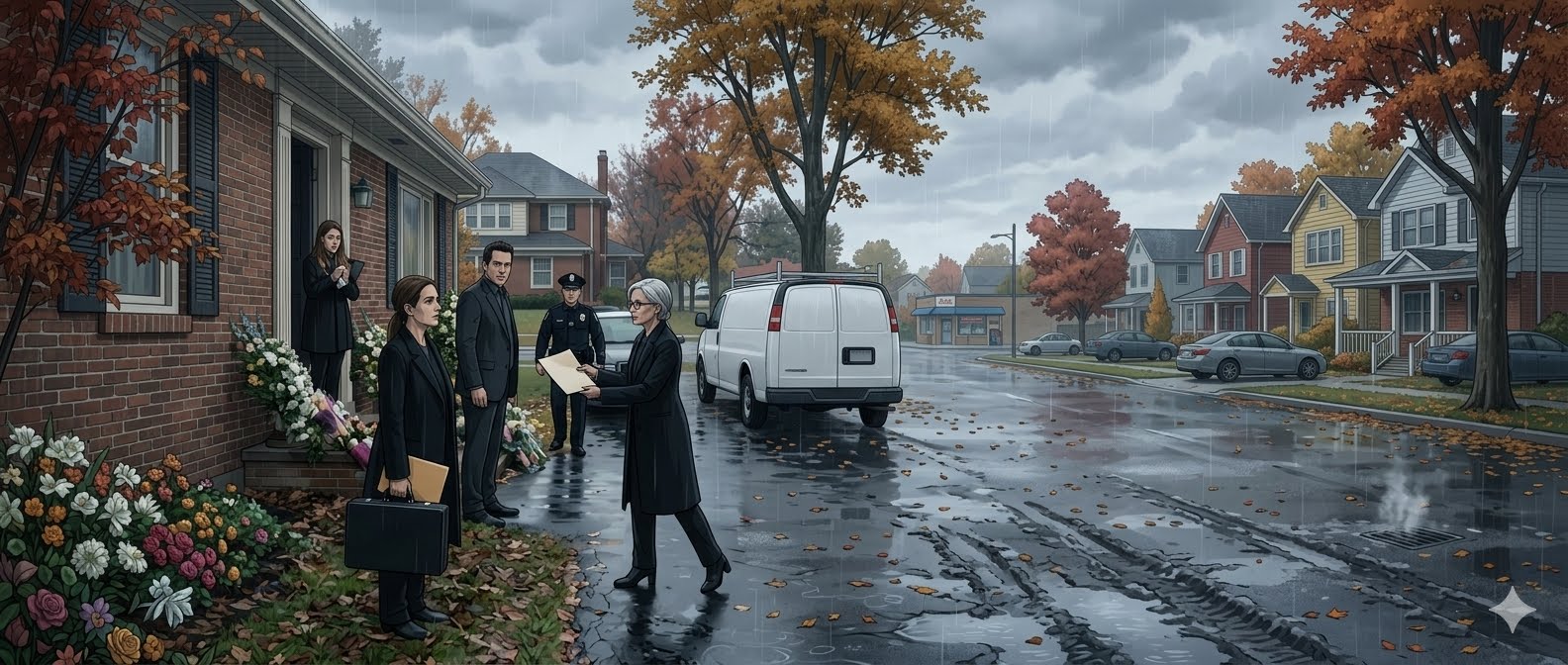
Gerald stared at the lawyer.
“What does that have to do with anything?” he repeated.
The lawyer didn’t answer immediately.
Instead, he slowly pulled the remaining papers from the manila envelope Ruth had left behind.
There were far more pages than either of us had expected.
Some were handwritten.
Others were neatly organized copies from the bank.
One page had yellow sticky notes attached in Ruth’s careful handwriting.
The lawyer flipped to the second document.
His eyebrows rose.
“When exactly,” he asked quietly, “did your mother give you signing authority?”
Gerald folded his arms.
“I told you. She couldn’t keep up with everything anymore.”
“What year?”
“I don’t remember.”
“You signed the paperwork.”
“I said I don’t remember.”
The lawyer glanced down again.
“It says March of 2020.”
Gerald shrugged.
“If that’s what it says.”
The lawyer turned another page.
“And according to this…”
He stopped reading.
His expression changed.
Not dramatically.
Just enough that I recognized the look.
It was the same face my husband used to make when a repair that should have cost fifty dollars suddenly became five thousand.
The kind of face that said something didn’t add up.
“What?” Gerald asked.
The lawyer looked at him.
“Did your mother authorize monthly electronic transfers to your personal account?”
Gerald answered too quickly.
“She helped me sometimes.”
“Every month?”
“There were circumstances.”
“For almost three years?”
Silence.
The lawyer slid one page across the porch.
I caught a glimpse before Gerald grabbed it.
Rows and rows of transactions.
The same amount.
Every month.
Like clockwork.
Eight hundred dollars.
Eight hundred.
Eight hundred.
Eight hundred.
Month after month.
Gerald looked up.
“That was repayment.”
“For what?”
“The things I bought her.”
The lawyer held out another sheet.
“According to these records, those transfers began four months before the first purchase you listed.”
Gerald blinked.
“I…”
“You also described every transfer as ‘Home Maintenance.’”
“So?”
“The bank records show no payments to contractors.”
Gerald’s jaw tightened.
“I did the work myself.”
The lawyer looked around the property next door.
The porch railing still leaned.
The gutters sagged.
Half the shutters were hanging loose.
Grass pushed through the cracked walkway.
It wasn’t the picture of a home that had received years of careful maintenance.
“I see,” the lawyer said.
For the first time since arriving, his voice had lost its confidence.
Instead of questioning me…
He was questioning his own client.
Gerald shoved the papers back.
“My mother knew exactly what those payments were.”
“I hope that’s true,” the lawyer replied quietly.
“Because if it isn’t…”
He didn’t finish.
He didn’t need to.
The silence said enough.
Then he unfolded the final handwritten letter.
Unlike the others, this one wasn’t addressed to a bank.
It wasn’t addressed to me either.
Across the front, in Ruth’s neat blue handwriting, were seven words.
To Be Read Only If Gerald Challenges My Will.
Neither of them spoke.
The lawyer carefully opened the letter.
Only halfway through the first paragraph…
He stopped reading.
He slowly removed his glasses.
Then he looked directly at Gerald.
“When your mother wrote this,” he said softly, “she specifically instructed me to contact the county’s Elder Financial Protection Unit before responding to any legal challenge.”
Gerald’s face lost every trace of color.
“What?”
The lawyer swallowed.
“She didn’t think someone had manipulated her.”
He looked down at the letter once more.
“She believed someone had been stealing from her.”
Gerald took one step backward.
Then another.
His voice barely came out.
“Who… who did she think that was?”
The lawyer met his eyes.
“I don’t think that’s the right question anymore.”
He folded the letter with extraordinary care.
“I think the question is…”
“…how much did she already prove?”
PART 4
THE LEDGER RUTH KEPT FOR THREE YEARS
For several seconds, nobody spoke.
The neighborhood seemed strangely quiet.
Even the birds that usually crowded Ruth’s maple tree had gone silent.
Gerald was the first to move.
“This is ridiculous,” he snapped. “My mother was confused. She forgot things all the time.”
The lawyer looked at him carefully.
“She occasionally forgot appointments,” he said. “That’s very different from forgetting where her money went.”
Gerald laughed once.
A short, nervous laugh.
“So now we’re taking the word of a dead woman over her own son?”
“No,” the lawyer replied.
“We’re taking the word of documents.”
He reached back into the envelope.
“I don’t believe these were all meant to be opened today.”
“What do you mean?” I asked.
He held up three smaller envelopes.
Each one had a date written neatly across the front.
January 14, 2023.
August 3, 2024.
October 18, 2025.
Each was sealed with the same careful handwriting.
Ruth had prepared them over nearly three years.
The lawyer frowned.
“She updated the file.”
Gerald folded his arms.
“Or someone updated it for her.”
The lawyer ignored him.
Instead, he opened the oldest envelope.
Inside was a small black notebook.
Not expensive.
Just one of those pocket ledgers people used before everything lived on a phone.
He flipped it open.
Every page contained the same neat handwriting.
Every expense.
Every deposit.
Every withdrawal.
Every phone call with the bank.
Every conversation about money.
Every page was dated.
Every entry was signed.
Sometimes Ruth even wrote the weather.
I recognized the notebook immediately.
She used to carry it in the pocket of her cardigan.
I had always assumed it was her grocery list.
It wasn’t.
It was a financial diary.
The lawyer stopped on one page.
He read silently.
Then he turned to another.
His forehead tightened.
“What is it?” I asked.
He handed me the notebook.
Halfway down the page, Ruth had written:
Gerald says I already paid him back. I don’t remember borrowing from him. Must ask the bank tomorrow.
The next day’s entry read:
Bank says transfer made online. I did not do it online. Gerald says I forgot.
Another page.
Changed my banking password today. Gerald became upset.
Another.
Password changed again. I did not change it. Must write everything down now.
The lawyer slowly closed the notebook.
“When was your mother’s computer replaced?” he asked.
Gerald blinked.
“What?”
“Her computer.”
“I don’t know.”
“It says here you bought her a new laptop for Christmas.”
“So?”
“And according to this notebook…”
He opened another page.
“…she never learned how to use it.”
Gerald looked away.
“She wasn’t good with computers.”
“Yet somehow,” the lawyer continued, “every disputed transfer was completed through online banking.”
The color drained from Gerald’s face.
“I helped her.”
“Did she watch you?”
“Sometimes.”
“Every time?”
Gerald didn’t answer.
The lawyer looked toward Ruth’s quiet house.
“I think we should stop talking.”
Gerald frowned.
“What?”
“I think we should start verifying.”
He took out his phone.
“I’m calling the bank’s fraud department.”
Gerald stepped forward immediately.
“That’s completely unnecessary.”
“Is it?”
“My mother’s dead.”
“Yes.”
“So what difference does it make now?”
The lawyer looked at him for a long moment.
“It makes all the difference.”
He pressed the call button.
Gerald suddenly reached out.
“Wait.”
The lawyer lowered the phone.
“There… there’s something I forgot to mention.”
Neither of us spoke.
Gerald rubbed both hands across his face.
“I…”
His voice cracked.
“I wasn’t the only person who had access to her accounts.”
The lawyer’s eyes narrowed.
“Who else?”
Gerald swallowed hard.
Then he quietly said two words that made my stomach drop.
“My sister.”
I stared at him.
“Ruth didn’t have a daughter.”
Gerald slowly shook his head.
“No.”
He looked at the ground.
“Not the kind you’re thinking of.”
PART 5
THE DAUGHTER NO ONE KNEW ABOUT
The porch fell completely silent.
Even the lawyer looked confused.
“You just said your mother didn’t have a daughter,” I said.
“I said…” Gerald replied carefully, “…not the kind you’re thinking of.”
The lawyer slipped his phone back into his pocket.
“I think you’d better explain.”
Gerald rubbed his forehead.
“When my father was alive, they took in a girl for several years.”
“A foster child?” I asked.
He nodded.
“Her name was Linda.”
The name meant nothing to me.
I had lived next door to Ruth for nearly twelve years.
I had shared tomatoes from my garden with her.
I had shoveled her walkway after snowstorms.
I had driven her to doctor’s appointments.
Never once had she mentioned a Linda.
“How old was she?” the lawyer asked.
“About nine when she came.”
“And when did she leave?”
“Six years later.”
“Did your parents adopt her?”
“No.”
“So why call her your sister?”
Gerald looked uncomfortable.
“Because that’s what she felt like.”
The lawyer made a note.
“Last name?”
“I don’t know what she uses now.”
“You haven’t spoken in years?”
“No.”
“Does she have access to your mother’s finances?”
Gerald hesitated.
“I… don’t know.”
The lawyer’s eyes narrowed.
“A moment ago you said she had access.”
“I said she wasn’t the only person.”
“Those are two very different statements.”
Gerald opened his mouth.
Then closed it again.
I watched him carefully.
He wasn’t remembering.
He was choosing.
Choosing which version of the truth sounded safest.
The lawyer turned another page of Ruth’s notebook.
“There are names here.”
He ran his finger down the margin.
“Gerald.”
Another line.
“Gerald.”
Another.
“Gerald.”
Then he stopped.
“There.”
He looked up.
“‘Linda called today. She says I should never sign anything without reading every page first.’”
Gerald’s head snapped toward the notebook.
“What?”
The lawyer continued reading.
“‘She worries Gerald is rushing me. I told her he means well, but I promised to be careful.’”
My heart skipped.
“So Linda did stay in touch,” I said.
Gerald didn’t answer.
The lawyer kept reading.
“‘Linda offered to review any papers before I signed them. Must remember to tell Gerald not to be offended.’”
He slowly closed the notebook.
“Interesting.”
“What?”
“Your mother trusted Linda enough to review legal documents.”
Gerald looked away.
“They barely talked.”
“According to this notebook…”
He tapped the cover gently.
“…they talked more than you realized.”
Just then, something slipped from between the notebook’s pages.
A photograph.
It landed face-up on my porch.
I bent down and picked it up.
It showed Ruth standing in front of her garden, smiling wider than I had ever seen.
Beside her stood a teenage girl with dark curls, one arm wrapped around Ruth’s shoulders.
On the back, written in blue ink, were the words:
‘My two children. One by birth. One by choice.’
Gerald’s breathing became noticeably heavier.
The lawyer held out his hand.
“May I?”
I passed him the photograph.
He studied the back for a long moment.
Then he noticed something tucked behind it.
A folded receipt.
No.
Not a receipt.
A deposit slip.
The lawyer unfolded it carefully.
His expression changed again.
“This…”
He looked from the paper to Gerald.
“…isn’t a personal account.”
“What is it?” I asked.
He turned the slip so both of us could see.
Across the top, beneath the bank’s logo, was a handwritten note in Ruth’s unmistakable script.
‘Emergency Records Fund. Opened after the first transfer disappeared. Linda knows where the second ledger is.’
Gerald’s eyes widened.
“The second… ledger?”
The lawyer folded the paper with deliberate care.
“I don’t think your mother expected one investigation.”
He looked toward Ruth’s quiet house.
“I think she expected two.”
“And if this note is accurate…”
He met Gerald’s gaze.
“…there is another book somewhere.”
“A book,” Gerald whispered, “that neither of us has seen.”
The lawyer gave a slow nod.
“And if Ruth hid it…”
“…she probably hid it where only Linda would know to look.”
PART 6
THE ATTIC THAT HAD BEEN LOCKED FOR FIFTEEN YEARS
Gerald was already shaking his head.
“There is no second ledger.”
The lawyer slipped the deposit slip back into the notebook.
“Then proving that should be simple.”
“I’ve been through that house.”
“Recently?”
“After the funeral.”
“What were you looking for?”
“My mother’s insurance papers.”
The lawyer watched him for a long moment.
“And did you find them?”
“No.”
“Interesting.”
Gerald frowned.
“Why?”
“Because according to this notebook, your mother kept her insurance documents in the top drawer of the dining room buffet.”
Gerald’s face stiffened.
“I must have overlooked them.”
The lawyer didn’t argue.
Instead, he looked toward Ruth’s front porch.
“Mrs. Doyle.”
“Yes?”
“When was the last time you were inside her house?”
“The afternoon before she passed.”
“Were there any rooms she kept locked?”
I thought about it.
“There was one.”
Gerald immediately interrupted.
“The attic.”
I turned toward him.
“You knew about it?”
“My father always kept it locked.”
The lawyer looked from one of us to the other.
“Did your mother ever go up there?”
“Only once every few months,” I said.
“Usually carrying a small box.”
“What kind of box?”
“Metal.”
“Like a toolbox?”
“No.”
I smiled faintly despite everything.
“It was an old recipe tin.”
Blue.
With little white flowers painted across the lid.
I’d seen it dozens of times.
Ruth always carried it herself.
Never let anyone else hold it.
The lawyer made another note.
“And after she came back down?”
“She always locked the attic again.”
Gerald crossed his arms.
“That attic is full of junk.”
“Have you been inside?”
“Years ago.”
“And after your father died?”
“No.”
The lawyer nodded slowly.
“So neither of you actually knows what’s up there.”
Before anyone could answer, a pickup truck pulled into Ruth’s driveway.
A woman stepped out wearing county maintenance overalls.
She carried a ring of keys clipped to her belt.
She looked at the three of us, then at the open notebook in the lawyer’s hands.
“I hope I’m not interrupting.”
The lawyer introduced himself.
She nodded politely.
“My name is Denise Walker.”
“I work for the county housing office.”
“What brings you here?” Gerald asked.
“I came to change the water account.”
His words stopped her.
“The account should transfer to the estate.”
She opened her tablet.
“Actually…”
She frowned.
“That’s strange.”
“What?”
“The account isn’t in Ruth Harper’s name.”
Gerald looked confused.
“Of course it is.”
Denise shook her head.
“It hasn’t been.”
She tapped the screen again.
“The account holder since April of 2019 has been…”
She looked up at me.
“…Margaret Doyle.”
Gerald spun toward me.
“You put the account in your own name?”
“I told the county to bill me.”
“You never told anyone?”
“There wasn’t anyone to tell.”
Denise looked between us.
“I remember this.”
“You do?” I asked.
She smiled gently.
“Mrs. Harper came into our office a few weeks later.”
Gerald stared at her.
“My mother knew?”
“Oh, yes.”
“She insisted on paying us back.”
My heart skipped.
“She did?”
Denise nodded.
“I told her the account holder wouldn’t accept reimbursement.”
The lawyer looked at me.
“You refused?”
“I did.”
Denise smiled again.
“I’ve never forgotten what Mrs. Harper said.”
“What did she say?” I asked softly.
“‘Then don’t tell her I cried.’”
No one spoke.
Denise’s eyes became a little watery.
“She said she hadn’t realized anyone still noticed whether she had water.”
The silence settled over all of us.
Then Denise reached into her folder.
“Oh.”
“I almost forgot.”
She removed a small envelope.
“This was left with our office almost two years ago.”
The lawyer frowned.
“Left by whom?”
“Mrs. Harper.”
Across the front, in Ruth’s familiar handwriting, were the words:
For Whoever Finally Starts Asking the Right Questions.
The lawyer carefully took the envelope.
He turned it over.
The seal had never been broken.
But in the lower-right corner, Ruth had written one final sentence that made all four of us stare.
“Before you open this, check the attic beam above the old cedar trunk.”
PART 7
THE CEDAR TRUNK UNDER THE RAFTERS
No one moved.
The little envelope seemed heavier than paper should have been.
The lawyer looked from the handwritten instruction to the house.
“I don’t think Ruth wanted this opened first.”
He slipped it carefully into his briefcase.
“I think she wanted us to follow directions.”
Gerald let out an impatient sigh.
“This is insane.”
“Is it?”
“My mother’s gone.”
“Yes.”
“So we’re chasing clues in an attic because of a sentence on an envelope.”
The lawyer closed his briefcase.
“No.”
“We’re following the instructions of a woman who spent three years documenting her finances.”
He looked directly at Gerald.
“So far, every instruction she’s left has led us to something real.”
Gerald didn’t answer.
For the first time since he’d arrived, he looked uncertain instead of angry.
“I have a key,” I said quietly.
Both men turned toward me.
“Ruth gave it to me last winter.”
“You never mentioned that,” Gerald said sharply.
“You never asked.”
I reached into my sweater pocket.
The small brass key was still attached to the faded blue ribbon Ruth had tied around it.
She had pressed it into my hand after one of her doctor’s appointments.
“If anything ever happens to me before Gerald gets here,” she’d whispered, “don’t let strangers wander through my house.”
I had promised.
I hadn’t expected that promise to matter.
The front door opened with the same soft creak it always had.
The familiar scent greeted me immediately.
Lavender.
Old books.
Freshly polished wood.
Even after eleven days, it still smelled like Ruth.
Gerald stepped inside without saying a word.
His eyes wandered around the living room.
Everything was exactly where his mother had left it.
The crocheted blanket over the armchair.
The half-finished crossword puzzle beside her reading glasses.
A knitting basket with a ball of blue yarn still threaded through the needles.
It suddenly didn’t feel like evidence.
It felt like someone had simply stepped outside for a walk.
The attic stairs folded down from the hallway ceiling.
Gerald climbed first.
The lawyer followed.
I came last.
Dust floated through the narrow beam of sunlight coming from the small round window.
The attic wasn’t full of junk.
It was full of memories.
Boxes labeled Christmas.
Old photo albums.
Army uniforms that must have belonged to Ruth’s husband.
A baby cradle.
Shelves of carefully labeled jars.
Nothing looked abandoned.
Everything looked intentionally preserved.
“There,” I said.
Against the far wall sat the old cedar trunk.
Exactly where it had always been.
Above it stretched one thick wooden support beam.
The lawyer climbed onto a short ladder.
He ran his fingers along the top edge.
For nearly a minute…
Nothing.
Then—
“Wait.”
He reached farther back.
“I feel something.”
Gerald stepped closer.
The lawyer slowly pulled out a narrow metal box wrapped in brown wax paper.
Years of dust covered it.
The faded masking tape across the top carried just four handwritten words.
Open With Witnesses Present.
The lawyer looked at both of us.
“I think that’s us.”
He carefully broke the tape.
Inside lay three items.
A small leather ledger.
A bundle of bank statements tied with green ribbon.
And a VHS cassette.
Gerald frowned.
“A videotape?”
The lawyer lifted it out.
A white label had been attached to the front.
Written across it in Ruth’s unmistakable handwriting were the words:
If you’re watching this, I was right.
None of us spoke.
The lawyer placed the cassette back in the box.
“We’ll need someone who can transfer this.”
I picked up the leather ledger.
Unlike the first notebook, this one wasn’t a diary.
Every page contained dates…
Check numbers…
Transfer confirmations…
And tiny initials beside nearly every entry.
The lawyer leaned over my shoulder.
“What are those letters?”
I traced the first column with my finger.
“GH.”
Another page.
“GH.”
Another.
“GH.”
Page after page.
The same two initials.
Gerald swallowed.
“That… could mean anything.”
The lawyer didn’t respond.
Instead, he turned to the final page.
Folded into the back cover was a single sheet of lined paper.
Across the top Ruth had written:
People deserve proof, not accusations.
Below it was a numbered list.
Evidence stored in five places.
- Attic ledger. ✓
- County records.
- First National Bank safe-deposit box.
- Video testimony.
- Attorney Margaret Ellis.
The lawyer stopped reading.
He looked up slowly.
“Gerald…”
“What?”
“You told me your mother never hired an attorney.”
“I…”
His voice faltered.
“I didn’t know she had.”
The lawyer folded the paper again.
“I believe she did.”
He took one long breath.
“And judging by this list…”
“…we’ve only found the first piece of what she intended us to see.”
PART 8
THE LAWYER RUTH NEVER TOLD HER SON ABOUT
None of us spoke for nearly a full minute.
The attic suddenly felt smaller.
The little leather ledger rested in the lawyer’s hands like it weighed a hundred pounds.
Finally, Gerald broke the silence.
“I’ve never heard of Margaret Ellis.”
The lawyer looked at him.
“Are you certain?”
“I’m her son.”
“That wasn’t my question.”
Gerald frowned.
“I said I’ve never heard of her.”
The lawyer carefully placed everything back into the metal box except the handwritten list.
“We’re not taking chances.”
He pulled out his phone.
“I’m calling her office.”
“You can’t.”
Gerald’s voice came out sharper than he intended.
The lawyer slowly looked up.
“And why not?”
“Because… because my mother’s dead.”
“Yes.”
“So none of this matters anymore.”
The lawyer’s expression hardened.
“When someone spends three years preserving financial records, hires an attorney without telling her only child, hides evidence in an attic, and leaves written instructions after her death…”
He paused.
“…it matters a great deal.”
He searched for the name.
A few seconds later, he found it.
Margaret Ellis.
Still practicing.
Less than twenty miles away.
The lawyer pressed the speaker button.
The phone rang twice.
Then a calm woman’s voice answered.
“Ellis Legal Group.”
“My name is Daniel Brooks. I’m an attorney representing the Estate of Ruth Harper.”
There was a pause.
Then the receptionist asked quietly,
“Has Mrs. Harper passed away?”
“She has.”
“I’m very sorry to hear that.”
“So are we.”
Another pause.
“I believe Ms. Ellis has been expecting this call.”
The lawyer looked up.
“What do you mean?”
“Mrs. Harper instructed us several years ago that if anyone ever contacted us regarding her estate, we were to ask only one question.”
The lawyer exchanged a glance with me.
“What question?”
The receptionist spoke slowly.
“Did they find the attic ledger?”
No one in the attic breathed.
The lawyer answered.
“Yes.”
“I’ll connect you.”
A moment later another voice came onto the line.
Older.
Confident.
“This is Margaret Ellis.”
“Ms. Ellis, I’m calling regarding Ruth Harper.”
“I know.”
“You do?”
“I’ve been waiting.”
The lawyer looked stunned.
“Mrs. Harper retained me in early 2022.”
“For what purpose?”
“To protect evidence.”
Gerald suddenly stepped closer.
“What evidence?”
There was silence on the phone.
Then Ms. Ellis asked,
“Who just spoke?”
“Gerald Harper.”
Another pause.
When she spoke again, her tone had changed completely.
“Mr. Harper…”
“…is anyone recording this conversation?”
“No.”
“Good.”
“Because I won’t discuss your mother’s evidence until I confirm something.”
“What?”
“Were you the person who insisted on handling all of her banking after March of 2020?”
Gerald froze.
“I helped my mother.”
“That wasn’t my question.”
“I…”
“I’ll take that as a yes.”
The lawyer cleared his throat.
“Ms. Ellis, can you explain why Ruth hired you?”
“I can explain part of it.”
“What part?”
“The part she authorized before her death.”
The attorney opened a folder on her end.
I could hear paper turning.
“On February 18, 2022, Ruth Harper told me these exact words.”
She read carefully.
“If my son ever accuses Margaret Doyle of influencing me, it means he still believes nobody knows what happened to my money.”
The attic became so quiet that I could hear the old rafters creaking overhead.
Gerald whispered,
“My mother said that?”
“Yes.”
“And she added something else.”
“What?”
Ms. Ellis took a slow breath.
“She said, ‘The money is important… but it isn’t what I’m trying to protect.’”
The lawyer frowned.
“If not the money…”
“What was she protecting?”
There was another long pause.
Then Ms. Ellis answered.
“A person.”
I felt a chill run through me.
“A person?”
“Yes.”
“Who?”
“I’m afraid I can’t answer that.”
“Why not?”
“Because Ruth left very specific instructions.”
“What instructions?”
“If the attic ledger was found…”
“…the next item must be recovered before any names are spoken.”
The lawyer looked down at Ruth’s handwritten list.
“Item number two?”
“No.”
“Then what?”
Ms. Ellis’s voice grew even quieter.
“There was one instruction Ruth never wrote down.”
“What was it?”
“Before anyone opens the safe-deposit box…”
“…you need to check the grandfather clock in her living room.”
I stared toward the attic stairs.
“The clock?”
“Open the back panel.”
“You’ll find an envelope taped inside.”
The lawyer asked one final question.
“What’s in the envelope?”
Ms. Ellis answered without hesitation.
“The reason Ruth stopped trusting someone she loved.”
Then the line went dead.
PART 9
THE LETTER HIDDEN INSIDE THE GRANDFATHER CLOCK
For a long moment, none of us moved.
The only sound in the house was the steady ticking of Ruth’s grandfather clock.
Tick.
Tick.
Tick.
It had stood in the corner of her living room for as long as I had known her.
Every Sunday afternoon, she wound it by hand.
She once told me, “If that clock ever stops, you’ll know something is terribly wrong.”
Now it was still keeping perfect time.
The lawyer closed his phone.
“I don’t think we should delay.”
Gerald looked exhausted.
“This is getting out of hand.”
“No,” the lawyer said quietly.
“It’s getting closer to the truth.”
We walked downstairs together.
The living room looked exactly as we had left it.
Late afternoon sunlight stretched across the hardwood floor.
Dust floated through the golden light.
The grandfather clock stood against the far wall, polished oak glowing softly.
The lawyer knelt beside it.
“There should be a small access panel.”
I pointed toward the back.
“Ruth always opened it from behind.”
He carefully turned the clock away from the wall.
A narrow wooden panel came free with almost no effort.
Inside were the pendulum…
The brass weights…
And something else.
A white envelope.
It had been taped neatly to the inside wall.
Across the front, in Ruth’s unmistakable handwriting, were five simple words.
Read Before Judging Anyone.
The lawyer looked at Gerald.
“I think your mother wanted all of us to hear this.”
He opened the envelope carefully.
Inside was a single handwritten letter.
He began reading aloud.
If this letter is being read, then I am gone, and Gerald believes Margaret Doyle somehow tricked me.
She did not.
Margaret never asked me for a dollar. She never asked to be included in my will. In fact, she spent years hiding her kindness because she knew I was too proud to accept it openly.
I lowered my eyes.
I had never expected Ruth to write about the water bill.
The lawyer continued.
If you are looking for the person who changed my mind, look in the mirror before you look next door.
Gerald’s shoulders stiffened.
The lawyer kept reading.
My son was not born dishonest. That is important. He became careless first. Then entitled. Those are not the same thing, but one often becomes the other.
Gerald whispered,
“Mom…”
No one interrupted.
The first time money disappeared, I believed it was a banking mistake. The second time, I believed I had forgotten something. The third time, I began writing everything down.
The lawyer paused.
He looked at Gerald before continuing.
I never wanted my son arrested. I wanted him to stop. Every conversation became another promise that things would be different. They never were.
Gerald sank into Ruth’s old armchair.
He covered his face with both hands.
“I tried to pay some of it back,” he said hoarsely.
The lawyer didn’t respond.
Instead, he finished the page.
If Gerald is reading this, then I hope he understands something I could never make him believe while I was alive. I loved him every single day. Love is why I kept giving him chances. But love is not permission to ignore the truth.
The room fell silent.
I felt tears gathering in my eyes.
Not because of the money.
Because Ruth had spent her final years hoping her son would choose honesty over excuses.
The lawyer folded the letter.
“I think your mother wanted reconciliation.”
Gerald nodded slowly.
“I know.”
“But she also wanted accountability.”
Gerald looked at the floor.
“I know that too.”
For the first time since he had arrived at my house, there was no anger left in his voice.
Only regret.
Then the lawyer noticed something.
“There are two pages.”
“What?”
“The letter…”
He turned it over.
A second sheet had been folded behind the first.
Unlike the heartfelt letter, this page contained only dates.
Account numbers.
Initials.
And one sentence written across the bottom in larger handwriting.
The lawyer read it twice before speaking.
“This changes everything.”
Gerald looked up.
“What now?”
The lawyer held up the page.
“These account numbers…”
He looked directly at Gerald.
“…they don’t belong to you.”
A chill swept through the room.
“What do you mean?” I asked.
“They belong to someone else.”
He pointed to the initials written beside every transfer.
Not GH.
There was one additional initial that appeared over and over again.
ME.
Gerald frowned.
“Margaret Ellis?”
The lawyer slowly shook his head.
“I don’t think so.”
He reached into the metal box from the attic and compared the handwriting on Ruth’s evidence list.
Then his expression changed.
“No…”
He whispered.
“I think we’ve all been making the same assumption.”
“What assumption?” I asked.
He looked toward the hallway where Ruth’s family photographs still hung on the wall.
“We assumed Gerald was the only person Ruth was trying to protect…”
He looked back at the mysterious initials.
“…but I think the person she was really protecting is the one we’ve never met.”
PART 10
THE NAME WRITTEN IN THE MARGIN
The room seemed to shrink around us.
The lawyer spread the second page across Ruth’s dining table.
He studied every line.
Every date.
Every account number.
Every tiny note Ruth had squeezed into the margins.
Finally, he pointed to a sentence written so lightly it was almost invisible.
“Look here.”
Gerald leaned closer.
I did the same.
Ruth had written only six words.
Never let them blame Emily.
Gerald frowned.
“Emily?”
The lawyer looked at him.
“Do you know anyone by that name?”
He hesitated.
Then he nodded once.
“I knew one.”
“Who?”
“My cousin.”
I blinked.
“You told us your mother didn’t have any close family nearby.”
“She didn’t.”
“This wasn’t her family.”
He rubbed his temples.
“Emily was my father’s niece.”
“The daughter of his younger brother.”
“I haven’t seen her in… fifteen years.”
The lawyer made another note.
“When was the last time Ruth saw her?”
“I honestly don’t know.”
I quietly spoke up.
“I do.”
Both men looked at me.
“It was four summers ago.”
Gerald stared.
“What?”
“A young woman came by on a Saturday afternoon.”
“They sat on the porch for hours.”
“I remember because Ruth baked peach pie.”
Gerald looked genuinely surprised.
“You never told me.”
“You never asked.”
The words came out more gently than before.
There was no satisfaction in saying them.
Only sadness.
The lawyer turned another page of the ledger.
“This is interesting.”
“What?”
“Several withdrawals are marked ‘E.’”
Gerald immediately shook his head.
“So?”
“So every one of those withdrawals happened on the exact same days Ruth wrote, ‘Emily visited.’”
My stomach tightened.
“You think Ruth was giving her money?”
“I don’t know.”
He tapped the page.
“But I know this.”
“The amounts don’t match the transfers to Gerald.”
He slid the ledger across the table.
“The transfers marked ‘GH’ came from online banking.”
“The withdrawals marked ‘E’ were made inside the bank.”
“Those are completely different transactions.”
Gerald frowned.
“So Emily wasn’t stealing.”
“I didn’t say that.”
“You implied it.”
“No.”
The lawyer folded his hands.
“I’m saying Ruth wanted us to notice the difference.”
Before anyone could speak again, there was a knock at the front door.
Three slow knocks.
Not loud.
Not hesitant.
Just deliberate.
We looked at one another.
“I’ll get it,” I said.
When I opened the door, a woman in her early forties stood on the porch.
She wore jeans, a navy cardigan, and carried a worn leather satchel over one shoulder.
Her eyes immediately drifted past me…
…to Ruth’s living room.
For a moment, they filled with tears.
“I was afraid I was too late,” she whispered.
“Can I help you?” I asked.
She nodded.
“My name is Emily Carter.”
Behind me, I heard Gerald’s chair scrape sharply across the floor.
The woman looked past me and saw him.
Her expression changed.
Not to anger.
To disappointment.
“You came,” she said quietly.
Gerald stared at her as though he’d seen a ghost.
“You…”
“I didn’t think you’d show.”
The lawyer stepped toward the doorway.
“Ms. Carter?”
She nodded.
“I’m Margaret Ellis’s client.”
Silence.
The lawyer’s eyebrows rose.
“Your client?”
Emily reached into her satchel.
“I received a phone call from Ms. Ellis an hour ago.”
“She told me Ruth’s attic ledger had finally been found.”
She carefully removed a thick, sealed envelope.
Unlike every other envelope Ruth had left behind…
…this one had never been in Ruth’s possession.
Across the front, in Margaret Ellis’s handwriting, were the words:
To Be Opened Only After Emily Arrives.
Gerald’s voice was barely audible.
“What’s in it?”
Emily looked at him with tired, sorrowful eyes.
“I don’t know.”
She swallowed.
“But Aunt Ruth told me one thing.”
“A week before she died.”
“What did she say?” I asked softly.
Emily tightened her grip on the envelope.
“She said…”
‘The first person everyone suspects will be innocent.’
She looked directly at Gerald.
“And the second person…”
“…will break your heart.”
PART 11
THE ENVELOPE MARGARET ELLIS WAS NEVER ALLOWED TO OPEN
No one reached for the envelope.
Emily held it with both hands as though it were made of glass.
The lawyer spoke first.
“Ms. Ellis said this was to be opened only after you arrived.”
Emily nodded.
“She also told me one more thing.”
“What?”
“That Ruth trusted witnesses.”
She looked around the room.
“She never wanted secrets shared in private.”
The lawyer stepped closer.
“Then I suggest we open it exactly as she intended.”
Emily carefully broke the seal.
Inside were three items.
A handwritten letter.
A certified copy of a legal document.
And a flash drive sealed inside a small plastic evidence bag.
The lawyer picked up the legal document first.
His eyes widened.
“This was notarized.”
“What is it?” Gerald asked.
“It isn’t a will.”
He turned another page.
“It isn’t a trust either.”
“So what is it?”
The lawyer read the title aloud.
Affidavit of Personal Knowledge.
He looked up.
“Ruth swore under oath that everything inside this statement was true.”
The room fell silent.
Emily unfolded the handwritten letter.
“I think she wanted this read first.”
She handed it to the lawyer.
He nodded and began.
If Emily is standing in this room, then she kept the promise she made me.
Thank you, sweetheart.
Emily lowered her head.
A tear landed quietly on the back of her hand.
The lawyer continued.
If Gerald is here, I hope he listens without interrupting. This is not written to punish him. It is written because truth deserves to outlive me.
Gerald didn’t move.
His eyes stayed fixed on the floor.
For years, I believed every missing dollar could be explained. Banks make mistakes. People forget. Sons struggle. Mothers forgive.
But forgiveness cannot replace facts.
The lawyer paused before reading the next paragraph.
His voice softened.
Gerald, the first transfer you hid from me broke my trust. The second broke my confidence. The third broke my sleep.
Gerald closed his eyes.
“I never…”
His voice disappeared.
The lawyer continued.
But none of those broke my heart.
Everyone in the room seemed to stop breathing.
What broke my heart was discovering someone else knew what was happening… and stayed silent.
Gerald’s head snapped up.
“What?”
He looked around the room.
“What does that mean?”
The lawyer slowly turned the page.
A single name appeared at the top.
He frowned.
Then read it aloud.
“Rebecca Harper.”
Gerald looked completely confused.
“Who?”
Emily’s face turned pale.
The lawyer looked from one to the other.
“You know this name.”
Emily hesitated.
Finally, she nodded.
“Rebecca…”
“…was Gerald’s wife.”
I stared at Gerald.
“You never mentioned your wife.”
He swallowed.
“We divorced eight years ago.”
Emily looked at him sadly.
“No.”
“You separated.”
“You never finalized the divorce.”
Gerald blinked.
“How do you know that?”
“Because Aunt Ruth asked me to verify it.”
The lawyer quickly flipped through the affidavit.
“There it is.”
He tapped one paragraph.
“Ruth hired a private investigator in 2023.”
Gerald looked stunned.
“A private investigator?”
The lawyer nodded.
“He wasn’t investigating missing money.”
“What was he investigating?”
The lawyer looked directly at Gerald.
“He was investigating who had access to your mother’s online banking credentials.”
The room fell silent again.
Then the lawyer slowly read the investigator’s conclusion.
‘No evidence was found that Gerald Harper personally accessed the online account after July 2022.’
I frowned.
“But… everyone thought—”
“Wait.”
The lawyer raised a hand.
He kept reading.
‘However, repeated logins originated from a residential internet connection registered to Rebecca Harper.’
Gerald’s face drained of color.
He whispered one word.
“Rebecca…”
Emily quietly closed her eyes.
“I begged Aunt Ruth not to tell you until there was proof.”
Gerald stared at her.
“You knew?”
“I knew she was afraid.”
“Afraid of what?”
Emily reached for the affidavit.
“There was one sentence Aunt Ruth underlined twice.”
She found it.
Then read it herself.
‘The hardest part of betrayal is discovering it came from someone your son still trusted.’
Gerald slowly sank back into his chair.
His hands trembled.
“I thought…”
He couldn’t finish.
The lawyer carefully picked up the flash drive from the envelope.
A small white label had been attached to it.
In Ruth’s neat handwriting were six words.
Bank security footage. July 14, 2023.
No one said anything.
The lawyer looked around the room before speaking quietly.
“I believe…”
“…we’re finally about to see what Ruth saw.”
PART 12
THE FOOTAGE THAT CHANGED EVERYTHING
The flash drive sat in the center of Ruth’s dining table.
No one reached for it.
It was strange.
After all the letters, notebooks, and hidden ledgers, this tiny piece of plastic somehow felt more dangerous than anything we’d uncovered.
The lawyer finally broke the silence.
“Does anyone here own a laptop?”
“I do,” I said.
“I’ll get it.”
I returned a minute later carrying the old computer Ruth herself had convinced me to buy during the pandemic.
“I still don’t trust those things,” she’d joked.
“But at least now you can see your granddaughter.”
The memory almost made me smile.
Almost.
The lawyer inserted the flash drive.
Only one file appeared.
Its title was simple.
BANK_CAMERA_07_14_2023.mp4
He clicked it.
The screen stayed black for several seconds.
Then grainy security footage appeared.
A timestamp in the corner read:
July 14, 2023 – 10:18 A.M.
The camera overlooked the lobby of First National Bank.
Customers entered.
Others left.
A teller called the next person forward.
Nothing unusual.
Then Ruth walked into view.
She wore the pale green cardigan she always saved for doctor’s appointments.
Her purse hung from her left shoulder.
Her little black notebook rested in one hand.
“That’s the day she bought tomatoes from my garden,” I whispered.
“I remember.”
The video continued.
Ruth approached a desk.
A bank employee greeted her warmly.
There was no audio, but they seemed to know one another well.
The employee handed Ruth several papers.
Ruth adjusted her glasses and began reading every page.
Slowly.
Carefully.
No one spoke.
Then another figure entered the frame.
Gerald leaned toward the screen.
“Rebecca…”
His voice cracked.
The woman walked directly toward Ruth.
She wasn’t smiling.
She looked hurried.
She pointed at the papers.
Ruth shook her head.
Rebecca pointed again.
More firmly.
Ruth folded the papers and placed them back on the desk.
The teller said something.
Rebecca crossed her arms.
Then she leaned down.
Very close to Ruth.
Too close.
The lawyer paused the video.
“I wish we had audio.”
Emily was staring at the screen.
“We don’t need it.”
“What do you mean?” I asked.
Emily pointed.
“Look at Ruth’s hands.”
I looked carefully.
Ruth wasn’t angry.
She wasn’t frightened.
She was gripping her notebook so tightly that her knuckles had turned white.
The lawyer played the video again.
Rebecca continued speaking.
Ruth slowly stood.
Then…
She reached into her purse.
Not for money.
Not for a checkbook.
She removed a folded sheet of paper.
Rebecca looked at it.
Her expression changed instantly.
She took one quick step backward.
Then another.
Without another word…
She turned around and walked out of the bank.
Fast.
Very fast.
The lawyer froze the image again.
“There.”
He pointed toward the bank entrance.
“Someone else is coming in.”
A tall man wearing a navy blazer entered just as Rebecca was leaving.
He nodded politely to Ruth.
She smiled with obvious relief.
The two of them shook hands.
The bank manager.
His name tag was visible when he turned toward the camera.
Thomas Keegan. Branch Manager.
The video ended.
No dramatic confession.
No argument.
Just silence.
The lawyer closed the laptop.
“I think we need to speak with Mr. Keegan.”
Emily slowly shook her head.
“We can’t.”
“Why not?”
She reached into her satchel.
“There was another letter.”
“I wasn’t supposed to give it to anyone…”
“…unless the video was watched first.”
She unfolded the letter.
It was addressed to only one person.
To Thomas Keegan.
Across the bottom, Ruth had written a single instruction.
‘If you are reading this, then please tell them what I asked you to witness that morning.’
The lawyer looked at the postmark.
His eyes widened.
“This letter…”
“What?”
“It was never mailed.”
Emily nodded.
“Aunt Ruth handed it to me herself.”
“Then why didn’t you deliver it?”
Emily swallowed hard.
“Because she made me promise.”
“What promise?”
“She said…”
‘Don’t give this to Thomas until someone finally believes Margaret Doyle was never the one I needed protection from.’
PART 13
THE BANK MANAGER WHO HAD KEPT HIS PROMISE
The room remained silent.
The unopened letter rested on the dining table between us.
The lawyer looked at Emily.
“Did Ruth tell you anything else?”
Emily nodded slowly.
“Only that Mr. Keegan would know exactly what to do with the letter.”
“And you’ve never contacted him?”
“Never.”
“Why?”
“Because I promised her I wouldn’t.”
The lawyer picked up his briefcase.
“Then I think it’s time we kept the other half of her promise.”
First National Bank looked exactly as it had in the security footage.
The same brick building.
The same flower boxes beneath the windows.
The same brass doors that reflected the afternoon sun.
As we walked inside, I couldn’t help remembering all the mornings I’d driven Ruth there.
She always wore her nicest cardigan.
She believed that people deserved respect, and dressing neatly was one way of showing it.
A young teller smiled politely.
“Good afternoon. How may I help you?”
The lawyer handed her his business card.
“We’re here to see Mr. Thomas Keegan.”
“I’m sorry,” she said. “Do you have an appointment?”
“No.”
“It’s regarding Ruth Harper.”
The teller’s smile faded.
“I’ll see if he’s available.”
She disappeared through a hallway.
Less than a minute later, a tall man with silver hair emerged.
His name tag still read:
Thomas Keegan
Branch Manager
The moment he saw Emily…
…his shoulders dropped.
“So,” he said quietly.
“You finally opened the attic.”
None of us answered.
We didn’t have to.
He already knew.
Mr. Keegan looked at the envelope in Emily’s hands.
“May I?”
She held it out.
“I think Aunt Ruth wanted you to have it.”
He accepted it carefully.
For several seconds, he simply stared at Ruth’s handwriting.
Then he whispered,
“I hoped this day would never come.”
He opened the envelope.
Inside was a single page.
He read it once.
Then again.
Finally, he folded it and slipped it into his jacket pocket.
Gerald stepped forward.
“What did my mother write?”
Mr. Keegan looked directly at him.
“She asked me to keep my word.”
“What word?”
“That I would tell the truth.”
“The whole truth.”
The lawyer spoke calmly.
“What happened on July 14, 2023?”
Mr. Keegan folded his hands.
“Your mother asked me to witness something.”
“What?”
“She wanted to prove that she was making her own decisions.”
Gerald frowned.
“About the will?”
“No.”
“The bank accounts.”
He continued.
“For nearly an hour, Ruth reviewed every statement herself.”
“She asked questions.”
“She took notes.”
“She compared dates.”
“She never appeared confused.”
The lawyer nodded.
“Did she mention why she was doing that?”
“Yes.”
Mr. Keegan’s expression grew heavier.
“She told me she was tired of people saying she had simply forgotten.”
He paused.
“Then she asked me a question I’ve never forgotten.”
“What was it?” I asked.
“‘Mr. Keegan,’ she said, ‘how does a woman lose money she never authorized… and end up apologizing for asking where it went?’”
No one spoke.
The question hung in the air.
Mr. Keegan continued.
“I told her she shouldn’t apologize.”
“I told her she had every right to ask.”
Gerald looked down.
“I didn’t know she felt that way.”
“No,” Mr. Keegan said gently.
“I don’t believe you did.”
The lawyer opened Ruth’s ledger.
“Did Mrs. Harper report fraud that day?”
Mr. Keegan nodded.
“She asked us to begin a preliminary review.”
Gerald looked up sharply.
“A fraud investigation?”
“Not exactly.”
“What do you mean?”
“She refused to accuse anyone.”
“Then what did she ask for?”
Mr. Keegan smiled sadly.
“She said, ‘I don’t want names. I want facts.’”
The lawyer slowly closed the ledger.
“Did the review find anything?”
Mr. Keegan didn’t answer immediately.
Instead, he walked to a locked filing cabinet behind his desk.
He unlocked the top drawer.
From the very back, he removed a thin blue folder.
Dust coated its edges.
“I’ve kept this for almost three years.”
He placed it on the desk.
Across the front, in Ruth’s handwriting, someone had written:
Do Not Release Unless Margaret Doyle Is Accused.
My breath caught.
“She… she planned even this?”
Mr. Keegan nodded.
“She told me something the day she left the bank.”
“What?”
He looked at me.
“She said, ‘Margaret will never defend herself the way I would defend her.’”
I felt tears sting my eyes.
Mr. Keegan rested his hand on the blue folder.
“Everything you’ve seen so far explains what happened to Ruth.”
He looked at Gerald.
“But this…”
He tapped the folder once.
“…explains why she stopped believing it was an accident.”
He opened the cover.
Inside was a color printout of an online banking login history.
The lawyer leaned forward.
His eyes widened.
“There are dozens of logins.”
Mr. Keegan nodded.
“Yes.”
The lawyer traced the first page with his finger.
Then he stopped.
His expression changed completely.
“What is it?” Gerald asked.
The lawyer slowly turned the printout around so all of us could see.
Every login had been made from the same internet address.
Except one.
One login…
…had come from inside Ruth Harper’s own house.
On the morning after someone had changed every password.
And according to the timestamp…
Ruth had been admitted to the hospital two hours earlier.
PART 14
THE LOGIN MADE FROM AN EMPTY HOUSE
No one spoke.
The printout lay on Mr. Keegan’s desk.
One line.
One impossible line.
The lawyer checked the timestamp again.
“Hospital admission,” he murmured.
“8:14 A.M.”
His finger slid down the page.
“Online banking login.”
“10:21 A.M.”
He looked up.
“Mrs. Harper was already in Memorial Hospital.”
Mr. Keegan nodded.
“That’s what our internal review concluded.”
Gerald stared at the paper.
“There has to be some mistake.”
“The timestamps were verified twice.”
“My mother could have come home.”
Mr. Keegan slowly shook his head.
“The hospital confirmed she was undergoing tests at that exact time.”
The lawyer closed the folder.
“So whoever logged in…”
“…was inside Ruth’s house.”
Emily folded her arms.
“And whoever it was knew exactly when the house would be empty.”
The room grew quiet again.
That thought landed harder than any accusation.
This hadn’t been random.
Someone had known Ruth wasn’t home.
Someone had known there would be no one to interrupt.
The lawyer turned another page.
“Was anything changed during that login?”
Mr. Keegan nodded.
“Yes.”
“What?”
“The online password.”
“The recovery email.”
“And the phone number used for verification.”
Gerald frowned.
“What does that mean?”
“It means,” the lawyer answered, “that after that morning, your mother could no longer recover her own online account without assistance.”
Gerald’s face went pale.
“She told me she kept forgetting her password.”
Mr. Keegan looked at him kindly.
“According to our records…”
“…she never forgot it.”
“She lost access to it.”
The words seemed to drain the strength from Gerald’s legs.
He lowered himself into a chair.
“I thought…”
He stared at the floor.
“I honestly thought she was becoming confused.”
Emily looked at him with sadness instead of anger.
“That’s what hurt her the most.”
Gerald looked up.
“What?”
“Every time she questioned a transaction…”
“…someone answered her with concern instead of an explanation.”
The lawyer quietly added,
“When people begin treating a competent person as though they’re unreliable…”
“…they eventually start doubting themselves.”
Mr. Keegan reached into the folder again.
“There was one more thing.”
He removed a single sheet.
Unlike the login history, this page contained only one paragraph.
At the bottom was Ruth’s signature.
Across the top were the words:
Statement Given to First National Bank
July 14, 2023
The lawyer read aloud.
“I am not accusing anyone today. I simply wish the bank to know that if I later begin doubting my own memory, they should trust these written words instead. Today I know exactly what I remember.”
The room fell silent.
I pressed a hand against my chest.
That sounded exactly like Ruth.
Gentle.
Careful.
Never rushing to blame.
Always insisting on facts.
Mr. Keegan looked toward the window.
“She cried after she signed that statement.”
Gerald closed his eyes.
“I’ve never seen my mother cry.”
“I don’t think she wanted you to.”
The lawyer placed the statement beside the ledgers.
“So now we know someone entered the account from the house while Ruth was hospitalized.”
Mr. Keegan nodded.
“Yes.”
“But that’s still only half the answer.”
Gerald looked up.
“What do you mean?”
“We know when.”
“We know where.”
“We still don’t know who.”
Mr. Keegan gave a slow nod.
“Actually…”
“I think we do.”
Every eye in the room turned toward him.
He unlocked the bottom drawer of the filing cabinet.
From inside, he removed a sealed evidence envelope with the bank’s security seal still intact.
Across the front, in thick black marker, someone had written:
DO NOT OPEN WITHOUT ESTATE COUNSEL PRESENT
The lawyer frowned.
“What’s inside?”
Mr. Keegan rested his hand on the envelope.
“The fraud department mailed this to me six days after Ruth’s review.”
“Why didn’t you open it?”
“Because Ruth asked me not to.”
“What was she waiting for?”
Mr. Keegan looked directly at Gerald.
“She said…”
‘If my son comes looking for the truth on his own, he deserves to hear it from the evidence—not from my anger.’
The lawyer carefully picked up the envelope.
He examined the unbroken seal.
Then his eyes stopped on one final line printed beneath the case number.
He read it aloud, almost in disbelief.
‘Contents: Device identification report and residential Wi-Fi connection records.’
Emily whispered,
“So…”
“…the bank didn’t just trace the login.”
Mr. Keegan nodded slowly.
“No.”
“They traced the device that logged in.”
The lawyer looked at Gerald.
“If this report is accurate…”
“…the next page won’t just tell us that someone was in your mother’s house.”
“It will tell us exactly whose device was used.”
PART 15
THE DEVICE THAT SHOULD NEVER HAVE BEEN THERE
The evidence envelope remained sealed.
No one reached for it.
It was strange.
For weeks, we had been uncovering notebooks, letters, bank records, and hidden ledgers.
Yet this thin envelope felt more dangerous than all of them combined.
The lawyer looked at Mr. Keegan.
“You’re certain this has never been opened?”
Mr. Keegan nodded.
“It came directly from the bank’s fraud investigation unit.”
“I signed for it.”
“I locked it in that cabinet the same day.”
“And no one has seen the contents since?”
“No one.”
The lawyer turned the envelope over.
The security tape was still intact.
“If we’re going to do this,” he said quietly, “we do it together.”
Emily nodded.
“So Ruth gets exactly what she wanted.”
Gerald said nothing.
His eyes never left the envelope.
The lawyer carefully broke the seal.
Inside were several printed reports.
A cover letter.
And a compact disc labeled:
FORENSIC LOGIN ANALYSIS
He picked up the cover letter first.
It was addressed to Thomas Keegan.
He began reading aloud.
At your request, our Digital Security Division analyzed the online banking session initiated on July 14, 2023, at 10:21 A.M.
The session originated from the residential internet service registered to Ruth Harper’s address.
“So far, we know that,” Gerald muttered.
The lawyer continued.
The login was completed using a device previously recognized by the bank’s security system.
He stopped.
Emily frowned.
“What does ‘previously recognized’ mean?”
Mr. Keegan answered.
“It means the bank had seen that device before.”
“So it wasn’t a stranger’s computer?”
“No.”
“It belonged to someone who had logged into Ruth’s account on earlier occasions.”
The lawyer turned the page.
“The report lists every recognized device.”
He ran his finger down the column.
“There are only three.”
My heart began pounding.
“Three?”
He nodded.
“Ruth’s desktop computer.”
“The laptop purchased in December 2020.”
“And…”
He stopped reading.
Gerald looked up.
“And what?”
The lawyer stared at the page for several seconds.
Then he looked at Mr. Keegan.
“I need you to confirm something.”
“Of course.”
“Can the bank identify a device by name?”
“Sometimes.”
“If the owner gave it one.”
The lawyer slowly turned the report toward us.
At the top of the final page, beneath Recognized Device Name, were three entries.
HARPER-DESKTOP
RUTH-LAPTOP
And the third…
The lawyer read it aloud.
REBECCA-IPAD
Gerald’s face lost all color.
“No…”
He whispered it.
Then louder.
“No.”
Emily closed her eyes.
Mr. Keegan remained silent.
The lawyer continued reading.
The July 14 login was completed using the device identified as REBECCA-IPAD.
The room fell completely silent.
Gerald shook his head over and over.
“That can’t be right.”
“My ex-wife gave that iPad away.”
The lawyer didn’t argue.
Instead, he kept reading.
Device identification confirmed through stored browser certificate, encrypted authentication token, and prior successful logins.
Mr. Keegan folded his hands.
“Our fraud team considered the match highly reliable.”
Gerald looked as though he might be sick.
“I haven’t even seen that iPad in years.”
Emily spoke gently.
“Gerald…”
“When was the last time Rebecca visited your mother’s house?”
He frowned.
“I…”
“I don’t know.”
“Think.”
He squeezed his eyes shut.
Then they opened suddenly.
“Last summer.”
“The week Mom went to the hospital.”
The lawyer looked up.
“The same week?”
Gerald nodded slowly.
“Rebecca said she wanted to check on Mom while I was working.”
He swallowed hard.
“I told her where Mom kept the spare key.”
No one blamed him.
No one needed to.
He had already begun blaming himself.
Mr. Keegan quietly slid another page across the desk.
“We’re not finished.”
“There was one more finding.”
The lawyer picked it up.
His eyebrows rose.
“This report includes internet activity.”
“What kind?”
“The forensic team noted that after the banking session ended…”
He paused.
“…the same device connected to a cloud photo service.”
Gerald frowned.
“What does that matter?”
The lawyer continued reading.
“It remained connected for eleven minutes.”
Emily looked confused.
“A photo service?”
Mr. Keegan nodded.
“Normally, that wouldn’t matter.”
“But the investigator wrote a note.”
“What note?” I asked.
The lawyer read it word for word.
‘The user appeared to be searching for photographs rather than financial documents.’
Gerald stared at him.
“Photographs?”
The lawyer slowly lowered the report.
“Which raises a completely different question.”
“What question?”
He looked toward the family photographs hanging on Ruth’s living-room wall.
“If someone had already gained access to the bank…”
“…why were they suddenly looking for pictures?”
At that moment, Emily’s eyes widened.
She turned toward me.
“Margaret…”
“Do you remember the old green photo album?”
I searched my memory.
“The one Ruth kept in the hall cabinet?”
Emily nodded.
“It was there when I visited her.”
She looked around the room.
“It isn’t there now.”
The lawyer slowly closed the report.
“The money may not have been the only thing someone was trying to find.”
And for the first time since this investigation began…
…I realized the missing photographs might matter just as much as the missing money.
The room fell quiet again.
Until that moment, every clue had pointed toward bank accounts.
Transfers.
Passwords.
Devices.
Now we were talking about photographs.
The lawyer slowly closed the forensic report.
“I don’t believe that’s a coincidence.”
Neither did I.
Ruth wasn’t sentimental about many possessions.
She had donated clothes every spring.
She had given away half her furniture after her husband died.
But there were three things she guarded with unusual care.
Her wedding ring.
The little black ledger.
And the old green photo album.
She kept it inside the hall cabinet beneath a folded quilt.
I had seen her take it out dozens of times.
She never left it lying around.
She always returned it to the exact same shelf.
Emily looked at me.
“It was definitely there the week before she died.”
“I’m sure of it.”
Gerald rubbed his forehead.
“I don’t even remember that album.”
“You wouldn’t,” I said quietly.
“You never looked through old family pictures.”
He didn’t argue.
He simply lowered his eyes.
The lawyer stood.
“I’d like to see the cabinet.”
The hall cabinet stood exactly where it always had.
Its brass handle squeaked as I opened the door.
The folded quilt remained on the middle shelf.
A tin of sewing supplies sat beside it.
An old flashlight.
A stack of recipe cards tied together with ribbon.
But no photo album.
The shelf where it had rested for years was empty.
The lawyer knelt down.
“Has anyone been in this cabinet since the funeral?”
Gerald answered first.
“I haven’t.”
Emily shook her head.
“Neither have I.”
I searched every shelf anyway.
Nothing.
No album.
No loose photographs.
Not even an empty cover.
The lawyer ran his fingertips across the wooden shelf.
Then he stopped.
“There’s less dust here.”
“What does that mean?” I asked.
“Something this size sat here for years.”
He pointed to a clean rectangular outline in the dust.
“And it was removed recently.”
Gerald swallowed.
“After Mom died?”
“Most likely.”
The lawyer looked around the hallway.
“Who had keys to the house?”
“I did,” Gerald said.
“I did,” I added.
Emily nodded.
“So did I.”
Mr. Keegan quietly spoke from behind us.
“And the funeral home returned another key.”
Everyone turned toward him.
“There was a house key attached to Mrs. Harper’s personal effects.”
Gerald frowned.
“What happened to it?”
“I handed it to you.”
Gerald’s eyes narrowed as he searched his memory.
“I…”
Then he froze.
“I put it on the kitchen counter.”
“After the funeral?”
“Yes.”
“Did anyone else come into the house that afternoon?”
He looked up slowly.
“Rebecca.”
The name settled over the room like a heavy blanket.
“She brought food.”
Emily’s voice was almost a whisper.
“Was she ever alone?”
Gerald’s face changed.
“I went outside.”
“For how long?”
“I helped my cousin load folding chairs into his truck.”
“Ten minutes?”
“Maybe fifteen.”
The lawyer didn’t interrupt.
He simply wrote down the timeline.
Rebecca.
Inside the house.
Alone.
Fifteen minutes.
Emily suddenly snapped her fingers.
“The hallway.”
“What about it?”
“There was a security camera.”
Gerald blinked.
“What?”
Emily pointed toward the front door.
“Aunt Ruth had one installed after someone stole her mailbox.”
I remembered immediately.
“The little camera above the porch light.”
The lawyer looked hopeful.
“If it stored recordings…”
“It might show who carried the album out.”
Gerald’s shoulders lifted for the first time all day.
“I still have the account.”
“You do?”
“I paid the subscription after she died.”
The lawyer smiled for the first time since we’d met.
“Then let’s see it.”
Gerald opened the security app on his phone.
His hands trembled as he logged in.
The recordings were still there.
He selected the afternoon after the funeral.
The four of us leaned over the screen.
At first…
Neighbors arrived with casseroles.
Relatives hugged one another.
Cars came and went.
Nothing unusual.
Then, at exactly 3:42 P.M., Rebecca stepped onto the porch.
She wasn’t carrying anything when she entered.
Eight minutes later…
She walked back out.
Still smiling politely.
Still talking to someone behind her.
But tucked beneath her black cardigan…
Pressed tightly against her side…
Was a flat green object.
Almost completely hidden.
Almost.
The lawyer paused the video.
He zoomed in.
The image became grainy.
But the dark green cloth cover was unmistakable.
Emily covered her mouth.
“That’s it.”
“My God…”
“That’s Aunt Ruth’s photo album.”
Gerald stared at the frozen frame.
His lips trembled.
“I never even noticed.”
The lawyer didn’t take his eyes off the screen.
“No.”
“You weren’t supposed to.”
He enlarged the image one last time.
Something white protruded from between the album’s pages.
A folded document.
Only one corner was visible.
Just enough to reveal three typed words.
CERTIFICATE OF…
The rest disappeared beneath Rebecca’s arm.
The lawyer slowly lowered the phone.
“I don’t think she stole the album for the photographs.”
He looked directly at Gerald.
“I think she was looking for whatever document Ruth had hidden inside it.”
And for the first time…
The missing photo album no longer looked like a sentimental keepsake.
It looked like the hiding place for evidence someone had been desperate to recover.
PART 17
THE CERTIFICATE HIDDEN BETWEEN TWO PHOTOGRAPHS
No one spoke.
The paused image remained on Gerald’s phone.
Rebecca.
The green photo album tucked beneath her arm.
The corner of a document peeking from between its pages.
The lawyer finally broke the silence.
“I don’t think we should guess.”
He looked at Gerald.
“I think we should ask one question.”
“What?”
“What documents did your mother ever keep with family photographs?”
Gerald rubbed the back of his neck.
“I honestly don’t know.”
“I never looked.”
Emily closed her eyes for a moment.
“I might.”
Everyone turned toward her.
“When I was sixteen, Aunt Ruth showed me the album.”
“What was in it?” I asked.
“Mostly photographs.”
She smiled faintly.
“Pictures from the fifties.”
“Her wedding.”
“Gerald as a little boy.”
“Her husband’s military service.”
She paused.
“But every so often…”
“…there would be an envelope between the pages.”
The lawyer leaned forward.
“What kind of envelope?”
“Plain white.”
“No writing.”
“Aunt Ruth said photographs were the safest filing cabinet in the house.”
Gerald looked surprised.
“Why?”
“Because thieves search desks.”
“They search safes.”
“They search file cabinets.”
She looked toward the empty shelf where the album had once rested.
“They almost never search memories.”
The lawyer nodded slowly.
“That’s… actually very clever.”
Emily continued.
“She told me that whenever something mattered more than money…”
“…she hid it where people would have to care about her life before they found it.”
The room fell quiet.
That sounded exactly like Ruth.
Mr. Keegan looked thoughtful.
“There may be another way.”
“What do you mean?” the lawyer asked.
“The album may be gone.”
“But the bank keeps copies of certain identification documents.”
Gerald frowned.
“What does that have to do with photographs?”
Mr. Keegan folded his arms.
“If Ruth ever placed an original certificate in her album…”
“…she probably brought a certified copy to the bank.”
The lawyer’s eyes brightened.
“What kinds of certificates?”
“Birth.”
“Marriage.”
“Death.”
“Property.”
“Trust registration.”
Emily whispered,
“Or adoption.”
Everyone looked at her.
“Why adoption?”
She hesitated.
“Because Aunt Ruth once told me something.”
“What?”
“‘Family isn’t always the people listed on your birth certificate.’”
Gerald frowned.
“I thought she was talking about you.”
“So did I.”
Emily lowered her eyes.
“Now I’m not so sure.”
The lawyer picked up the second ledger again.
“We’ve been looking at this the wrong way.”
He flipped carefully through the pages.
“This isn’t just a financial record.”
“It’s a timeline.”
He stopped near the middle.
“Here.”
A date had been circled twice.
September 3, 2022.
Next to it Ruth had written:
Moved certificate. Safer now.
Below that:
Photographs stay together. Never separate them.
The lawyer tapped the page.
“She moved something.”
“But not into a safe.”
“Into the album.”
Gerald swallowed.
“So Rebecca knew.”
“We don’t know that.”
“Then why steal it?”
“No.”
The lawyer looked directly at him.
“That’s the better question.”
He turned another page.
A tiny note had been written sideways in the margin.
So small it almost escaped notice.
Emily leaned closer.
“What does it say?”
The lawyer read it aloud.
If the album disappears before the truth comes out, ask Helen what she witnessed.
I frowned.
“Helen?”
Gerald looked puzzled.
“I don’t know anyone named Helen.”
Emily blinked.
“I do.”
“You do?”
She nodded slowly.
“Helen Brooks.”
“She lived across the street.”
“She and Aunt Ruth drank tea together every Thursday.”
I looked toward the front window.
“Helen moved into assisted living last year.”
Emily shook her head.
“No.”
“She moved back.”
“What?”
“I visited her two weeks ago.”
“She’s living with her granddaughter now.”
The lawyer closed the ledger.
“If Ruth wrote her name…”
“…then Helen saw something.”
Just then, Gerald’s phone vibrated.
The screen lit up with an incoming call.
No name.
Just a number.
He almost ignored it.
Then Mr. Keegan noticed the area code.
“Answer it.”
“Why?”
“Because that’s the same area code Margaret Ellis’s office uses.”
Gerald accepted the call.
He put it on speaker.
A woman’s voice came through immediately.
“This is Margaret Ellis.”
“I’ve just received something by overnight courier.”
The lawyer frowned.
“From whom?”
“I don’t know.”
“There was no return address.”
“What was inside?”
There was a brief silence.
Then Margaret Ellis answered in a voice that had suddenly become very serious.
“A single photograph.”
“Of what?”
“Ruth Harper.”
“Standing beside the missing green photo album.”
“And tucked halfway inside the album…”
“…is the exact certificate everyone has been searching for.”
The lawyer took a slow breath.
“Can you tell what kind of certificate it is?”
Margaret answered quietly.
“Yes.”
“I can.”
“But once I tell you…”
“…you’re going to understand why Ruth believed someone was willing to risk everything to make that album disappear.”
PART 18
THE CERTIFICATE THAT CHANGED THE ENTIRE FAMILY STORY
Nobody spoke.
Margaret Ellis’s words seemed to hang in the air.
On the speakerphone, we could hear papers being turned.
The lawyer finally broke the silence.
“Margaret…”
“What kind of certificate was it?”
There was a long pause.
When she answered, her voice was steady.
“It wasn’t a property deed.”
“It wasn’t a stock certificate.”
“It wasn’t anything related to Ruth’s money.”
Gerald frowned.
“Then why would someone steal it?”
“Because,” Margaret replied quietly, “it had the power to change who inherited everything.”
Every eye in the room turned toward the phone.
The lawyer leaned forward.
“Please explain.”
“I can only tell you what I can clearly see from the photograph.”
She took a slow breath.
“The document is a certified court record.”
“It bears the seal of the county probate court.”
“And across the top…”
“…are the words…”
FINAL DECREE OF ADOPTION
The room went completely still.
Gerald looked as though he hadn’t understood.
“Adoption?”
“Yes.”
“But… my parents never adopted anyone.”
Margaret didn’t answer immediately.
Instead, she asked a question.
“Gerald…”
“Did your mother ever tell you why she stopped fostering children?”
He shook his head.
“No.”
“She only said it became too difficult after my father got sick.”
Margaret sighed softly.
“That wasn’t the whole story.”
Emily slowly lowered herself into a chair.
“Aunt Ruth…”
“…always told me that some children become family long before any judge signs a piece of paper.”
The lawyer looked toward her.
“Did she ever mention filing adoption papers?”
Emily shook her head.
“Never.”
“But she once said there was one decision in her life that she never regretted.”
No one interrupted.
Margaret continued.
“The photograph doesn’t show the entire certificate.”
“But I can clearly read one sentence.”
“What sentence?” I asked.
“‘The petition for adoption is hereby granted…’”
She stopped.
“The name below that line is covered by another photograph.”
Gerald swallowed.
“So we still don’t know who was adopted.”
“No.”
“But whoever that person was…”
“…Ruth wanted the certificate hidden.”
The lawyer frowned.
“Not destroyed.”
“No.”
“Hidden.”
“There’s an important difference.”
Mr. Keegan nodded thoughtfully.
“If someone wanted to erase the document…”
“…they would’ve burned it.”
“They stole the album instead.”
The lawyer’s eyes narrowed.
“Meaning they were looking for one specific paper.”
“Exactly.”
Gerald stood and began pacing.
“This doesn’t make sense.”
“My mother would’ve told me if she’d adopted someone.”
Margaret answered gently.
“Not necessarily.”
“Why not?”
“Because the adoption may have taken place before you were old enough to understand.”
“Or…”
“…because someone asked her to keep it private.”
Emily suddenly looked up.
“There was another photograph.”
“What?”
“The one Aunt Ruth never let anyone borrow.”
“What photograph?”
“It showed her…”
“…standing on the courthouse steps.”
I felt a jolt of recognition.
“I remember that picture.”
“It was framed in her bedroom.”
Gerald turned toward me.
“It disappeared years ago.”
“No.”
I shook my head.
“It disappeared after your father died.”
The lawyer stopped writing.
“When exactly?”
I thought carefully.
“The spring of 2010.”
Mr. Keegan folded his arms.
“So this family has had two missing items.”
“The courthouse photograph.”
“And the green album.”
The lawyer nodded.
“And both relate to the same certificate.”
Just then, Margaret spoke again.
“There’s something else.”
“What?”
“The courier package contained more than the photograph.”
“It also contained a note.”
The lawyer straightened.
“Was it signed?”
“No.”
“It was typed.”
“What does it say?”
Paper rustled softly.
Then Margaret read it aloud.
‘You are looking in the wrong generation.’
The room fell silent once more.
Gerald frowned.
“I don’t understand.”
Neither did I.
But the lawyer did.
His pen stopped moving.
He slowly looked around the room.
“We’ve been assuming the adoption involved one of Ruth’s children.”
He paused.
“What if it didn’t?”
Emily stared at him.
“What are you saying?”
The lawyer spoke carefully.
“What if…”
“…the person Ruth legally adopted…”
“…wasn’t a child at all?”
No one answered.
Because for the first time since Ruth’s funeral…
…every theory we’d built over the past two days suddenly seemed far too small.
PART 19
THE COURT FILE NO ONE HAD REQUESTED
No one spoke for several seconds.
The lawyer’s question settled over the room like dust.
What if the person Ruth legally adopted wasn’t a child at all?
Gerald was the first to shake his head.
“That’s impossible.”
“It isn’t common,” the lawyer replied.
“But under certain circumstances, adult adoptions are perfectly legal.”
Emily looked confused.
“Why would anyone do that?”
“There are many reasons.”
“To formalize a lifelong parent-child relationship.”
“To secure inheritance rights.”
“To recognize someone who had already become family.”
He looked toward Ruth’s empty armchair.
“Knowing what we’ve learned about her…”
“…none of those possibilities surprise me.”
Gerald rubbed both hands over his face.
“So all this time…”
“…I’ve been fighting over money…”
“…when Mom might have been trying to protect someone’s identity.”
No one answered.
Because none of us knew.
Not yet.
Margaret Ellis’s voice came back through the speaker.
“Daniel?”
“Yes?”
“I think there’s one place you’ve overlooked.”
“The probate court?”
“No.”
“The clerk’s archive.”
The lawyer frowned.
“Why there?”
“Because Ruth was meticulous.”
“If she obtained a certified decree…”
“…she almost certainly requested certified copies.”
“And every certified copy leaves a paper trail.”
The lawyer’s eyes brightened.
“Application logs.”
“Exactly.”
Mr. Keegan nodded.
“If someone later requested another certified copy…”
“…the clerk’s office would have recorded it.”
Gerald looked up.
“You mean we’d know who came looking for the document?”
“Perhaps.”
“Or at least when.”
An hour later, we were standing inside the county courthouse.
The building smelled of polished stone and old paper.
Behind a long wooden counter sat a woman wearing reading glasses attached to a silver chain.
She smiled politely.
“How may I help you?”
The lawyer introduced himself.
“We’re trying to locate records connected to Ruth Harper.”
The clerk typed for a moment.
“I’ll need a case number.”
“We don’t have one.”
She searched again.
“Approximate year?”
The lawyer glanced at Emily.
“Any idea?”
Emily thought for a long moment.
“Aunt Ruth once said she celebrated something important the summer after Uncle Frank retired.”
Gerald looked surprised.
“My father retired in 1998.”
The clerk entered another search.
Several seconds passed.
Then…
Her fingers stopped.
“I have something.”
Everyone leaned forward.
“What is it?”
She frowned at the screen.
“That’s unusual.”
“What?”
“The original file has been sealed.”
The lawyer blinked.
“Sealed by whom?”
She read carefully.
“By order of the probate court.”
“When?”
“Twenty-three years ago.”
Gerald looked stunned.
“My mother never mentioned a sealed court file.”
The clerk continued reading.
“There have only been three requests to access it.”
The lawyer immediately asked,
“Who?”
“I’m sorry.”
“I can’t release names without judicial authorization.”
“Can you tell us the dates?”
She nodded.
“The first request…”
“…was made by Ruth Harper.”
“Naturally.”
“The second…”
“…was made by Attorney Margaret Ellis.”
Margaret’s voice came faintly through the lawyer’s phone.
“Yes.”
“Ruth authorized me.”
The clerk continued.
“And the third request…”
She stopped.
Her forehead creased.
“What is it?” Gerald asked.
“The third request wasn’t approved.”
“Why?”
“Because the person requesting access…”
“…wasn’t authorized.”
The lawyer exchanged a glance with me.
“Can you at least tell us when it happened?”
The clerk nodded.
“Nine days before Ruth passed away.”
Gerald swallowed.
“Whoever it was…”
“…already knew the file existed.”
“Apparently.”
The lawyer asked one final question.
“Did they give a reason for requesting it?”
The clerk clicked one more screen.
Then her expression changed.
“They wrote only one sentence.”
“What sentence?”
She looked directly at the lawyer.
‘The document inside belongs to my family, and it needs to disappear before the will is read.’
Silence swept across the archive room.
The lawyer slowly closed his notebook.
“Someone knew exactly what they were looking for.”
The clerk nodded.
“Yes.”
“And according to our records…”
She looked back at the monitor.
“…that same person returned to the courthouse again.”
Gerald frowned.
“I thought you said there were only three requests.”
“There were.”
She swallowed.
“But the second visit…”
“…wasn’t a request.”
“It was reported as a break-in.”
The lawyer’s eyes widened.
“A break-in?”
She nodded slowly.
“The records room was entered after hours.”
“Nothing appeared to be stolen.”
She paused.
“At least…”
“…that’s what everyone believed.”
Then she turned the monitor toward us.
A scanned inventory report was displayed on the screen.
One line had been highlighted in yellow.
Item Missing: One photographic exhibit attached to sealed adoption file.
PART 20
THE PHOTOGRAPH THAT HAD BEEN STOLEN TWICE
No one in the records office said a word.
The highlighted line on the computer screen seemed impossible to ignore.
Item Missing: One photographic exhibit attached to sealed adoption file.
The lawyer read it again.
Then a third time.
Finally, he looked at the clerk.
“You’re telling me someone broke into the courthouse…”
“…and the only thing that disappeared was a photograph?”
The clerk nodded.
“As far as we could determine.”
“What about the court file itself?”
“It was still there.”
“The adoption decree?”
“Still there.”
“The judge’s order?”
“Still there.”
“The signatures?”
“Untouched.”
She folded her hands.
“Only the photograph was missing.”
Gerald frowned.
“Why would anyone steal a picture and leave the legal document behind?”
The lawyer answered before anyone else could.
“Because sometimes a photograph proves something a document doesn’t.”
The clerk disappeared into the archive room.
A few minutes later she returned carrying a thick gray binder.
She placed it gently on the counter.
“This contains the investigation notes from the break-in.”
“Nothing confidential?”
“No.”
“The sealed court file is protected.”
“But the maintenance reports and inventory logs are public.”
The lawyer opened the binder.
Inside were photographs of the damaged archive door.
Broken lock.
Scratches around the frame.
A shattered filing cabinet latch.
Then he stopped.
“What is it?” I asked.
He turned one page toward us.
A crime scene photograph showed the open file drawer.
Every folder remained perfectly stacked.
Except one.
A single folder had been pulled halfway out.
Across its tab was typed:
HARPER, RUTH – SEALED
The lawyer frowned.
“Whoever entered this room knew exactly where to look.”
The clerk nodded.
“The investigating deputy wrote the same thing.”
She pointed to a paragraph.
The lawyer read aloud.
‘No evidence of random searching. The intruder proceeded directly to the Harper file.’
Emily whispered,
“So they weren’t looking for money.”
“No.”
“They were looking for proof.”
The lawyer continued turning pages.
Near the back of the binder was a photocopy of the missing exhibit log.
Most of the image had been blacked out after the theft.
Only the written description remained.
He read slowly.
Exhibit 7: Color photograph taken on courthouse steps immediately following final hearing. Subjects: Ruth Harper, Attorney William Sanders, Presiding Judge Eleanor Price, and one additional individual.
Gerald looked confused.
“That’s all?”
The lawyer kept reading.
The additional individual’s identity is confirmed elsewhere in the sealed record.
Emily leaned closer.
“So the photograph showed someone’s face…”
“…that the document identified by name.”
The lawyer nodded.
“And once the photograph disappeared…”
“…it became much harder to connect that face to the adoption.”
Mr. Keegan had been silent for several minutes.
Now he spoke.
“I’ve seen this before.”
We all looked at him.
“When I worked bank security years ago.”
“What?”
“Identity theft cases.”
“The paperwork remains.”
“But the photographs disappear.”
“Why?”
“Because people recognize faces much faster than names.”
He looked at Gerald.
“If someone wanted to hide a person’s connection to your mother…”
“…removing every photograph would be the quickest way.”
Gerald slowly sank into a chair.
“So first the courthouse photograph…”
“…then the green album.”
Emily’s eyes widened.
“There was another.”
“What?”
“The framed picture in Aunt Ruth’s bedroom.”
“The courthouse picture.”
“It vanished after Uncle Frank died.”
The lawyer stopped writing.
“So that’s three.”
“The original exhibit.”
“The framed copy.”
“And the album.”
He looked around the room.
“Someone has spent years removing every photograph connected to that courthouse day.”
The clerk cleared her throat.
“There is… one more thing.”
The lawyer looked up.
“What is it?”
“When the deputy inventoried the scene…”
“…he found something on the floor.”
She opened a small evidence envelope.
Inside was a brittle piece of yellowed masking tape.
Attached to it was a handwritten property tag.
The lawyer carefully unfolded it.
On the back of the tape, barely visible in faded blue ink, were four handwritten words.
He stared.
Then handed it to me.
I read them aloud.
Don’t forget the bench.
“The bench?” Gerald asked.
“What bench?”
The clerk shrugged.
“The deputy assumed it referred to a park bench.”
Emily suddenly inhaled sharply.
“No…”
She looked at me.
“You remember.”
At first I didn’t.
Then, all at once, I did.
Twenty years earlier…
Every Thursday afternoon…
Ruth had insisted on stopping at the old courthouse square before going home.
She always sat on the same weathered wooden bench beneath the giant oak tree.
Never for long.
Five minutes.
Sometimes ten.
Then she’d smile to herself and say,
“Some promises deserve a visit.”
I looked slowly at the lawyer.
“The bench is still there.”
He nodded.
“If Ruth left instructions hidden in an attic…”
“…and letters inside a grandfather clock…”
“…I’m no longer willing to assume that bench is just a bench.”
As we hurried toward the courthouse exit, none of us noticed the elderly janitor watching from the end of the hallway.
He waited until we disappeared outside.
Then he quietly removed an old brass key from his pocket.
A tiny paper tag still hung from it.
Written in Ruth Harper’s neat handwriting were six words.
Bench Box. Return Only If Necessary.
PART 21
THE BOX BENEATH THE COURTHOUSE BENCH
The courthouse square looked almost exactly as it had in the old photographs.
The giant oak still stretched its branches over the brick walkway.
Children chased pigeons across the fountain.
Office workers hurried past with coffee cups in their hands.
To everyone else, it was an ordinary Tuesday afternoon.
To us…
It had become another crime scene.
The lawyer stopped at the weathered wooden bench.
“This one?”
I nodded.
“Ruth never sat anywhere else.”
Gerald slowly ran his hand across the worn armrest.
“I remember coming here with Dad once.”
He looked surprised by his own memory.
“I couldn’t have been more than eight.”
“What happened?” Emily asked.
He smiled sadly.
“Mom bought me an ice cream.”
“Dad said she’d be ‘just a minute.’”
“But she sat here by herself before we drove home.”
“No one ever explained why.”
The lawyer knelt beside the bench.
It looked ordinary.
Old green paint.
Rusted bolts.
Deep scratches from decades of weather.
He checked underneath.
Nothing.
Then he tapped one of the wooden slats.
It sounded different.
“Hollow.”
Mr. Keegan crouched beside him.
“I hear it too.”
The lawyer examined the underside more closely.
One bolt looked newer than the others.
Not shiny.
Just… newer.
He pulled a small screwdriver from his briefcase.
“You carry that with you?” Gerald asked.
The lawyer smiled faintly.
“Thirty-two years of probate litigation teaches you strange habits.”
Within a minute, the bolt loosened.
A narrow wooden panel slid sideways.
Behind it…
Was a small metal compartment.
No larger than a cigar box.
Everyone froze.
The compartment was empty.
Gerald let out a disappointed breath.
“We’re too late.”
“Maybe,” the lawyer replied.
“But look.”
Inside the compartment lay a folded sheet of cream-colored stationery.
It was the only thing left behind.
The paper was perfectly dry.
Protected from the weather all these years.
Across the top, in Ruth’s familiar handwriting, were the words:
If this box is empty, then someone found it before you did.
No one interrupted.
The lawyer continued reading.
Do not waste your time searching for what was inside. If it is gone, the person who took it has already made the mistake I expected.
Emily frowned.
“What mistake?”
The lawyer kept reading.
People who steal evidence believe possession gives them control. It rarely does.
He turned the page.
Everything important was copied first.
A smile slowly appeared on Mr. Keegan’s face.
“That’s Ruth.”
“What do you mean?” I asked.
“She never relied on only one copy.”
The lawyer nodded.
“Neither do good investigators.”
He continued.
The original contents of this box were removed only after certified copies were delivered elsewhere.
Gerald looked up.
“Elsewhere where?”
The lawyer reached the next paragraph.
Then he stopped.
His expression changed.
“What is it?” Emily asked.
He looked directly at me.
“Margaret…”
“This part mentions you.”
“Me?”
He nodded.
Then he read aloud.
Margaret Doyle has unknowingly protected the final piece for years.
My heart skipped.
“I don’t understand.”
Neither did anyone else.
The lawyer read the next sentence.
She doesn’t know she has it because she believes it belongs to me.
I stared at him.
“I’ve never kept anything that belonged to Ruth.”
The lawyer folded the letter.
“Apparently…”
“…you have.”
Gerald looked completely bewildered.
“What could Mom possibly have left with Margaret?”
I shook my head.
“I don’t know.”
I searched my memory.
The countless casseroles.
Holiday cards.
Garden seeds.
Recipe books.
The spare house key.
Nothing seemed important.
Then…
Something surfaced.
Not a document.
Not a box.
An object.
Something Ruth had insisted I take after her husband died.
My stomach tightened.
“Oh…”
Everyone turned toward me.
“What is it?” the lawyer asked.
“I thought it was just an old clock.”
“What clock?”
“The mantel clock.”
“The little brass one that hasn’t worked in years.”
Emily’s eyes widened.
“The one on your fireplace?”
I nodded slowly.
“Ruth wouldn’t let me refuse it.”
“She said…”
My voice caught as I remembered her exact words.
‘One day, someone will come looking for what they think I left behind. Let them search my house. They’ll never think to search yours.’
The lawyer slowly closed the letter.
“I don’t believe Ruth gave you a broken clock.”
He looked me straight in the eye.
“I believe she gave you a hiding place.”
And for the first time since Gerald had arrived at my porch with a lawyer…
Every clue we had uncovered…
Every letter…
Every hidden ledger…
Every missing photograph…
Seemed to be pointing toward one ordinary brass mantel clock that had been sitting on my fireplace for six years.
PART 22
THE BROKEN CLOCK THAT HAD NEVER BEEN BROKEN
No one said a word.
I was already reaching for my car keys before I realized I had picked them up.
The lawyer noticed.
“Mrs. Doyle.”
“Yes?”
“How far is your house?”
“Three minutes.”
He nodded once.
“Let’s not waste another one.”
The drive felt longer than it ever had.
Gerald followed in his SUV.
Mr. Keegan rode with the lawyer.
Emily sat beside me.
Neither of us spoke.
My mind kept returning to that afternoon six years earlier.
Frank had been gone almost a month.
Ruth had appeared at my front door carrying the little brass mantel clock wrapped in one of her old dish towels.
“I can’t take this,” I’d told her.
“It belonged to Frank.”
She smiled.
“He’d rather hear it ticking in your house than gathering dust in mine.”
“But it doesn’t work.”
“It will.”
“When?”
“When it’s supposed to.”
At the time, I’d thought she was talking about repairing it.
Now…
I wasn’t so sure.
We stepped into my living room.
Everything looked perfectly ordinary.
The bookshelf.
The rocking chair by the window.
The family photographs above the fireplace.
And there…
Exactly where it had sat for six years…
Was the little brass mantel clock.
Its hands still pointed to 4:17.
They had never moved.
Gerald stared at it.
“That’s it?”
“That’s it.”
“It looks…”
“…ordinary.”
The lawyer smiled faintly.
“I suspect that’s exactly why Ruth chose it.”
He carefully lifted the clock from the mantel.
It was heavier than it looked.
Much heavier.
He frowned.
“That’s unusual.”
Mr. Keegan took it from him.
“I agree.”
“For something this size…”
“…it weighs almost twice what it should.”
The lawyer turned it over.
The bottom was covered in faded green felt.
One corner had begun peeling away with age.
He gently lifted it.
Beneath the felt…
Were four tiny screws.
Gerald whispered,
“My God…”
The lawyer removed them one by one.
The brass base loosened.
He lifted it slowly.
Instead of gears…
Instead of springs…
There was a hidden compartment.
Inside rested a flat leather pouch.
Nothing else.
No mechanism.
No clockwork.
The clock had never been meant to keep time.
It had been built to keep secrets.
Emily covered her mouth.
“Aunt Ruth…”
The lawyer carefully removed the pouch.
It was tied shut with a faded blue ribbon.
The same shade Ruth had always loved.
A small handwritten tag hung from the knot.
It read:
Final Copy
Mr. Keegan let out a slow breath.
“So she really did make copies.”
The lawyer untied the ribbon.
Inside were five neatly folded documents.
A small envelope.
And an old Polaroid photograph.
He picked up the photograph first.
The image had faded around the edges.
It showed Ruth.
Frank.
A much younger Gerald.
Emily as a teenager.
And another woman standing beside Ruth with one arm around her shoulders.
No one recognized her.
Until Gerald suddenly inhaled.
“No…”
His voice cracked.
“It can’t be.”
Emily looked at him.
“You know her?”
He nodded slowly.
“I haven’t seen her in almost twenty-five years.”
“Who is she?”
Gerald swallowed.
“Rebecca.”
The room froze.
Not the Rebecca he had married.
Another Rebecca.
Older.
Nearly twenty years older.
The lawyer turned the photograph over.
Ruth had written a caption in blue ink.
The two Rebeccas. One entered our family by marriage. The other saved it long before that. Never confuse them.
Silence.
The lawyer looked up.
“So there were two women named Rebecca.”
Gerald nodded.
“My wife always hated when Mom talked about ‘Rebecca.’”
“She thought Mom meant her.”
Emily slowly shook her head.
“Aunt Ruth never corrected her.”
“No.”
The lawyer looked thoughtfully at the photograph.
“Perhaps because she wanted someone to make that mistake.”
He reached for the small envelope.
Across the front were only three words.
Open This Last.
Instead, he unfolded the first document.
It was a certified copy.
Across the top, beneath the county seal, appeared the title they had all been expecting.
FINAL DECREE OF ADOPTION
The lawyer scanned the page.
His eyes stopped halfway down.
He looked up at Gerald.
Then at Emily.
Then at me.
No one spoke.
Finally, Gerald whispered,
“Tell us.”
The lawyer took a careful breath.
“I will.”
“But before I read this…”
He turned the page over.
Something had been clipped to the back.
A yellow sticky note.
In Ruth’s unmistakable handwriting.
It contained only one sentence.
Before you learn who became my family… you must learn who gave them away.
PART 23
THE WOMAN WHO SIGNED AWAY EVERYTHING
The room fell completely silent.
No one reached for the adoption decree again.
Ruth’s yellow sticky note had changed everything.
Before you learn who became my family… you must learn who gave them away.
The lawyer carefully placed the decree on my dining table.
“Ruth wanted the story told in the right order.”
Gerald frowned.
“What difference does the order make?”
“The difference,” the lawyer said quietly, “between understanding… and judging.”
He unfolded the second document from the leather pouch.
It wasn’t a court record.
It was a hospital form.
The paper had yellowed with age.
Across the top were the words:
VOLUNTARY GUARDIANSHIP CONSENT
The date caught my attention immediately.
May 11, 1999.
Emily leaned closer.
“That was the year Uncle Frank retired.”
The lawyer nodded.
“The same year mentioned in the courthouse records.”
Gerald swallowed.
“So this happened before the adoption.”
“It appears so.”
The lawyer continued reading.
“This document records that an adult woman voluntarily requested temporary guardianship for another individual.”
“For a child?” I asked.
“We don’t know yet.”
He turned the page.
The identifying information had been covered with thick black privacy tape.
Only one signature remained visible.
The lawyer stopped.
“What is it?” Gerald asked.
He slowly pointed to the bottom of the page.
“The signature.”
We all leaned in.
The handwriting wasn’t Ruth’s.
It wasn’t Frank’s.
It belonged to someone none of us recognized.
Below the signature was a single handwritten sentence.
I cannot keep them safe.
Emily pressed a hand against her mouth.
The lawyer said nothing for several seconds.
Then he unfolded another sheet.
It appeared to be a letter.
Not addressed to anyone.
Simply titled:
Statement
He began reading aloud.
If you are reading this, then Ruth believed the truth had finally become more important than my shame.
My name is Rebecca Collins.
Gerald immediately looked up.
“Rebecca…”
“The woman in the photograph,” Emily whispered.
The lawyer nodded and continued.
I did not abandon my family because I stopped loving them.
I left because someone convinced me that loving them was no longer enough to keep them alive.
The room grew very still.
I had nowhere to live.
No money.
No relatives willing to help.
Every door closed except one.
Ruth Harper opened it without asking for an explanation.
I felt tears forming.
That sounded exactly like Ruth.
She fed us before she asked our names.
She found us beds before asking where we had come from.
She told me that frightened people deserve soup before questions.
Emily smiled through tears.
“That sounds exactly like Aunt Ruth.”
“It does,” I whispered.
The lawyer turned another page.
His expression slowly changed.
“What is it?” Mr. Keegan asked.
“This wasn’t written all at once.”
“What do you mean?”
“There are different dates.”
He pointed to the margins.
Rebecca had added notes over several years.
One in 2001.
Another in 2004.
Another in 2012.
Each written in different ink.
Each beginning with the same words.
Still grateful.
Then…
The final note.
Dated only eight months before Ruth’s death.
The lawyer read it carefully.
If anyone ever accuses Margaret Doyle of taking advantage of Ruth, they never truly knew her. Ruth collected lonely people the way others collect antiques. She couldn’t bear seeing either one abandoned.
My eyes filled.
I had never heard anyone describe Ruth so perfectly.
Gerald quietly wiped his face.
“I didn’t know…”
“No,” Emily said gently.
“You didn’t.”
The lawyer reached the final paragraph.
Then he stopped.
His voice became almost a whisper.
“Gerald…”
“What?”
“I think this letter answers a question you never knew to ask.”
“What question?”
He read aloud.
Frank told Ruth there was room in their home for one more person. He was wrong. There was room for four.
Gerald frowned.
“Four?”
The lawyer looked back at the Polaroid.
Ruth.
Frank.
Young Gerald.
Rebecca Collins.
Then he looked again at the adoption decree lying on the table.
His eyes widened.
He quickly counted something on the document.
Once.
Then twice.
Emily noticed.
“What is it?”
The lawyer slowly looked up.
“We’ve all made the same mistake.”
“What mistake?” Gerald asked.
“We assumed…”
He placed his finger on the decree.
“…that this court order involved one person.”
He looked directly at Gerald.
“It doesn’t.”
“It authorizes…”
He took a slow breath.
“…two adoptions finalized on the very same day.”
No one in the room moved.
Gerald stared at him.
“Two?”
The lawyer nodded.
“One name is still covered by Ruth’s sticky note.”
He tapped the second line on the decree.
“But the other…”
His voice trailed off.
He carefully lifted the edge of the yellow note that Ruth had attached years before.
Just enough to reveal the first handwritten initial beneath it.
A single letter.
G.
PART 24
THE INITIAL THAT SHOULDN’T HAVE BEEN THERE
No one breathed.
The single letter seemed to fill the entire room.
G.
Gerald stared at the adoption decree.
His face had gone completely pale.
“No…”
His voice was barely audible.
“No, that’s impossible.”
The lawyer didn’t answer.
He adjusted his glasses and looked closer.
“The rest of the name is still covered.”
Emily leaned over the table.
“So we don’t actually know whose name begins with G.”
“Not yet.”
Gerald let out a shaky breath.
“My name begins with G.”
“It does.”
“But so do thousands of others.”
The lawyer carefully lowered the sticky note again.
“We’re not going to guess.”
“We’re going to follow Ruth’s instructions.”
He reached for the final folded document inside the leather pouch.
Unlike the others, it wasn’t a legal record.
It was written entirely in Ruth’s own hand.
Across the top she had written:
Read Only After You Find The Decree.
The lawyer unfolded it.
The paper crackled softly with age.
He began reading.
If you’ve reached this letter, then you’ve already discovered more than I ever hoped you would.
Please remember something before you continue.
Families are built by truth. They are destroyed by secrets.
He paused.
Then continued.
I never wanted Gerald to believe I loved him less.
Gerald lowered his head.
Because I never did.
Love is not divided. It is multiplied.
Emily quietly wiped away a tear.
The lawyer continued.
If you are wondering why I kept certain things hidden, the answer is simple.
They were never hidden from the people who needed to know.
They were hidden from the people who wanted to use them.
Mr. Keegan slowly nodded.
“That sounds exactly like Ruth.”
The lawyer turned the page.
Another paragraph had been underlined twice.
The adoption was never about inheritance.
Gerald looked up.
“What?”
“It says the adoption wasn’t about money.”
The lawyer read the next sentence.
Anyone who tells you I adopted someone for my estate has already misunderstood everything I believed.
The room grew quiet again.
Emily whispered,
“Then why did she do it?”
The lawyer continued reading.
Sometimes the law is the only way to protect someone the heart has already chosen.
No one interrupted.
The next paragraph was shorter.
Only three lines.
Yet they seemed heavier than everything before them.
Frank and I made one promise in the hospital waiting room.
If fear ever separated this family…
We would spend the rest of our lives putting it back together.
Gerald closed his eyes.
“I’ve never heard that story.”
“No,” the lawyer replied softly.
“I don’t think your parents wanted you carrying that burden.”
He reached the bottom of the page.
“There are instructions.”
“What do they say?” Emily asked.
The lawyer read carefully.
Do not uncover the names until Helen Brooks tells you what happened in the hospital. She is the last living witness who was there that night.
Mr. Keegan looked surprised.
“The hospital?”
Emily nodded slowly.
“Helen wasn’t just Ruth’s friend.”
“What do you mean?”
“She was a nurse.”
The lawyer froze.
“A nurse?”
“Yes.”
“She retired from Memorial Hospital.”
I suddenly remembered something Ruth had once said while we were planting tulips.
“Helen has forgotten more about keeping promises than most people ever learn.”
At the time, I thought she was talking about friendship.
Now…
I wasn’t so sure.
The lawyer carefully folded Ruth’s letter.
“I think we’ve reached the end of the documents.”
Gerald frowned.
“So now what?”
The lawyer looked toward the window.
“Now…”
“…we stop asking what happened in the courtroom.”
He looked back at the adoption decree.
“And we start asking what happened in a hospital…”
“…that made two ordinary people walk into probate court a few months later.”
Just then, Emily’s phone vibrated.
She looked down at the screen.
Her expression changed instantly.
“What is it?” I asked.
“It’s Helen’s granddaughter.”
“What does she want?”
Emily answered the call.
She listened for only a few seconds before her face turned completely white.
“Helen…”
She swallowed hard.
“…has been asking for Ruth all morning.”
A pause.
Then Emily quietly asked,
“What exactly did she say?”
The young woman’s voice was loud enough for all of us to hear through the speaker.
“She keeps repeating the same sentence over and over.”
Emily looked around the room.
“What sentence?”
The answer came back in a trembling voice.
‘Tell Gerald the baby was never the one Ruth promised to protect.’
PART 25
HELEN’S LAST MEMORY
No one in my living room moved.
The words echoed in every corner of the house.
“Tell Gerald the baby was never the one Ruth promised to protect.”
Gerald looked as though the floor had disappeared beneath him.
“The baby?”
He shook his head.
“What baby?”
Emily was already grabbing her purse.
“We’re going.”
The lawyer nodded.
“Now.”
Helen Brooks lived with her granddaughter in a small white farmhouse just outside town.
The drive took twenty minutes.
None of us spoke.
Each of us was trying to fit one impossible sentence into a story that already seemed too complicated to be real.
When we arrived, Helen’s granddaughter met us on the porch.
She looked exhausted.
“You must be Emily.”
Emily nodded.
“I’m Claire.”
She glanced toward Gerald.
“And you must be Gerald.”
“Yes.”
Claire hesitated.
“My grandmother has been asking for you.”
Gerald frowned.
“She hasn’t seen me in years.”
“I know.”
“But this morning she kept saying your name.”
Helen was ninety-three.
Time had stolen much of her memory.
Some days she remembered everything.
Other days she believed she was still working the night shift at Memorial Hospital.
She sat beside the window wrapped in a blue blanket.
The moment we stepped into the room…
Her eyes found Gerald.
She smiled.
“There you are.”
Gerald slowly knelt beside her chair.
“It’s been a long time, Helen.”
She reached out and touched his cheek.
“So much gray.”
He laughed softly through tears.
“I suppose there is.”
Then Helen looked around the room.
“Where’s Ruth?”
The smile disappeared from Emily’s face.
“Helen…”
“Aunt Ruth passed away.”
Helen stared quietly at the window.
“I know.”
“I forget.”
“Then I remember again.”
A single tear rolled down her cheek.
“She always hated making people cry.”
The lawyer gently introduced himself.
“Helen, we’re trying to understand something Ruth left behind.”
She nodded.
“The promise.”
Everyone froze.
“What promise?” the lawyer asked.
“The hospital promise.”
She closed her eyes.
“I was there.”
“We know.”
She took a slow breath.
“It rained that night.”
“So hard the emergency entrance flooded.”
“I remember because Frank came in soaked from head to toe.”
Gerald frowned.
“My father?”
Helen nodded.
“He kept apologizing for dripping water on my clean floor.”
A faint smile crossed her face.
“He was always polite.”
Then the smile faded.
“They weren’t there for themselves.”
“They came because of… her.”
“Rebecca?” Emily asked.
Helen slowly nodded.
“The first Rebecca.”
“The frightened one.”
“The one who hadn’t slept in days.”
The room became perfectly still.
Helen’s hands trembled slightly.
“She kept saying…”
“‘Please don’t let him find us.’”
The lawyer looked up.
“Him?”
Helen nodded.
“I never learned his name.”
“Neither did Ruth.”
“Rebecca wouldn’t say it.”
“She only said…”
Helen’s voice grew faint.
“‘If he finds us… he’ll take everything.’”
Gerald whispered,
“Everything?”
Helen looked directly into his eyes.
“No.”
“Everyone.”
The lawyer quietly opened his notebook.
“Helen…”
“Do you remember why Ruth and Frank went to probate court?”
Helen answered immediately.
“Of course.”
“It wasn’t their idea.”
Everyone looked at her.
“It was mine.”
The lawyer stopped writing.
“Yours?”
She nodded.
“I told them love wasn’t enough.”
“They needed the law.”
“They needed papers.”
“They needed a judge.”
“Otherwise…”
She paused.
“…someone could come back and claim what wasn’t theirs anymore.”
Gerald’s breathing became shallow.
“The baby?”
Helen slowly shook her head.
“No.”
“The mother.”
Silence.
No one had expected that answer.
Helen reached toward the small table beside her chair.
Claire handed her an old tin box.
The blue paint had almost completely worn away.
Helen smiled sadly.
“Ruth asked me to keep this.”
“For years.”
“She said…”
“‘Only give it to Gerald when he finally comes looking for answers instead of arguments.’”
With trembling hands, Helen placed the tin box into Gerald’s lap.
Across the lid, in Ruth’s careful handwriting, were seven words.
The Hospital Promise — Keep Closed Until Together.
Gerald looked around the room.
At Emily.
At me.
At the lawyer.
At Mr. Keegan.
Then he whispered,
“I don’t think Mom meant together as a place.”
The lawyer nodded.
“No.”
“I think she meant…”
“…that this box should only be opened when everyone she trusted was finally standing in the same room.”
Gerald rested both hands on the lid.
For a long moment…
He couldn’t bring himself to lift it.
Because for the first time since his mother’s funeral…
He realized that whatever waited inside this little blue tin box…
Had been protected for more than twenty-five years.