I’d seen combat freeze men twice my size, seen Marines go glassy-eyed before stepping into firefights that might be their last. Fear is a familiar thing in the Corps; it smells like sweat and CLP and stale coffee.
But I had never seen fear silence an entire base the way it did the morning General Alexander Ward started to cry in front of me.
A four-star legend. The Iron General. The man people said could burn your career to ashes with a single raised eyebrow. The man whose name was used like a ghost story at OCS—if you screwed up badly enough, Ward would appear and personally end you.
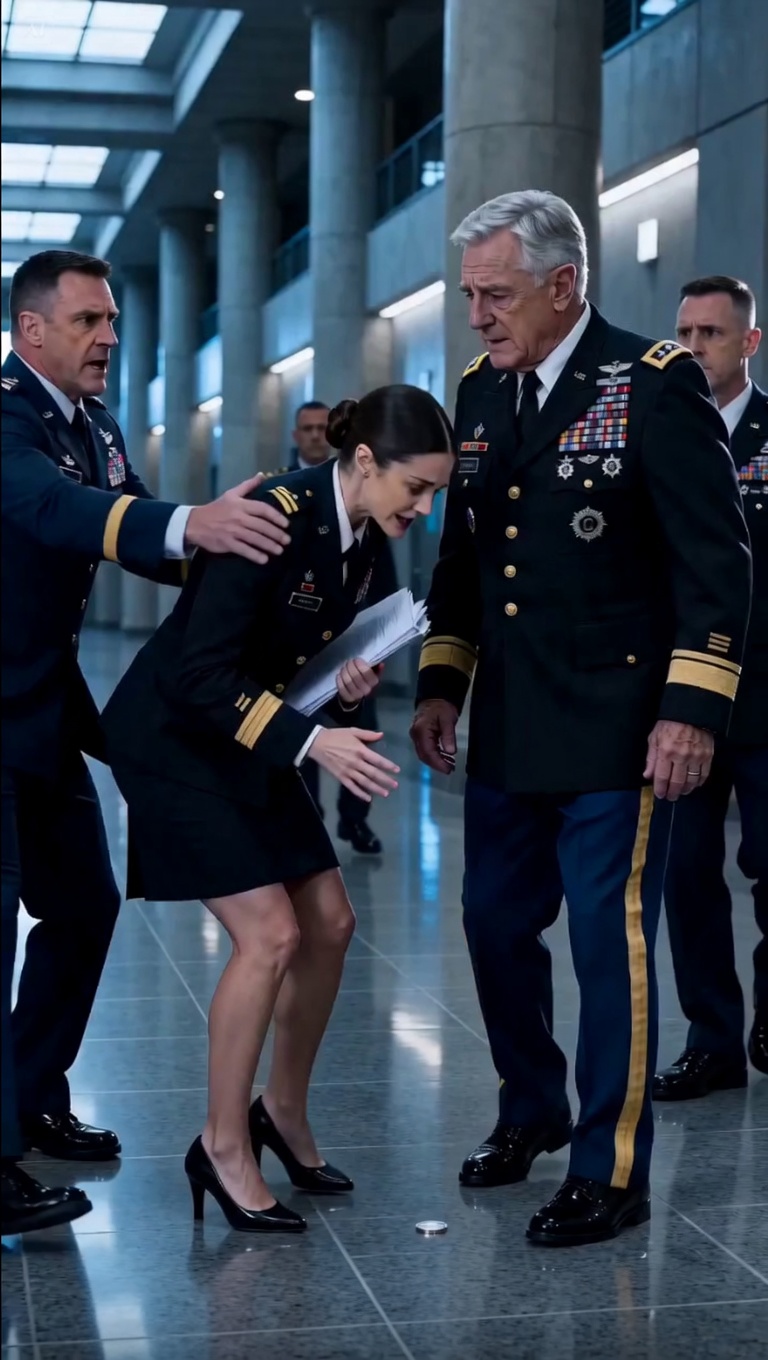
And there he was, standing ten feet away from me in the hallway outside HQ, shoulders rigid, jaw clenched. His eyes locked on a small circle of worn metal resting in his palm—my father’s old service coin.
His fingers trembled.
The coin slipped. Hit the tile with a bright metallic ring.
And General Alexander Ward, United States Marine Corps, four stars and forty years of war behind him, bowed his head and began to cry.
Not loud, not dramatic. Just quiet, broken shudders, like something inside him had finally run out of places to hide.
No one moved.
The colonel beside him looked like he’d watched a jet fall out of a clear sky. The staff officers along the corridor stood locked in place, eyes wide, faces pale. A pair of enlisted Marines backed out of sight like they’d just stepped into a chapel by mistake.
And me?
I stood there staring at the man who was supposed to terrify me, clutching air where the coin had been moments before, my brain trying and failing to catch up.
I didn’t understand it—the tears, the way he looked at that coin like it was a ghost. I didn’t understand why my father had made me carry that old piece of metal everywhere I went, why he’d pressed it into my palm on his deathbed and whispered, “One day, someone will need this more than you do. You’ll know who.”
I’d thought he was delirious.
But standing there, watching the strongest man in the Marine Corps shake like he’d been hit center mass, I realized two things at once:
Whatever my father had been in the Corps, it was more than he’d ever told me.
And whatever the Iron General was carrying, it was about to land on me.
A few hours earlier, none of this existed.
That morning, I was just another junior officer trying to beat the motor pool maintenance logs into submission. The sky over the base was clear, the kind of washed-out blue that promised another blistering day. Marines shouted across the bay as engines turned over and wrenches clanged. Diesel fumes hung heavy in the air.
I was halfway through a checklist when Staff Sergeant Perez burst through the door like we were taking incoming.
“Lieutenant Carter!” he panted. “Ma’am, you need to get to HQ. Now.”
I looked up from the clipboard, grease on my hands, hair stuck to my neck. “What happened? Another vehicle down?”
He shook his head, eyes wide. “No, ma’am. General Alexander Ward is landing in fifteen minutes.”
For a second, I actually laughed.
“Yeah, right,” I said. “And the Commandant’s bringing donuts.”
“I’m serious,” Perez hissed. “The colonel just got the call. Ward’s bird is already inbound. He wants the base ready, and he wants a Marine escort from the flight line to HQ. The colonel said your name.”
That stopped the laugh in my throat.
“Me?”
“Yes, ma’am.” Perez swallowed. “His words: ‘Get me Lieutenant Carter.’”
I didn’t know which part rattled me more—Ward coming here at all, or the fact that a four-star general, with an entire Corps at his command, had asked for someone as insignificant as me.
I wiped my hands on a rag, shrugged out of my stained work jacket, and checked my uniform like my life depended on it. Straightened collar. Smoothed blouse. Fixed my cover.
As I jogged toward HQ, the base was already shifting. Marines were moving with a different kind of urgency, the kind that comes when a legend is about to walk through your life and inspect whether your soul is squared away.
Dust disappeared from railings. Crooked signs were yanked straight. Stray trash vanished off sidewalks like it had never existed.
General Ward was famous for spotting imperfections smaller than a grain of sand.
He was less famous for forgiving them.
I’d never met him, but I’d read enough. Three tours in Afghanistan. Two in Iraq. Decorations that took up nearly the entire left side of his uniform. Stories about firefights where he’d stood up under fire like a stone column and dragged men out of hell with his own hands.
And then there were the whispers:
He refuses excuses.
He doesn’t believe in second chances.
He carries ghosts, heavy ones.
That last line had been my father’s. I remembered him saying it once, years ago, while we watched some talking head interview with Ward on TV.
“He’s brilliant,” Dad had said quietly. “But he carries ghosts, and they don’t let him sleep.”
I’d looked over, wanting to ask more, but Dad’s eyes had gone distant, and the moment slipped away. Like a lot of things did with him.
By the time I reached HQ, the colonel was pacing in the foyer, face pale, jaw clenched.
“Carter,” he snapped when he saw me. “Good. You’re with me.”
“Yes, sir. But—”
“No time. Ward wants a young officer escort who’s ‘squared away and level-headed.’” His tone said he’d argue with the general’s criteria, but not the order. “I picked you. Don’t prove me wrong.”
I swallowed. “Yes, sir.”
We stepped outside just as two black SUVs rolled through the gate, flanked by security forces. The vehicles stopped with perfect precision. The air seemed to tighten.
The back door of the first SUV opened.
General Alexander Ward stepped out like a storm given human shape.
He wasn’t tall in an exaggerated way, but he felt big—broad shoulders under a perfectly pressed uniform, silver crew cut sharp enough to cut steel, chest heavy with ribbons and medals that looked less like decoration and more like scars.
His eyes were ice. Not empty, not bored—icy in the way of a winter ocean: deep, dangerous, hiding everything beneath.
The colonel snapped to attention, hand extended.
“General Ward, sir, welcome to—”
Ward didn’t take his hand.
He looked at him for half a second, then his gaze cut past him and landed on me.
It hit like a physical impact, that look. Like being scanned and weighed and judged all at once. I forced myself not to shift under it.
“What’s your name, Lieutenant?” he asked.
“Lieutenant Arya Carter, sir.”
Something flickered in his expression. A tiny muscle jumped in his cheek. His jaw tightened.
“Carter,” he repeated, quiet, like the word had sharp edges.
I opened my mouth, suddenly sure there was something I was supposed to say, some explanation I didn’t have, but he’d already turned away.
“Begin the tour, Colonel,” he said. “We’ll start with the barracks.”
And just like that, the Iron General started moving, and the entire base moved with him.
I walked half a step behind and to his right, the official escort, unofficially trying not to draw his fire.
He inspected everything.
Dust on a railing. A loose bolt on a stairwell. A scuffed boot on a corporal who clearly wished he could evaporate.
He dressed down a captain in the chow hall so thoroughly that two privates went gray.
He asked about readiness numbers, maintenance cycles, training rotations. I answered everything I could, voice level, heart hammering.
Nothing in his expression shifted.
He was iron.
Right up until we reached the memorial wall.
It was just a hallway off HQ, lined with plaques and photographs. Names etched in brass. Faces frozen in time. Marines who had trained here, laughed here, bled here, and then never came back from wherever the Corps had sent them next.
Ward stopped dead in front of the wall.
His shoulders drew back. His breathing changed.
For the first time since he stepped on base, he said nothing.
The colonel wisely kept his mouth shut. I stood beside Ward, just far enough not to crowd him, close enough to hear his voice when he finally spoke.
“Lieutenant Carter,” he said without looking at me. “Do you know what a service coin really is?”
“Yes, sir,” I answered. “It represents respect. Brotherhood. Legacy.”
He nodded once, slow. “Good answer.”
I felt the coin in my pocket then, like it was calling attention to itself. A small circle of metal, smooth from years of being turned between my father’s fingers.
Carry it, he’d told me. Even when I rolled my eyes, even when I went to boot camp, even when I pinned on my butter bars.
“You never know when someone will need it more than you do,” he’d said.
Now, standing beside Alexander Ward, that old memory pulled at me with something that felt strangely like gravity.
My hand slid into my pocket almost on its own.
I didn’t intend to take it out.
I’d never shown it to anyone on base before. It was private, a piece of Dad I kept to myself.
But my fingers closed around the coin and before I knew it, I’d drawn it out, turning it absently with my thumb.
A glint of metal. A familiar weight.
Ward’s eyes snapped to it like a magnet.
“What is that?” he asked sharply.
“A service coin, sir,” I said, suddenly self-conscious. “My father’s.”
He held out his hand. “Let me see it.”
I hesitated. It was stupid, but the thought of handing over the last thing my father had pressed into my palm made my chest tighten.
“Lieutenant,” Ward said. “Now.”
I placed it in his hand.
He looked down.
And everything changed.
His breath hitched. His shoulders jerked like someone had punched him. The mask he’d been wearing since he stepped off the SUV cracked right down the middle.
For the first time since I’d learned his name, he looked less like a monument and more like a man.
His fingers closed around the coin. He turned it once, twice.
Then his gaze lifted to my face.
There was nothing cold in it now. Just disbelief. Grief. Recognition so raw it made my skin prickle.
His hand shook.
The coin slipped from his grip and hit the tile with a bright metallic ring.
And the Iron General began to cry.
The Coin Was Never Meant to Return. The Man Who Took It Was Never Meant to Live.
The sound of a four-star general crying is quieter than you’d expect—and far more terrifying.
It wasn’t loud. There were no gasps or dramatic breaks. Just soft, uneven breaths breaking against silence, like something deep inside him had finally cracked open after decades of pressure.
General Alexander Ward didn’t look at anyone.
He stared at the floor where the coin had fallen, his chest rising and falling like he’d just run a mile under fire. His hands—hands that had commanded battalions and signed orders that shaped wars—trembled like they didn’t belong to him anymore.
No one moved.
No one dared.
I swallowed hard, every instinct screaming that I had just stepped into something far bigger than a routine base visit.
“Sir…” the colonel tried.
Ward lifted a hand slightly.
That was all it took.
Silence slammed back into place.
Then, slowly—painfully—Ward bent down. His fingers hovered above the coin before finally picking it up. He held it like it might disappear if he blinked.
“Where,” he said quietly, voice raw, “did you get this?”
I forced my voice steady.
“My father, sir. He gave it to me.”
Ward closed his eyes.
For a second, I thought he might collapse.
“What was his name?” he asked.
“Staff Sergeant Daniel Carter, sir.”
The reaction was immediate.
Ward’s breath stopped. Completely.
When his eyes opened again, they weren’t cold anymore.
They were haunted.
“Daniel Carter…” he repeated, almost to himself. “That’s not possible.”
The colonel shifted uneasily. “General, is there—”
“Clear this hallway,” Ward snapped.
The command hit like a detonation.
Within seconds, the corridor emptied. Officers disappeared into side rooms. Enlisted Marines vanished like shadows. The colonel hesitated—just long enough to show concern—then followed the order.
And just like that—
It was just the two of us.
And whatever lived inside that coin.
Ward didn’t look at me immediately.
He turned the coin over in his fingers, tracing its worn edges like he was reading something written in a language only he understood.
“Your father,” he said slowly, “what do you know about his service?”
I blinked.
“Not much, sir. He… didn’t talk about it.”
Ward let out a hollow laugh.
“Of course he didn’t.”
Something in his tone made my stomach tighten.
“He said you carried ghosts,” I added quietly.
Ward froze.
Then, very slowly, he looked at me.
“And what do you think that means, Lieutenant?”
I hesitated.
“It means,” I said carefully, “you’ve seen things you can’t forget.”
Ward stared at me for a long moment.
Then shook his head.
“No,” he said softly. “It means I’ve done things I can’t forgive.”
The air grew heavier.
“Your father,” he continued, “was not just a Staff Sergeant.”
My pulse quickened.
“What do you mean?”
Ward turned away, pacing once, like he was fighting something inside himself.
Then he stopped.
And faced me again.
“Daniel Carter,” he said, “was the best Marine I ever served with.”
The words hit harder than anything else he could have said.
“My father?” I whispered.
Ward nodded.
“He saved my life.”
Silence.
Sharp. Electric.
“How?” I asked.
Ward’s jaw tightened.
“There was a mission,” he said. “Classified. Deep in Helmand Province. We were embedded with a unit that… didn’t officially exist.”
A chill crawled up my spine.
“We walked into an ambush,” he continued. “Perfectly executed. We were pinned down. Outnumbered. Cut off.”
His eyes darkened.
“I made a call,” he said. “A bad one.”
I didn’t speak.
Didn’t breathe.
“I ordered a push forward,” Ward said. “Thought we could break through.”
His voice cracked.
“We couldn’t.”
The weight of it pressed down on both of us.
“Men went down,” he continued. “One after another.”
His hand tightened around the coin.
“And then your father…” He stopped, swallowing hard.
“What did he do?” I asked, barely above a whisper.
Ward looked at me.
And for the first time, I saw something like shame.
“He disobeyed my order.”
That surprised me.
“My father?” I said.
Ward nodded.
“He dragged me out of the kill zone,” he said. “Took a bullet meant for me.”
My chest tightened painfully.
“He shouldn’t have survived,” Ward added. “None of us should have.”
“But you did,” I said.
Ward’s expression twisted.
“Yes,” he said. “Because of him.”
A pause.
Heavy.
“He gave me that coin,” Ward said, lifting it slightly. “Right before we were extracted.”
I frowned.
“That’s not possible. He gave it to me.”
Ward shook his head.
“No,” he said. “He gave it to me first.”
The ground seemed to shift beneath my feet.
“What?”
Ward’s voice dropped.
“He told me something I’ve never forgotten.”
My heart pounded.
“What did he say?”
Ward hesitated.
Then—
“‘If I don’t make it,’” he recited quietly, “‘give this to my daughter.’”
My breath caught.
“He said her name,” Ward continued. “Arya.”
My knees nearly gave out.
“That’s… that’s me.”
Ward nodded slowly.
“I know.”
The silence that followed was suffocating.
“But he didn’t die there,” I said, struggling to piece it together. “He came home. He raised me.”
Ward’s expression darkened.
“Yes,” he said. “He came home.”
Something in his tone made my stomach drop.
“What aren’t you telling me?” I asked.
Ward didn’t answer immediately.
He looked at the coin again.
Then back at me.
And when he spoke—
Everything changed.
“He shouldn’t have survived,” Ward said.
“You said that,” I replied.
“I meant it,” he said.
A chill spread through my chest.
“What do you mean?”
Ward stepped closer.
Lowered his voice.
“That mission wasn’t just an ambush,” he said. “It was a test.”
My pulse roared in my ears.
“A test of what?”
Ward hesitated.
Then—
“Of something we were never supposed to bring back.”
My breath caught.
“What are you saying?”
Ward’s eyes locked onto mine.
“Your father wasn’t the same man when he came out of that valley.”
The world tilted.
“No,” I said immediately. “That’s not true.”
“He was stronger,” Ward continued. “Faster. More aware. Like he could see things before they happened.”
My chest tightened.
“That’s training,” I insisted.
Ward shook his head.
“No,” he said. “That’s something else.”
A terrible realization began to form.
“You’re wrong,” I whispered.
“I wanted to believe that too,” Ward said.
My hands trembled.
“He raised me,” I said. “He taught me everything.”
Ward’s expression softened.
“I know,” he said.
“And he loved me,” I added, almost desperately.
Ward nodded.
“I believe that.”
Relief flickered—
Until he added:
“But that doesn’t mean he was still entirely human.”
The words hit like a bullet.
“No.”
“He changed,” Ward said. “We all saw it.”
“You’re lying,” I snapped.
Ward flinched—but didn’t back down.
“I kept that coin,” he said. “For years. Waiting to find you.”
My breath hitched.
“Then why didn’t you?” I demanded.
Ward’s face twisted with something close to fear.
“Because he came back for it.”
Everything inside me froze.
“What?”
“Three months after the mission,” Ward said. “Your father broke into a secure facility.”
My heart pounded.
“That’s impossible.”
“He killed two guards,” Ward continued. “Didn’t make a sound. Took the coin.”
My mind reeled.
“No… no, he wouldn’t—”
“He looked at me,” Ward said, voice shaking now. “Right before he left.”
Silence.
“And do you know what he said?”
I couldn’t speak.
Ward leaned closer.
“‘She’s not ready yet.’”
The words sliced through me.
My legs felt weak.
“What does that mean?” I whispered.
Ward stared at me.
And for the first time—
He looked afraid of me.
“I think,” he said slowly, “your father wasn’t protecting you.”
My breath stopped.
“I think,” he continued, “he was preparing you.”
The world collapsed inward.
“No…”
“Lieutenant Carter,” Ward said carefully, “have you ever noticed anything… unusual about yourself?”
My mind flashed.
Moments.
Instincts.
Reflexes.
Things I’d dismissed.
“No,” I said—but it sounded hollow.
Ward didn’t look convinced.
“He taught you everything,” Ward said. “Didn’t he?”
“Yes,” I whispered.
“He made you carry this coin,” Ward added.
I nodded.
“And he told you someone would need it,” Ward said.
My chest tightened.
“Yes.”
Ward exhaled slowly.
“Maybe he wasn’t talking about me.”
Silence.
Heavy.
Terrifying.
“Then who?” I asked.
Ward’s eyes never left mine.
“You.”
The word hit like a detonation.
“No…”
“Think about it,” Ward pressed. “Why would he pass it down?”
“I don’t know!”
“Yes, you do,” Ward said quietly.
Something deep inside me stirred.
Unfamiliar.
Cold.
Precise.
“Because one day,” Ward continued, “you would need to remember.”
My heartbeat slowed.
Too slow.
The world sharpened.
Every sound clearer.
Every movement sharper.
“What… remember what?” I asked.
Ward’s voice dropped to a whisper.
“Who you really are.”
The coin in his hand glinted.
And suddenly—
I knew.
Not in words.
Not in thoughts.
But in something deeper.
A memory that wasn’t supposed to wake up.
My hand moved.
Faster than I intended.
Snatching the coin from his grip.
Ward stumbled back.
“What are you—”
I turned the coin over.
The worn surface.
The tiny scratches.
The edge I’d traced a thousand times.
And now—
I could feel it.
Not just metal.
But something embedded.
Encoded.
Waiting.
My breath steadied.
Completely steady.
Ward stared at me.
Horror creeping into his expression.
“No…” he whispered.
I looked up.
And for the first time—
I understood why my father had looked at me the way he did.
Not just with love.
But with caution.
“Sir,” I said calmly.
My voice sounded… different.
“What did my father really bring back from that mission?”
Ward’s face went pale.
“You,” he said.
Silence.
Absolute.
The truth settled like a final piece clicking into place.
Not a realization.
An awakening.
I smiled faintly.
And Ward flinched.
Because it wasn’t quite human.
“My father didn’t survive that mission,” I said softly.
Ward shook his head, backing away.
“No… no, that’s not possible…”
“He changed,” I continued. “You said it yourself.”
My grip tightened on the coin.
“And then he raised me.”
Ward’s voice broke.
“What are you?”
I tilted my head slightly.
The same way, suddenly, that my father used to.
“I think,” I said, “I’m what he brought home.”
Ward’s breathing became uneven.
“You’re lying…”
I stepped forward.
He stepped back.
The Iron General.
Retreating.
“He told you I wasn’t ready yet,” I said.
Ward’s eyes widened.
“Yes…”
I looked down at the coin.
Then back at him.
“Well,” I said quietly—
“I think I am now.”
And in that moment—
General Alexander Ward, the man who feared nothing—