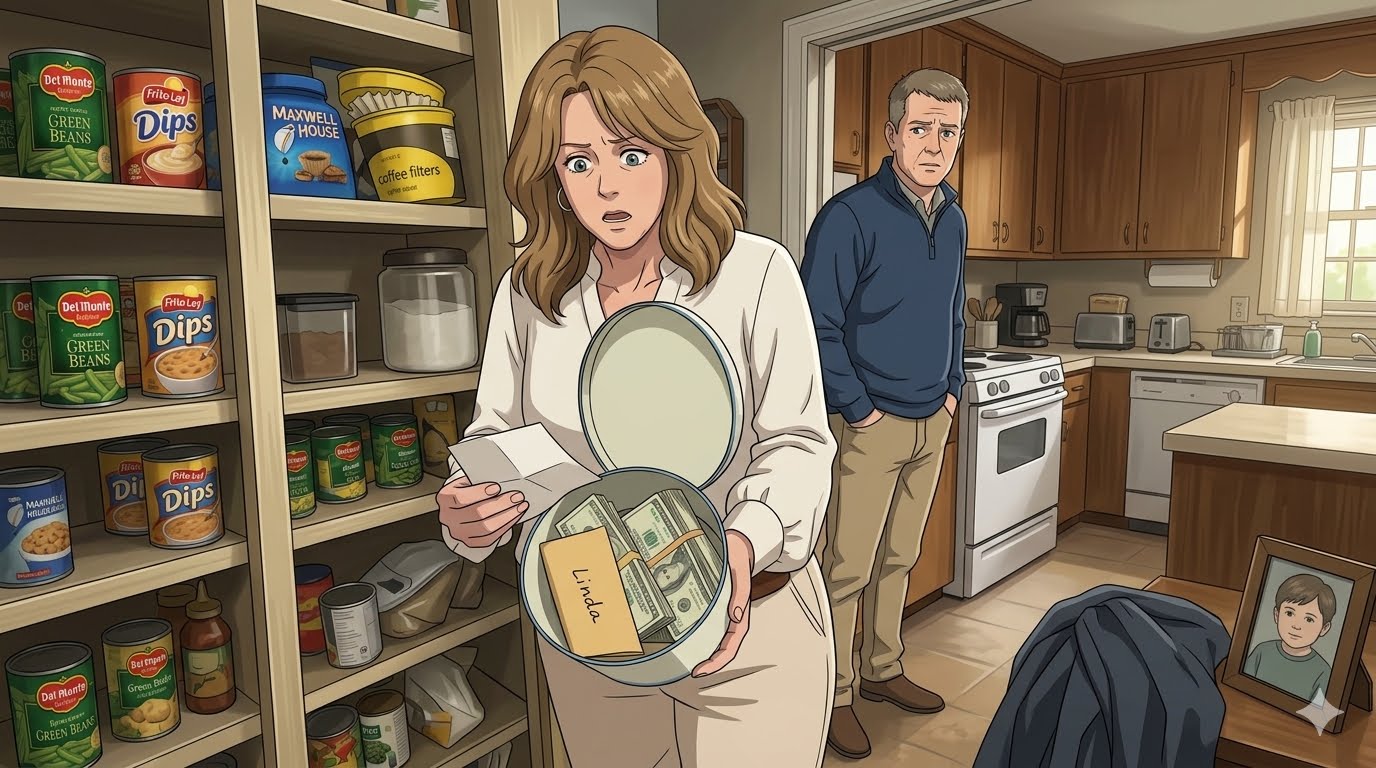

The first line read, I’m sorry, Elena. My brother shrugged and called it forgotten grocery money. But when I read the next sentence—and saw my stepfather Arthur’s name—I knew this was something much bigger. By 5:05 that evening, I was driving to the bank with the flour tin beside me and traces of flour still clinging to my clothes.
Part 1
Mama’s pantry was barely larger than a walk-in closet, but she organized it with the seriousness of someone preparing for a long emergency.
Cans of green beans were lined up according to date.
Sugar stayed inside the same glass jar.
Coffee filters had been kept in an old yellow Tupperware container since 1993.
And above everything else, on the highest shelf, sat one object we were never allowed to touch.
The flour tin.
It was made of white enamel, with faded blue decoration around the rim and several chips that showed its age.
Mama guarded that tin like it contained something precious.
When I was twelve, I once reached for it because I wanted to make biscuits and couldn’t find enough flour elsewhere.
Before I could pull it down, Mama smacked my hand away.
The surprise made me cry.
She immediately softened.
Later, she made me a cup of cocoa, sat with me at the kitchen table, and apologized while gently brushing my hair back.
But she never explained why she had reacted that way.
The tin simply went back onto the top shelf.
And after that, I never touched it again.
Years passed.
Mama eventually passed away at seventy-eight.
The day after her funeral, my older brother Julian announced that he wanted the entire house emptied within forty-eight hours.
That was typical Julian.
He had lived in Memphis for years and always seemed to be in a hurry.
He mentioned his camper payment.
His bad back.
The long drive home.
And repeatedly reminded me that he couldn’t stay.
Our stepfather, Arthur, had already been out of Mama’s life for six years, so there was nobody else to help us sort through nearly eight decades of belongings.
Julian claimed the living room.
I took the pantry.
Nobody else was exactly volunteering to go through old canned goods and forgotten kitchen supplies.
The kitchen still smelled faintly of cinnamon, dust, and the lemon oil Mama used on the cabinets every spring.
I placed a cardboard box marked DONATE beside my feet.
Although after finding eleven cans of beets, I wasn’t entirely sure who I planned to donate them to.
Then I reached for the flour tin.
The moment I lifted it, I knew something was strange.
It was far too heavy.
I stepped down and placed it on the counter.
From the living room, I could hear Julian wrapping Mama’s television remote in newspaper as though it were a priceless antique.
I lifted the lid.
There was no flour inside.
Only cash.
Twenties.
Fifties.
Hundreds.
The bills had been separated into bundles and held together with rubber bands so old they were beginning to crack.
Some of the money looked as though it had been sitting there for decades.
I stared at it, completely confused.
Then I noticed something beneath the cash.
An envelope.
My name was written across the front in Mama’s handwriting.
Elena.
Not Julian.
Not “for the children.”
Just Elena.
My fingers started shaking.
A thin cloud of leftover flour dust slipped from the edge of the tin and landed across the black pants I was still wearing from the funeral.
That was when Julian walked into the kitchen.
The instant he saw the money, his entire expression changed.
“What’s all that?”
“I found it inside the flour tin.”
He stared at the cash for several seconds.
Then he shrugged.
“Probably grocery money she forgot about.”
We counted it.
$18,940.
I looked at him.
“Forgot?”
Before Julian could reach toward the counter, I picked up the envelope and opened it.
The first words were enough to make my stomach tighten.
I’m sorry, Elena.
Then I read the next sentence.
I should have told you what Arthur did with your settlement.
I dropped into Mama’s kitchen chair.
Suddenly, I was seventeen years old again.
That year, I had been struck by a delivery truck outside the Piggly Wiggly.
My injuries kept me in a cast for nine weeks.
For months afterward, I walked with a limp.
There had been an insurance settlement.
But Arthur handled everything.
He told Mama and me that most of the money had gone toward medical expenses.
Whatever remained, he said, had been used up by additional costs.
There was nothing left for me.
I was young.
I didn’t understand legal documents or insurance claims.
So I believed him.
I remembered Mama crying when Arthur explained that the money was gone.
All these years, I had assumed she cried because she felt helpless and worried about me.
Sitting in her kitchen with that letter in my hands, another possibility entered my mind.
Maybe those tears had been guilt.
I looked toward Julian.
He was watching me carefully.
Then he said something that immediately made me suspicious.
“Don’t start digging up old things.”
I stared at him.
That wasn’t something a person said unless there was something buried.
“You know something.”
Julian looked away.
Mama’s letter was three pages long.
I kept reading.
But before I reached the end, I noticed that the final page had been folded separately.
It had been sealed with tape so old that it had yellowed and turned brown around the edges.
Written across the outside were seven words:
Read this at First County Bank, not inside the house.
I read them twice.
Then I carefully put the cash back into the flour tin.
I placed Mama’s letter inside my purse.
And I left.
At exactly 5:05 that afternoon, I walked through the doors of First County Bank carrying the old flour tin under my arm.
The teller recognized my name.
I explained that Mama had recently passed away and that I had found something among her belongings.
The teller typed something into her computer.
Then her face suddenly lost its color.
She looked at me.
Then at the flour tin.
Without explaining anything, she reached for the phone.
“I need to call the branch manager.”
That was when I realized Mama hadn’t simply hidden money in her pantry.
She had been preparing for me to find it.
And whatever Arthur had done all those years ago, Mama had apparently spent a very long time trying to make sure the truth eventually reached me.
Part 2
At first, she tried to describe it as something other than stealing.
Then she crossed out the words and admitted what it was.
Yes.
She was stealing.
But she was stealing from the man who had stolen far more from her daughter.
Mama had spent years taking small bills directly from Arthur’s wallet while he slept, hiding twenty-dollar notes inside her pantry containers bit by bit.
She did it for eleven years.
After Arthur eventually left her, she continued adding money from her pension, Social Security payments, tax refunds, birthday gifts, and a small inheritance.
Dollar by dollar, the amount reached $18,940.
She knew it wasn’t the $63,000 I had lost.
But it was everything she had managed to recover.
Then I reached the final page.
It had been folded separately and sealed with yellowing tape.
On the outside, Mama had written:
Read this at First County Bank. Not in the house.
I put the money back into the tin.
Then I walked past Julian, carried Mama’s secret outside, and drove directly to the bank.
Part 3
The branch manager, an elderly woman named Mrs. Gable, escorted me into her quiet, glass-walled office.
She looked at the old flour tin resting on her desk, then looked up at me with profound sympathy. “Elena… your mother came to see me five years ago, right after Arthur left her.”
Mrs. Gable opened a locked filing cabinet and pulled out a blue ledger along with a safety deposit box key.
“Your mother didn’t just save cash in that tin,” Mrs. Gable explained softly. “She opened a court-mandated escrow account under your name, using Arthur’s signed admission of guilt.”
I stared at her, stunned. “Arthur signed an admission?”
“He didn’t have a choice,” Mrs. Gable replied. “When your mother discovered that Arthur and your brother Julian had split your $63,000 settlement to buy a commercial property in town, she threatened to go to the police. Arthur signed over his half of the property deed to protect himself and Julian from prosecution for insurance fraud.”
My breath hitched in my throat. Julian. My brother hadn’t just known about the stolen settlement; he had actively profited from it.
Mrs. Gable handed me the official bank statement. The escrow account, funded by the commercial rental income over the last twenty years, was sitting at $142,000.
“Your mother made sure that every cent Arthur stole—plus twenty years of accrued commercial rent and interest—was placed into a trust that transfers to you upon her death,” Mrs. Gable said gently. “The money in the flour tin was just her personal way of apologizing for not stopping them sooner.”
I sat in the quiet office, tears finally spilling down my cheeks. All those years, I thought Mama was passive and weak against Arthur’s domination. In reality, she had quietly, meticulously fought a twenty-year war behind the scenes to secure my future.
I took the documents and drove straight back to Mama’s house.
Julian was standing on the porch, holding a trash bag, looking anxious. The moment I stepped out of the car with the legal file in my hand, his face went pale.
“What did the bank say, Elena?” he asked nervously.
I walked up the porch steps, looking my brother dead in the eye. “They told me about the $63,000 settlement. They told me about the commercial property. And they told me about your partnership with Arthur.”
Julian took a step back, swallowing hard. “Elena… listen, I was young. Arthur told me it was family money—”
“You let me walk with a limp for years thinking we were broke,” I said, my voice steady and cold. “You let me believe there was nothing left for my medical care while you used my pain to start your life.”
I held up the legal papers. “The commercial property is mine now. The back rent is mine. And if you don’t pack your things and leave this house in the next ten minutes, the bank manager and I will deliver Arthur’s signed confession and the audit logs straight to the district attorney.”
Julian opened his mouth to argue, but the unshakeable resolve in my voice stopped him cold. He looked at me, then down at the blue folder, realizing he had lost completely. Without another word, he dropped the trash bag, walked to his truck, and drove away without looking back.
I walked into the quiet kitchen and set the old white enamel flour tin on the dining table.
I ran my fingers over the faded blue rim, feeling the cool metal beneath my touch.
Mama had spent decades guarding that top shelf, protecting a secret that would eventually set me free. I opened the tin one last time, taking out the remaining flour dust on my hands, and smiled through my tears.
She hadn’t just saved money in that tin.
She had saved my justice.