PART 1

“If that boy says one more word about a man trapped inside a tank, I am having him committed to a pediatric psychiatric facility,” Director Rachel Vance declared, her voice cold and unyielding.
Six-year-old Toby heard every word from the hallway of Oakridge Children’s Home, on the outskirts of Houston, Texas. He didn’t cry. He simply pressed his late mother’s faded teddy bear tighter against his chest.
Six months had passed since his world fell apart. His mother died from untreated pneumonia. A month later, his father, spiraling into alcoholism, was killed in a brawl outside a local bar. Toby ended up in state custody and was sent to this shelter—a place of peeling paint, rusted bunk beds, and a fenced-in yard overlooking an abandoned industrial zone.
Beyond the second-floor window lay a desolate stretch of decaying warehouses, rusted train tracks, and massive industrial steel tanks covered in rust and graffiti.
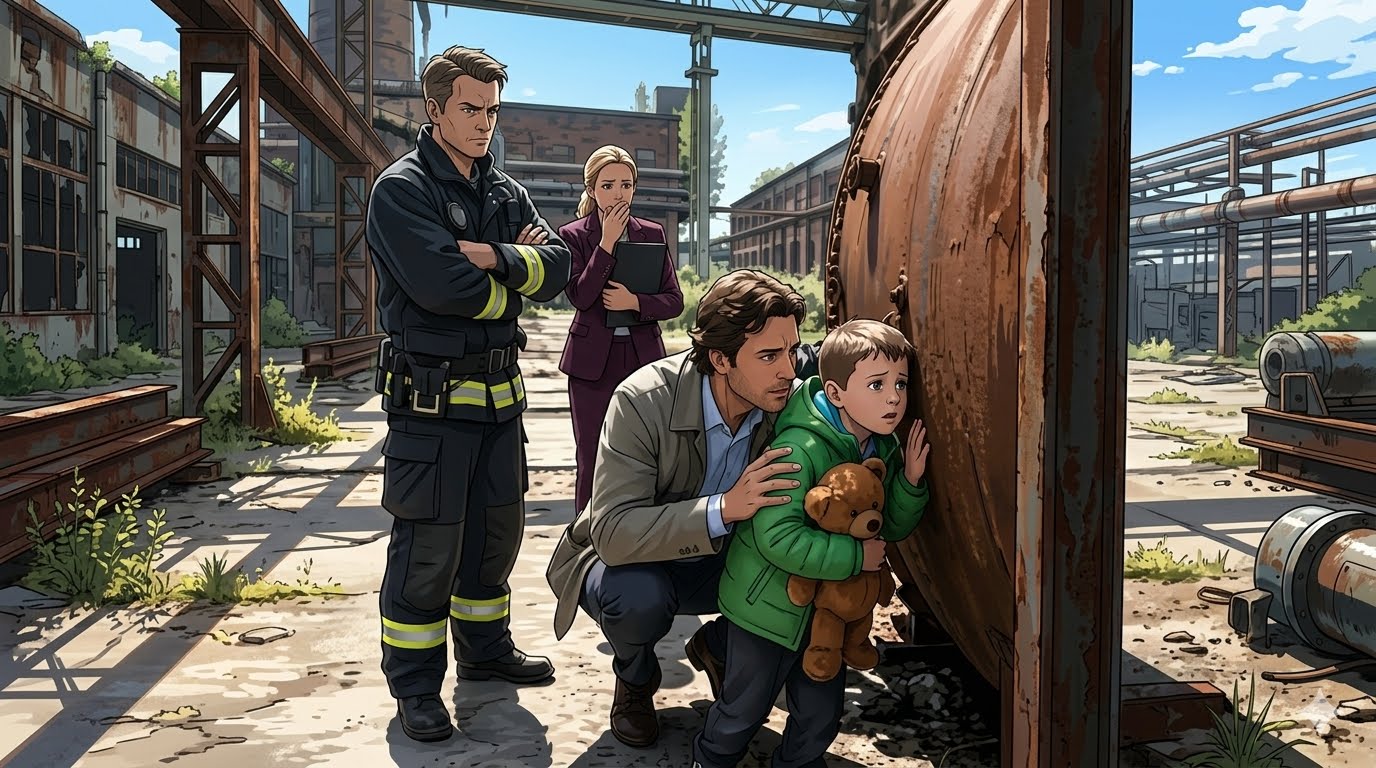
The first time Toby ran away, Daniel Miller, one of the shelter’s youth workers, found him two hours later with his ear pressed flat against the side of a massive, cylindrical tank.
“Toby, what are you doing out here? It’s dangerous.”
The boy placed a tiny finger over his lips. “Listen.”
Daniel rested his hand on the cold steel. He heard only the howling Texas wind. “There’s nothing there, buddy.”
“Yes, there is. A man is banging from the inside.”
Daniel assumed it was a manifestation of grief. The visiting child psychologist thought the same. But Toby kept escaping. Once in the pouring rain, once during lunch, and once after crawling through a bathroom window.
He always ran straight to the exact same tank.
The other kids began to taunt him mercilessly. “Look, there goes Crazy Toby, talking to the scrap metal again!”
Toby never answered them. He would just sit beside the tank, press his cheek against the cold iron, and wait.
One afternoon, Daniel found him weeping quietly.
“His banging is getting softer every day,” Toby whispered. “He’s thirsty. He says it’s pitch black.”
A sudden chill ran down Daniel’s spine. “Who, Toby?”
“Mr. Victor.”
“How do you know his name?”
“He said it. Very softly. ‘My name is Victor… help me.’”
That night, Daniel went through the drawings Toby had made over the past few weeks. There were fifteen of them. Nearly every page depicted the exact same scene: a massive industrial tank, a circular hatch, a human silhouette inside, and outside, old train tracks running alongside a collapsed wooden barn.
It wasn’t a random scribble. It was a repeated map.
Daniel took the drawings straight to Director Vance’s office.
Rachel Vance barely glanced at them. “It’s an obsession. I’ve already spoken with the state psychologist. The evaluation board is coming on Monday to sign his transfer to a secure psychiatric facility.”
“Director, what if we just check the tank? Just to be certain?”
She glared at him as if he had lost his mind. “Are you suggesting we mobilize law enforcement because a traumatized six-year-old draws ghost stories?”
Toby, standing right outside the door, heard the word transfer and went pale.
Late that night, when the shelter was silent, he slipped into the main office. On the desk lay a file with his name on it, signed by Rachel Vance: Severe auditory hallucinations. Flight risk. Immediate residential psychiatric placement recommended.
Toby backed out, his small hands shaking.
He found Daniel and handed him his very last drawing. “If they take me away, Mr. Victor is going to die.”
Daniel looked at the drawn tank, then down into the boy’s terrified, desperate eyes.
For the first time, he chose to believe him.
First thing tomorrow morning, he was going to the police—even if they laughed in his face.
Neither of them could have imagined what was waiting inside that rusted steel drum.
PART 2
At the local precinct, the desk sergeant flashed an incredulous smirk when Daniel explained that a six-year-old orphan was hearing cries for help inside an abandoned water tank.
“Kids have wild imaginations, son.”
Daniel slammed Toby’s drawings onto the counter. “Then check your system. Is there a missing person named Victor reported in this county?”
The sergeant’s smile vanished instantly.
Minutes later, Daniel was sitting across from Detective Alex Hayes.
“Victor Hernandez, forty-two. An industrial electrician from a plant down in Deer Park. His wife reported him missing six days ago.”
The plant was less than a mile from the abandoned industrial site.
Detective Hayes didn’t hesitate. He called for backup, dispatched a team from Search and Rescue, and drove straight to the site with Daniel.
The massive steel tank was secured from the outside with a heavy, rusted latch.
“Are you sure this is the one?” Hayes asked, surveying the surrounding area.
Daniel held up Toby’s drawing, matching the scene perfectly: the collapsed barn, the rusted tracks, the crushed metal boxes. “This is it.”
A rescue worker hammered on the hatch with a iron mallet. Silence.
For a sickening second, Daniel thought they were too late—or worse, that he had fallen for a child’s delusion.
Then Toby’s words echoed in his head: “His banging is getting softer every day.”
“Cut the latch!” Hayes ordered.
The metal grinder sparked, snapping the lock. As the hatch swung open, a wave of stale, suffocating heat rushed out.
A firefighter shone his flashlight into the dark abyss and yelled, “WE’VE GOT A BODY! HE’S ALIVE!”
Victor Hernandez was lying at the bottom, unconscious, severely dehydrated, his breath shallow and thready.
They hoisted him out using ropes and a basket stretcher. Paramedics later confirmed that another few hours inside that sweltering metal tomb would have resulted in organ failure.
When Daniel returned to Oakridge, Toby was waiting at the window.
“Did you find him?”
Daniel knelt beside him, his eyes shining. “Yes, Toby. He’s alive.”
The little boy broke down in tears of sheer relief.
Yet, Director Vance refused to back down. “Finding a missing man does not prove the child is mentally sound,” she stated coldly. “He could have overheard rumors from the local teens. The evaluation board arrives Monday.”
Daniel exploded. “The police saved a man’s life because of him!”
“My decision is final.”
Meanwhile, at the hospital, Victor woke up and gave his statement to Detective Hayes. He revealed that a former coworker, Andrew Miller, had lured him to the top of the tank under the pretense of retrieving stolen company tools. Miller had shoved him inside and locked the hatch.
“He wanted to punish me,” Victor whispered through cracked lips. “We had an argument three years ago over a promotion.”
For six agonizing days, Victor had hammered on the metal walls, screamed his name, and prayed for rain until his voice gave out entirely.
When Detective Hayes told him a six-year-old boy had insisted on searching the tank, Victor froze.
“A boy?”
“Toby. Six years old. And right now, the shelter director is trying to put him in a psychiatric ward because she thinks he hears voices.”
On Friday evening, still weak and wearing a hospital bracelet, Victor arrived at Oakridge Children’s Home.
Daniel met him at the door in shock. “Mr. Hernandez, you should be resting!”
“I’ll rest later,” Victor said firmly. He looked toward the dormitory hallway. “Two years ago, my wife and I were approved foster parents. The process was paused when her mother fell ill, but our file is still active. First thing tomorrow, I’m filing an emergency petition with Child Protective Services.”
Daniel stared at him. “What are you saying?”
“I’m saying I won’t let them lock away the boy who saved my life.”
PART 3
The following morning, Victor arrived at the CPS regional office accompanied by his wife, Laura, and Detective Hayes.
Laura and Victor had a ten-year-old daughter named Maya. Their foster-to-adopt certification was fully documented. Given the extraordinary circumstances, the state director agreed to freeze Toby’s transfer pending a full investigation.
Detective Hayes submitted a formal police report stating that Victor’s rescue was directly attributable to Toby’s specific, detailed information.
On Monday morning, Director Vance was preparing her presentation for the state evaluation board. Instead, her office was walked into by two senior CPS investigators, an independent child psychiatrist, Detective Hayes, and Victor.
Rachel Vance’s face drained of color. “What is the meaning of this?”
State Investigator Sarah Jenkins placed a file on the desk. “The transfer order is officially suspended.”
“I run this facility!” Vance snapped.
“Which is precisely why we are auditing your administrative decisions,” Jenkins replied coldly.
When Vance tried to argue that Toby was unstable and hearing voices, Victor stepped forward.
“The voice he heard was mine,” Victor said, looking her dead in the eye. “I was shouting my name from inside that hellhole. If that child hadn’t listened when everyone else ignored him, my wife would be planning my funeral today.”
The independent psychiatrist spent two hours interviewing Toby. The boy explained clearly that he didn’t hear random voices. He only heard banging near the tank, and when he pressed his ear to the metal, he heard faint words. He kept going back because the sound was fading.
The psychiatrist’s conclusion was unequivocal: Toby suffered from grief and mild PTSD due to his parents’ deaths, but showed absolutely zero signs of psychosis.
“He needs a loving home and grief counseling,” the doctor reported. “Not to be punished for saving a man’s life.”
Subsequent state audits revealed that Director Vance had routinely rushed “difficult” or high-maintenance orphans into specialized psychiatric facilities to clear beds and cut facility costs. She was immediately suspended, and eventually fired, while the state launched a formal investigation into her administration.
Meanwhile, police apprehended Andrew Miller at a motel near the state line. Faced with physical evidence and Victor’s testimony, Miller confessed to attempted murder and was sentenced to twenty-five years in federal prison.
That afternoon, Victor and Laura returned to the shelter.
Toby was sitting alone in the courtyard, drawing with a worn stub of a pencil. When he saw Victor approach, he froze.
Victor knelt in front of him. “Hi, Toby. I’m Victor.”
Toby studied his face carefully. “Your voice sounds different now.”
Victor smiled, tears welling in his eyes. “That’s because I have water, food, and air now.”
Toby looked down at his hands. “I told them you were in there, but no one believed me.”
“I believe you,” Victor said softly. “And I will always believe you.”
“Are they taking me to the hospital for crazy kids?”
Victor swallowed the lump in his throat. “No. Never. In fact, my wife Laura, my daughter Maya, and I want to know if you’d like to come home and live with us.”
Toby looked up, hesitant. “Will you send me back if I make a mistake?”
Victor took Toby’s small hands in his. “I promise you, on my life, we will never abandon you. You will always have a seat at our table, a warm bed, and a family that listens to you.”
Ten-year-old Maya peeked out from behind her parents, holding a brand-new pack of colored markers. “Just so you know, I don’t share my purple marker easily.”
For the first time in six months, Toby let out a tiny, genuine laugh.
EPILOGUE
The transition took several weeks, but the bond was instant. Toby moved into the Hernandez family home in Houston with his small backpack, his mother’s teddy bear, and a framed photograph of his parents.
At night, whenever Toby woke up terrified that it was all a dream, he would creep down the hallway to find Victor sitting in the living room, waiting for him with a smile and a glass of warm milk.
A year later, the adoption was finalized in family court.
As they walked down the courthouse steps, Maya bumped her shoulder against Toby’s. “So, you’re officially my annoying little brother now?”
“That’s what the judge said!” Toby grinned.
That night, Toby sat at his new desk in his bright, sunny bedroom. For months, he had filled sketchbooks with dark steel tanks and rusted metal.
Now, he picked up a bright yellow marker and drew a big, warm sun hovering over a house with four people holding hands. In the top corner, he drew two tiny angels smiling down.
Victor walked in and sat beside him, looking at the drawing. “Who are those two up there, buddy?”
“My mom and dad from before,” Toby whispered. “I don’t want them to feel left out.”
Victor wrapped an arm around the boy’s shoulders. “They’ll always be part of your story, Toby. You never have to forget them.”
Toby looked up at his father, his eyes clear and peaceful.
He didn’t hear cold, dark banging in his head anymore. He heard the sizzle of dinner in the kitchen, his sister playing music down the hall, and the warm, steady voice of the man who had promised to always listen.
Sometimes, the greatest bravery isn’t making noise—it’s refusing to stop listening to those who need help, even when the rest of the world chooses to be deaf.