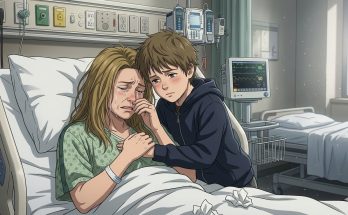
“That’s not a mass.”
The words hung in the sterile hospital room like a match held over gasoline.
For one frozen second, nobody moved.
The monitor continued its merciless tone.
Flat.
Unbroken.
Final.
Dr. Malcolm Voss, the chief physician, turned slowly toward Leo with the exhausted fury of a man whose authority had just been challenged by a barefoot truth in torn sneakers.
“What did you say?”
Leo swallowed hard.
He was suddenly aware of everything. The polished floor beneath his dirty shoes. The heavy sack of empty bottles still digging into his shoulder. The eyes of nurses, doctors, security guards, and the richest man he had ever seen all fixed on him like he had broken a sacred rule.
Maybe he had.
But he could not take the words back.
He pointed again, his small finger trembling.
“That swelling,” he said. “It’s not a mass.”
One of the younger doctors gave a sharp, disbelieving laugh. “And you know this because?”
Leo’s cheeks burned.
He looked at the baby again.
Five-month-old Ethan Coleman lay still inside the incubator, impossibly tiny beneath wires and tubes. His lips were pale. His little fists rested open beside him. Everything about him looked already surrendered.
Except the swelling.
Leo could not explain why it mattered. Not in the language these doctors would respect. He did not know anatomy. He did not know scans or lab reports or medical terminology. He only knew what his grandfather had taught him after years of repairing broken radios, broken bicycles, broken watches, broken things people threw away because they never looked closely enough.
A broken thing always tells you where it hurts.
Leo’s voice came out small but steady.
“It’s too smooth on one side,” he said. “And the skin pulls around it like something is pushing from underneath. Tumors don’t sit like that.”
The room went deathly silent.
The doctor who had laughed stopped laughing.
Richard Coleman slowly turned toward his son.
His eyes, hollow moments earlier, sharpened with desperate attention.
“What do you mean, something pushing?”
Leo stepped closer before fear could stop him.
Security moved instantly.
“Don’t let him near the patient,” Dr. Voss snapped.
Richard’s voice cracked across the room.
“Wait.”
Everyone stopped.
Even Dr. Voss.
Richard looked like a man standing at the edge of a cliff, listening to a child describe a rope.
“Let him speak.”
Dr. Voss stiffened. “Mr. Coleman, with respect, this is not medicine. This child wandered into a critical care room carrying garbage.”
Leo flinched.
Richard did not.
His face hardened.
“That child returned my wallet with more honesty than most men in this city have shown me in a lifetime. Let him speak.”
Isabelle Coleman lifted her tear-streaked face from the incubator railing. Her hair had fallen loose from its elegant pins. She looked nothing like the polished woman from magazine photographs Leo had once seen on newspapers wrapped around discarded food.
She looked like a mother who would believe the moon could be lowered by hand if someone told her it might save her child.
“What do you see?” she whispered.
Leo’s throat tightened.
He took one more step toward the incubator.
This time, no one stopped him.
The swelling on the baby’s neck was barely visible unless one looked from the side. A tiny raised curve just beneath the jawline, near the soft place where skin met shadow. Under the bright hospital lights, it seemed ordinary. But Leo had spent his life seeing ordinary things differently.
A bottle with a hairline crack sounded different when tapped.
A bent bicycle spoke through the wheel.
A jammed music box clicked once before it failed.
And this swelling looked like pressure, not growth.
“It’s round,” Leo said. “But not soft. It’s like… like when a marble gets stuck under cloth.”
Dr. Voss’s jaw tightened. “That is not a diagnosis.”
“No,” Leo said quietly. “But it’s something.”
The monitor tone continued.
Flat.
Every second felt like theft.
One nurse, older than the others, stepped closer and bent toward the baby. Her name tag read MARIA SANTOS. Unlike the doctors, she did not look offended. She looked.
Really looked.
Her brow furrowed.
“Doctor,” she said slowly.
Dr. Voss shot her a warning look. “Nurse Santos.”
She did not back away.
“There is a localized protrusion on the right lateral neck.”
“We know that,” he said. “It was noted in imaging.”
“It may have shifted.”
The room changed.
Shifted.
The word entered like a crack in a sealed wall.
Dr. Voss’s eyes narrowed. “The imaging showed a suspected congenital mass contributing to airway compromise.”
Nurse Santos kept her gaze on the baby. “The ultrasound was performed nearly three hours ago.”
One of the specialists, a woman with silver glasses and a surgical cap still hanging from her pocket, moved closer. Dr. Priya Anand, pediatric airway surgeon. She had been silent until now, her face pale with failure.
“Move the light,” she said.
A resident grabbed the examination lamp and angled it toward Ethan’s neck.
The swelling cast the faintest shadow.
Dr. Anand leaned in.
Her expression sharpened.
“Get me the portable ultrasound.”
Dr. Voss’s head snapped toward her. “Priya—”
“Now.”
The resident ran.
Hope did not return all at once.
It returned cruelly.
As a question.
As the sudden frantic movement of professionals who had already surrendered.
Richard clutched the edge of a chair. Isabelle whispered her baby’s name over and over, as if sound itself might tether him.
Leo stood very still, afraid to breathe.
Dr. Voss looked furious now, but not only at Leo. Something else was beneath it. Fear, perhaps. Or the darker fear of a man who might have been wrong when wrong had become irreversible.
The portable ultrasound arrived.
Dr. Anand worked quickly. Gel. Probe. Screen.
The room crowded around the small monitor.
At first, Leo saw only ghostly gray shapes. Meaningless shadows.
Then Dr. Anand went completely still.
Nurse Santos inhaled sharply.
“What is it?” Richard demanded.
Dr. Anand did not answer immediately.
She adjusted the probe.
Again.
Then her voice came out low.
“That is not a tumor.”
The words struck the room like lightning.
Isabelle made a sound—half sob, half gasp.
Richard stepped forward. “Then what is it?”
Dr. Anand’s face had gone pale, but her eyes were alive now with terrible urgency.
“It appears to be a foreign object lodged near the airway, compressing externally after migration.”
Dr. Voss snapped, “Impossible. The scans—”
“Were incomplete,” she said.
The room fell silent.
Dr. Voss looked as if she had slapped him.
She continued, sharper. “We interpreted swelling and obstruction as congenital mass effect. But this has a distinct boundary and acoustic shadowing. It’s not tissue.”
Leo did not understand all the words.
But he understood the room.
The impossible had become possible.
The dead baby had not been lost to disease.
Something was trapped inside him.
Richard’s voice shook. “Can you remove it?”
Dr. Anand looked at the monitor.
Then at Ethan.
Then at the flatline.
Her jaw tightened.
“We may have minutes. Maybe less. If airway compression triggered the arrest, relieving it may allow resuscitation—but we need to act immediately.”
Dr. Voss said, “He has already been declared.”
Dr. Anand turned on him.
“Then undeclare him.”
No one breathed.
For one second, the hierarchy of the room cracked wide open.
Dr. Voss’s face darkened. “You are out of line.”
“No,” Nurse Santos said quietly.
Every eye turned toward her.
She lifted her chin.
“She’s right.”
Dr. Voss stared at her in disbelief.
Nurse Santos looked at the baby, then at Richard and Isabelle.
“This child has a potentially reversible cause that was not addressed.”
The words were simple.
Devastating.
Dr. Anand was already moving.
“I need ENT backup, pediatric anesthesia, surgical airway tray, rigid scope, and resuscitation team back in position. Now.”
The room exploded into motion.
The flatline still screamed.
But now people were fighting back.
Leo was pushed gently toward the wall by Nurse Santos, who somehow found time to put a hand on his shoulder.
“Stay here, sweetheart.”
“I didn’t mean to—”
“You did exactly right.”
Her words nearly broke him.
Nobody had ever said that to him in a room like this.
Richard Coleman turned toward Leo.
For a moment, the billionaire did not seem rich or powerful or frightening. He seemed like a father who had just realized a stranger child might have brought his son back from the edge.
“What’s your name again?” Richard asked.
“Leo.”
“Leo what?”
“Leo Mercer.”
Richard nodded, as if engraving it somewhere permanent.
“Leo Mercer,” he said, voice thick, “if my son lives, I will owe you more than I know how to repay.”
Leo shook his head quickly.
“I didn’t do it for money.”
Richard’s face changed.
The wallet.
The returned money.
The boy with the bottle sack.
The honesty of someone who had nothing but still chose not to take what was not his.
“I know,” Richard whispered.
Then Ethan’s tiny body was surrounded by doctors.
The next minutes became a blur of commands.
“Prepare suction.”
“Airway tray ready.”
“Pulse check.”
“No pulse.”
“Continue compressions.”
“Position.”
“Careful.”
Dr. Anand worked with controlled urgency, her voice steady even as sweat gathered at her temple. Another specialist arrived, breathless and confused, then instantly absorbed the situation. A tiny incision was prepared near the swollen area, the details blocked from Leo’s view by bodies and surgical drapes.
He turned away, not because he wanted to abandon the baby, but because he suddenly remembered he was ten.
He was ten years old and had spent the morning collecting bottles.
He was ten and had returned a wallet because Grandpa Henry said a man’s worth was measured when nobody could punish him for doing wrong.
He was ten and somehow the entire room now held its breath because of something he had seen.
Behind him, Isabelle prayed.
Not loudly.
Not beautifully.
Just the same words over and over.
“Please. Please. Please.”
Leo squeezed the strap of his bottle sack until his fingers hurt.
The monitor tone continued.
Then stopped.
For a horrible second, Leo thought that meant everything was over.
Then a nurse said, “Artifact. Resetting leads.”
Another tone.
Still flat.
Dr. Anand’s voice: “I see it.”
The room froze around the sentence.
“Forceps.”
A pause.
Long.
Terrible.
Then—
“Object removed.”
Silence.
No one breathed.
“What is it?” Richard whispered.
No one answered him.
Leo turned back despite himself.
Dr. Anand held something small in a metal dish. The room’s attention flicked to it for one second, then back to Ethan.
“Continue resuscitation,” Dr. Anand ordered. “Airway pressure improving. Give oxygen. Come on, baby. Come on.”
Leo stared at the dish from across the room.
Inside lay a tiny translucent object, slick with fluid, no bigger than the tip of his thumb.
Not a tumor.
Not a mass.
A broken piece of plastic.
A valve cap?
A bead?
Something manufactured.
Something that did not belong inside a baby’s neck.
Nurse Santos saw it too.
Her expression changed.
Dr. Voss looked at the object and went utterly still.
That stillness was different from the shock of a mistake.
It was recognition.
Leo noticed.
He always noticed small things.
The way Dr. Voss’s fingers twitched.
The way his eyes darted toward the medication cart.
The way he took half a step backward.
Then the monitor beeped.
Once.
So soft it almost sounded imagined.
Everyone froze.
Another beep.
Tiny.
Fragile.
Impossible.
Isabelle made a sound like her soul had been thrown back into her body.
Richard grabbed the rail of the incubator.
The line on the monitor trembled.
Rose.
Fell.
Rose again.
“Pulse,” Nurse Santos said, voice breaking. “Weak pulse.”
Dr. Anand did not celebrate.
Not yet.
“Keep ventilating. Stabilize. NICU response. Prepare transfer. He’s not out of danger.”
But Ethan Coleman had a heartbeat.
A heartbeat Leo heard like a bell.
Richard turned toward him.
No words came.
He simply looked at the bottle collector with an expression so raw that Leo had to look away.
Because gratitude from powerful people can feel frightening when you have spent your life learning not to be seen.
Thirty minutes later, Ethan was moved to a surgical recovery suite under intense monitoring.
He was alive.
Critical.
Fragile.
But alive.
The private wing, which had moments earlier been a chamber of surrender, became a storm of controlled panic. Specialists conferred. Nurses updated charts. Security cleared hallways as word spread through the hospital faster than any official announcement could contain.
The baby declared dead had regained a heartbeat.
Because a boy with empty bottles had noticed a swelling.
Leo sat alone on a bench outside the room, his sack at his feet.
Nobody had told him to leave.
Nobody had told him to stay.
So he waited.
That was what poor children learned to do in rich buildings. Wait until someone remembered what they wanted from you.
Through the glass, he saw Richard and Isabelle beside their son. Isabelle had one hand pressed against the incubator wall. Richard stood behind her, his own hand resting lightly on her shoulder, as if afraid anything stronger might break them both.
Nurse Santos came out first.
She carried a small juice box and a wrapped sandwich.
“Here,” she said.
Leo stared at them.
“For me?”
She smiled sadly. “Yes, for you.”
He took the juice carefully.
“Do I have to pay?”
Her face softened with pain.
“No, sweetheart.”
He looked down.
“My grandpa says nothing is free unless someone loves you or wants something.”
Nurse Santos sat beside him.
“Your grandpa sounds like he knows the world.”
“He does.”
“What do you think I want?”
Leo studied her.
She did not look like she was tricking him.
“Maybe for me not to faint.”
She laughed quietly.
“That would be nice.”
He opened the sandwich and tried not to eat too fast. His stomach betrayed him. He had eaten only a stale roll that morning.
Nurse Santos pretended not to notice.
That kindness mattered.
After a moment, Leo asked, “Will the baby be okay?”
“We’re doing everything we can.”
He heard the carefulness in her answer.
Adults used careful words when the truth was still too slippery to hold.
He nodded.
Then he asked, “What was the plastic thing?”
Nurse Santos’s smile faded.
“I don’t know yet.”
“But you think it matters.”
She looked at him.
Again, she did not lie.
“Yes.”
Leo glanced toward the room where Dr. Voss was speaking to another doctor in low, tense tones.
“Nurse?”
“Yes?”
“Dr. Voss knew what it was.”
Her expression changed.
“Why do you say that?”
“Because he looked scared before everyone else did.”
Nurse Santos followed his gaze.
Dr. Voss stood near the far end of the hallway, speaking on his phone now. His back was turned, but his shoulders were stiff. He covered the phone slightly with his hand, as if shielding words from the hallway.
Nurse Santos stood.
“Stay here.”
Leo immediately felt he had made a mistake.
“Am I in trouble?”
She looked back at him.
“No. But you may be right again.”
She walked toward Dr. Anand, who had just emerged from the recovery suite.
Leo could not hear what Nurse Santos said, but he saw Dr. Anand’s eyes sharpen.
Both women looked toward Dr. Voss.
He noticed.
Ended his call.
Slipped the phone into his pocket.
Then smiled.
It was a smooth smile.
A doctor’s smile.
A rich-people smile.
The kind Leo had seen from men who gave coins to children only when cameras were around.
Dr. Anand approached him.
“Malcolm,” she said, “where is the object?”
Dr. Voss frowned. “What object?”
Nurse Santos said, “The foreign body removed from Ethan Coleman’s neck.”
“It should be with surgical waste processing,” he said.
Dr. Anand went still.
“No. It should be in a labeled specimen container.”
“The priority was resuscitation.”
“The priority now is determining how a five-month-old infant came to have a plastic object lodged near his airway.”
Dr. Voss’s expression tightened. “Are you suggesting negligence?”
“I’m asking where it is.”
He looked offended.
Too offended.
Leo saw it.
People who were truly innocent often got confused before angry. Dr. Voss jumped straight to injury.
Nurse Santos looked toward the metal tray station.
“I placed it in a kidney dish beside the airway cart,” she said.
Everyone turned.
The dish was gone.
Dr. Anand’s face hardened.
“Lock down the room.”
Dr. Voss snapped, “That is unnecessary.”
Richard Coleman stepped into the hallway.
The conversation died.
“What is unnecessary?” he asked.
Nobody answered.
His eyes moved from Dr. Anand to Nurse Santos to Dr. Voss.
Then to Leo.
Leo looked down at his sandwich.
Richard’s voice changed.
“What happened?”
Dr. Anand took a breath.
“The object removed from Ethan has not been properly secured.”
Richard stared.
“Meaning?”
“It is missing,” Nurse Santos said.
The hallway went silent.
For one second, Richard looked as though he did not understand the words.
Then he did.
His face hardened into something Leo had not seen before. Not grief. Not fear.
Power.
Cold, focused, immediate.
“No one leaves this wing,” Richard said.
Dr. Voss stepped forward. “Mr. Coleman, please. Emotions are high, and this is a medical environment—”
Richard turned on him.
“My son died on your monitor. A child off the street saw what eight specialists missed. A foreign object was removed, my son’s heart restarted, and now that object is missing.”
His voice lowered.
“Do not say emotions to me.”
Dr. Voss went pale.
Richard lifted his phone.
“Security. Private wing. Immediate lockdown. Preserve all camera footage from the last six hours. Nobody enters or exits without my authorization and hospital security present.”
Dr. Voss’s jaw clenched.
“You do not control hospital procedure.”
Richard’s smile was terrible.
“I own the building.”
That ended the argument.
Within minutes, the private wing transformed again.
Security officers stationed themselves at elevators. Hospital administrators appeared, breathless and terrified. The chief legal officer arrived with a tablet and a face that suggested she had already aged ten years since receiving the call.
Richard demanded the full chain of events.
Dr. Anand gave it.
Nurse Santos confirmed.
Leo sat very still on the bench, trying to disappear.
It did not work.
Richard eventually turned to him.
“Leo.”
The boy stiffened. “Yes, sir.”
“Did you see anyone move the dish?”
Leo shook his head.
“No. I turned away when they were helping the baby.”
Richard nodded, not disappointed.
Then Leo hesitated.
“But…”
Everyone looked at him.
His grip tightened around the juice box.
“But Dr. Voss stepped back before the monitor beeped.”
Dr. Voss’s head snapped toward him.
Leo’s voice grew smaller but did not stop.
“He looked at the plastic thing, then at the cart, then at the door.”
Dr. Voss laughed sharply.
“This is absurd. Are we taking testimony from a child who digs through trash?”
Richard stepped toward him so quickly the doctor stopped laughing.
“Careful.”
Dr. Voss’s throat moved.
Richard’s voice was low. “That child saw what you missed. You would be wise to respect his eyes.”
Dr. Anand looked at Leo gently.
“Anything else?”
Leo looked at Dr. Voss, whose face had gone tight with controlled anger.
Fear pressed against Leo’s ribs.
He thought of his grandfather.
Most people stop looking too soon.
Leo whispered, “He made a phone call after.”
Richard turned to security.
“Pull corridor footage.”
Dr. Voss spoke loudly.
“This is outrageous. I have given this hospital twenty years. I led the resuscitation. I made the clinical call based on available evidence.”
“You declared my son dead,” Isabelle said from the doorway.
Everyone turned.
She stood barefoot in the hallway, hospital blanket wrapped around her shoulders. Her face was pale, eyes swollen from crying, but her voice did not tremble.
“You told me to say goodbye,” she said.
Dr. Voss softened his expression instantly.
“Mrs. Coleman, I know this is distressing.”
“No,” she said. “You don’t.”
He looked stunned.
She stepped closer.
“You said there was nothing else. You said turning off the machines was mercy. You said continuing would only prolong suffering.”
Her voice cracked, but she kept going.
“And then a hungry little boy walked in with my husband’s wallet and saved my baby because he looked where you stopped.”
No one spoke.
Dr. Voss’s face drained.
Isabelle looked at Leo.
“Thank you.”
Leo’s eyes filled before he could stop them.
He stared at his shoes.
“You’re welcome,” he whispered.
The corridor footage arrived twenty minutes later.
They gathered in a small consultation room.
Richard stood at the head of the table, Isabelle beside him, Dr. Anand, Nurse Santos, the hospital legal officer, two security supervisors, and Leo seated awkwardly near the door because Richard had insisted he remain.
Dr. Voss was there too.
He looked furious.
The first video showed the recovery moment from a hallway angle. Blurred bodies moved around the incubator. The dish was placed on the airway cart, exactly where Nurse Santos said. Doctors moved. Nurses shifted. Ethan’s monitor flickered.
Then, during the chaos after the first heartbeat returned, Dr. Voss stepped toward the cart.
He glanced around.
His hand moved.
The angle was partially blocked by a nurse’s shoulder.
When he stepped away, the dish was no longer visible.
Richard’s voice turned deadly calm.
“Zoom.”
The security supervisor adjusted the footage.
The image sharpened enough to show Dr. Voss sliding something small into a folded gauze packet.
Dr. Voss stood abruptly.
“This is being wildly misinterpreted.”
Nobody looked at him.
The footage continued.
He exited the room.
Entered the corridor.
Made a phone call.
Then walked toward a restricted utility alcove.
“Camera inside?” Richard asked.
The supervisor shook his head. “No, sir.”
“Show the next angle.”
The next camera caught Dr. Voss leaving the alcove empty-handed.
Richard turned slowly toward him.
“Where is it?”
Dr. Voss’s face was pale now.
“Mr. Coleman—”
“Where is the object?”
The doctor’s mouth opened.
Closed.
The silence became a confession before words could form.
Hospital legal spoke carefully. “Dr. Voss, I advise you not to answer without counsel.”
Richard laughed once.
It was bitter and terrifying.
“My son almost died, and now the hospital lawyer is protecting the man hiding evidence?”
The legal officer looked stricken.
Dr. Anand’s face had gone hard. “Malcolm, what was it?”
Dr. Voss lowered himself back into the chair.
For a moment, he looked older.
Then he said, “A component.”
Richard’s hands tightened on the table.
“What component?”
Dr. Voss swallowed.
“From a neonatal airway device.”
Nurse Santos whispered, “No.”
Isabelle grabbed the back of a chair.
Dr. Anand went very still.
“Which device?”
Dr. Voss looked at the table.
“Coleman Biomed prototype ventilatory assist collar.”
The words meant nothing to Leo.
But they meant everything to everyone else.
Richard’s face changed completely.
Not anger now.
Shock.
Horror.
“My company doesn’t have neonatal devices in clinical use.”
Dr. Voss said nothing.
Richard’s voice dropped.
“We have prototypes. They are not approved. They are not in hospitals. They are not used on children.”
Dr. Voss closed his eyes.
Isabelle whispered, “Richard?”
He looked as if someone had opened a trapdoor under his life.
Coleman Biomed.
His company.
His building.
His son.
A prototype component from his own medical technology division had been lodged near Ethan’s airway.
Dr. Anand spoke slowly.
“Are you saying Ethan was exposed to an unauthorized device?”
Dr. Voss’s silence deepened.
Richard slammed his hand onto the table.
“Answer.”
Dr. Voss flinched.
“Yes,” he whispered.
Isabelle staggered.
Nurse Santos caught her.
Richard’s voice was barely human.
“Who authorized it?”
Dr. Voss looked up.
And for the first time, true terror entered his face.
“I can’t say.”
Richard leaned across the table.
“My son was declared dead because an unauthorized component from my own company was inside his neck. You removed it, hid it, and called someone. You will say.”
Dr. Voss whispered, “You don’t understand.”
“No,” Isabelle said, voice breaking. “We understand enough.”
Dr. Voss looked at her, then at Richard.
“It wasn’t supposed to detach.”
The words struck the room like glass breaking.
Leo felt suddenly cold.
Not supposed to detach.
That meant it had been placed there.
In the baby.
On purpose.
Richard stepped back as if physically hit.
“My son was used in a trial?”
Dr. Voss shook his head quickly.
“No. No, not a trial.”
“Then what?”
Dr. Voss said nothing.
The consultation room door opened.
A woman entered without knocking.
She wore a charcoal suit, her white hair cut short, her expression composed with terrifying precision. Richard turned, and his face went even paler.
“Mother,” he said.
Evelyn Coleman stepped into the room as though it belonged to her.
Leo had never seen a woman like her. She looked old, but not fragile. Her diamond earrings were small, her posture perfect, her eyes cold enough to freeze water. She glanced at Richard, then Isabelle, then the doctors, then finally Leo.
Her gaze lingered on his torn sneakers.
“Who is this child?”
Richard’s voice was low.
“The child who saved Ethan.”
Evelyn’s expression did not change.
“How fortunate.”
Nothing about the way she said it sounded fortunate.
Richard stared at her.
“How did you know to come?”
Evelyn removed her gloves finger by finger.
“The hospital called the family office when the wing locked down.”
Richard’s eyes sharpened.
“No. I called security. Not family office.”
Hospital legal looked uncomfortable.
Evelyn smiled faintly.
“This family has protocols, Richard.”
Isabelle’s voice trembled with rage.
“Your grandson almost died.”
Evelyn looked at her.
“I am aware.”
Isabelle recoiled slightly at the coldness.
Richard stepped toward his mother.
“What do you know about the Coleman Biomed prototype?”
The room went still.
Evelyn’s eyes flicked once toward Dr. Voss.
Only once.
Leo saw it.
So did Richard.
His voice turned hollow.
“Mother.”
She sighed softly.
“This discussion should not involve staff, outsiders, or children.”
Leo immediately stood. “I can go.”
Richard turned to him.
“No.”
Evelyn’s eyes narrowed.
Richard kept his gaze on his mother.
“He stays.”
“Don’t be dramatic.”
“My son is alive because he stayed.”
Evelyn’s mouth tightened.
Then she looked at Dr. Voss.
“Malcolm, you may leave.”
“No,” Richard said.
Dr. Voss froze halfway out of his chair.
Evelyn’s gaze returned to her son.
“You are emotional.”
Richard laughed once, disbelieving.
“My baby was declared dead.”
“Yes,” she said calmly. “And now he is alive. So let us be grateful and careful.”
Careful.
Leo hated that word in her mouth.
It sounded like a blanket thrown over something rotting.
Richard stepped closer.
“Who authorized Ethan’s exposure to the prototype?”
Evelyn’s face hardened.
“No one exposed him.”
“Don’t.”
The word came from Isabelle.
Everyone turned.
She stood straighter now, grief sharpening into fury.
“Do not come into this room and speak in circles. Not after I held my child and thought he was gone.”
Evelyn looked at her daughter-in-law with faint distaste.
“Isabelle.”
“No,” Isabelle said. “I have been polite to you for five years. I have smiled through your corrections, your quiet insults, your little comments about my nerves, my body, my mothering. But today you will answer plainly.”
The room changed.
Richard stared at his wife.
Perhaps he had never heard her speak to Evelyn that way.
Perhaps Evelyn had not either.
Isabelle’s voice shook, but only with force.
“Was my son used?”
Evelyn’s expression did not move.
But her silence answered.
Isabelle’s hand flew to her mouth.
Richard whispered, “Mother.”
Evelyn exhaled.
“The device was developed for high-risk infant respiratory stabilization. Ethan’s airway vulnerability made him an ideal candidate for monitoring.”
Dr. Anand looked horrified.
“Without parental consent?”
Evelyn’s eyes turned icy.
“His father owns the company.”
Richard stepped back.
The betrayal spread across his face slowly, painfully.
“I own the company,” he said. “Not his body.”
For the first time, Evelyn’s composure cracked.
Only slightly.
“Don’t be sentimental. Your father built Coleman Biomed because sentiment kills innovation. We were trying to save children like Ethan.”
“You nearly killed Ethan,” Isabelle whispered.
Evelyn’s gaze sharpened. “The component failure was unforeseen.”
Dr. Anand snapped, “Because unauthorized experimental devices are not placed on infants outside regulated protocols.”
Evelyn looked at her as though she were a noisy machine.
“Doctor, spare me the lecture.”
Richard’s voice dropped.
“Where is the object?”
Evelyn looked at Dr. Voss.
He would not meet her eyes.
Richard turned toward security.
“Search the utility alcove.”
Evelyn said calmly, “That will not be necessary.”
“It will.”
She looked at him, and something like disappointment crossed her face.
“You always were too slow to understand cost.”
Richard froze.
“What did you do?”
Before she could answer, Leo spoke.
“She didn’t come to get the plastic thing.”
Everyone turned toward him.
The words had escaped before he realized he was saying them.
Evelyn stared at him.
Leo swallowed.
Richard’s voice softened despite everything.
“What do you mean?”
Leo looked at Evelyn’s gloves.
She had removed them when she came in.
But one glove was thicker at the wrist than the other. A tiny plastic seam peeked from inside the fold.
His grandfather’s voice echoed.
Truth hides in the smallest details.
“She already has something,” Leo whispered.
Evelyn’s face went still.
Richard followed Leo’s gaze.
“Your glove.”
Evelyn did not move.
Security did.
One supervisor stepped toward her.
Evelyn lifted her chin.
“Do not touch me.”
Richard’s voice was ice.
“Remove the glove.”
“Richard.”
“Remove it.”
A long silence.
Then Evelyn slowly handed over the glove.
Inside the folded wrist lining was a tiny sealed capsule.
Dr. Anand took it carefully.
Her face changed when she saw what was inside.
A translucent plastic fragment.
Not the object from Ethan’s neck.
A matching piece.
“Backup component,” Dr. Voss whispered.
Evelyn shot him a lethal look.
Richard turned to him.
“There were more?”
Dr. Voss closed his eyes.
“The prototype uses micro-valve stabilizers.”
Dr. Anand’s voice was sharp.
“How many were placed?”
Dr. Voss did not answer.
Isabelle swayed.
Richard grabbed the table.
“How many, Malcolm?”
Dr. Voss broke.
“Three.”
Isabelle cried out.
Dr. Anand was already moving.
“Get Ethan scanned immediately. Full neck, airway, upper chest. Now.”
Evelyn said, “That will create unnecessary panic.”
Richard rounded on her.
“Get out.”
For the first time, Evelyn Coleman looked shocked.
“What?”
His voice shook.
Not with weakness.
With fury barely contained.
“Get out of my hospital wing before I forget you are my mother.”
Evelyn’s eyes widened.
No one spoke.
Then her face hardened.
“You will regret this.”
Richard stepped closer.
“No. I regret not seeing you sooner.”
Security escorted Evelyn out.
She did not resist.
She did not need to.
Her final look at Richard promised that family was never finished using its knives.
When the second scan confirmed two additional micro-components remained near Ethan’s airway system, the hospital entered a full emergency response. This time, no one declared anything finished too soon.
Dr. Anand led the procedure with outside surgical oversight called in immediately. Richard demanded state health regulators, police, and federal medical device authorities be contacted before Coleman family lawyers could bury anything. Isabelle stayed outside the surgical suite, refusing to sit.
Leo waited with her.
No one asked him to.
He simply sat at the far end of the hallway, his bottle sack beside him, his sandwich wrapper folded neatly in his lap.
Eventually Isabelle looked over.
“You can go home, Leo.”
He shook his head.
“My grandpa says if you start helping, don’t leave before the heavy part.”
A broken smile moved across her face.
“Your grandfather sounds extraordinary.”
“He fixes things.”
“Does he?”
“Mostly things people throw away.”
Isabelle looked toward the surgical doors.
“Those are often the things most worth saving.”
Leo did not know what to say, so he looked down.
After a while, Richard approached.
He had aged years in hours.
“Leo,” he said, “we called the number you gave us. Your grandfather is on his way.”
Leo’s eyes widened.
“You called Grandpa Henry?”
“Yes.”
“Is he mad?”
Richard blinked. “Why would he be mad?”
“I’m late.”
Something twisted in Richard’s expression.
“No,” he said softly. “He did not sound mad.”
Leo nodded, but worry remained.
Grandpa Henry’s knees were bad. He hated crossing busy streets. The hospital was far from the tracks. Leo should have gone back before dark.
As if summoned by his thoughts, a commotion rose near the elevator.
A security guard said, “Sir, please wait.”
An old man’s voice answered, rough with anger.
“My grandson is in this palace, and unless your marble floor is allergic to poverty, I’m walking on it.”
Leo leapt up.
“Grandpa!”
Henry Mercer stepped out of the elevator wearing a patched coat, work pants, and a flat cap soaked from rain. He carried a wooden cane in one hand and looked ready to fight every person in the private wing if necessary.
His eyes found Leo.
The hardness vanished.
“Boy.”
Leo ran to him.
Henry grunted as Leo collided with his stomach, but his free arm wrapped around the child with fierce tenderness.
“You scared ten years off me,” Henry muttered.
“I’m sorry.”
“You better be.”
But his hand rested on the back of Leo’s head, shaking slightly.
Richard approached slowly.
“Mr. Mercer.”
Henry looked him up and down.
“You the wallet man?”
Richard nodded. “Richard Coleman.”
Henry’s gaze sharpened.
“You lose things often?”
Richard glanced toward the surgical doors.
“Today, yes.”
Henry looked at Isabelle, then at the doctors moving nearby, then at Leo.
“What happened?”
Leo began trying to explain all at once.
“The baby was dead but not dead and they thought it was a mass but it wasn’t and there was plastic and then the scary grandma had another piece in her glove and—”
Henry lifted a hand.
“Breathe.”
Leo inhaled sharply.
Henry looked at Richard.
“You explain.”
Richard did.
Not fully. Not every medical detail. Not every betrayal. But enough.
Henry listened without interrupting.
When Richard finished, the old man looked at Leo for a long moment.
Then said, “You looked.”
Leo’s throat tightened.
“Like you taught me.”
Henry nodded.
“Good.”
No praise had ever meant more.
Richard’s phone buzzed. He glanced at it, ignored it, then faced Henry.
“Your grandson saved my son’s life.”
Henry’s expression did not soften into gratitude. Instead, it became guarded.
“And?”
Richard blinked.
Henry leaned on his cane.
“Rich men don’t say sentences like that without deciding what they want to buy.”
Leo’s face flushed. “Grandpa—”
“No,” Richard said quietly. “He’s right to ask.”
Henry studied him.
“What do you want?”
Richard looked toward Leo.
“I want to make sure he and you are safe tonight.”
“We have a place.”
Richard’s eyes moved briefly to Leo’s torn sneakers.
Henry saw it and stiffened.
“Careful.”
Richard’s gaze returned to him immediately.
“I apologize.”
The apology was instant.
Sincere.
Henry seemed surprised by it.
Richard continued. “I also want to repay him in some way, but not by insulting him.”
Henry snorted.
“You already ahead of most.”
Leo whispered, “Mr. Coleman said if Ethan lived, he owed me.”
Henry looked at Richard.
“Did he now?”
Richard nodded.
“I did.”
Henry’s voice turned low.
“Then owe him truth.”
Richard went still.
Henry tapped his cane once against the floor.
“Money spends. Truth protects longer.”
The old man’s eyes moved toward the guarded elevator where Evelyn Coleman had been escorted away.
“From the look of this place, truth is what you people hide first.”
Richard absorbed the blow.
Then nodded.
“You may be right.”
“I usually am when poor people are bleeding and rich people are whispering.”
Leo tugged his sleeve. “Grandpa.”
Henry looked down.
“What?”
“That was rude.”
Henry’s mouth twitched.
“So was declaring a baby dead with parts inside him.”
Richard almost smiled.
Almost.
Then the surgical doors opened.
Dr. Anand emerged.
Everyone stood.
Isabelle could barely speak.
“Ethan?”
Dr. Anand removed her mask.
Her eyes were tired, but alive.
“He’s stable.”
Isabelle collapsed into Richard’s arms.
Dr. Anand continued, voice careful. “We removed the remaining components. There was inflammation and airway trauma, but he responded. He is still critical, but he has a strong heartbeat and improving oxygenation.”
Richard closed his eyes.
Isabelle sobbed into his chest.
Leo felt Henry’s hand settle on his shoulder.
The old man squeezed once.
Not dramatically.
Enough.
Richard turned toward Leo and Henry.
“He’s alive,” he whispered.
Leo smiled for the first time that day.
“I’m glad.”
Henry looked at the surgical doors.
“Now comes the heavier part.”
He was right.
By midnight, police had arrived.
So had medical regulators.
So had Coleman Biomed executives, summoned into a secure conference room where Richard looked at them one by one and realized he no longer knew which faces belonged to allies.
Dr. Voss was suspended pending investigation. Evelyn Coleman’s access to the hospital network was revoked. The prototype program was sealed. Internal servers were preserved.
But secrets, once cornered, rarely die quietly.
At 12:34 a.m., Richard received an encrypted email from an internal Coleman Biomed server no one admitted controlling.
Subject line:
PROJECT LULLABY — AUTHORIZATION HISTORY
Attached were documents.
Prototype designs.
Consent forms.
Internal communications.
Infant monitoring data.
Richard opened the first file and went silent.
Isabelle sat beside him, one hand shaking against her mouth.
Leo and Henry should not have been in the conference room.
But Richard had asked them to stay until transportation could be arranged, and Henry refused the private family lounge because “rooms with too many pillows make liars comfortable.”
So Leo sat in a corner with a blanket around his shoulders, half-asleep, while adults opened the next layer of the nightmare.
Richard’s voice was hollow.
“My signature.”
Isabelle whispered, “What?”
“These authorizations have my digital signature.”
Hospital legal leaned over. “That can be forged.”
Richard’s face remained pale.
“Yes. But board systems would treat them as valid.”
Dr. Anand looked at the screen.
“Who had access?”
Richard laughed bitterly.
“My mother. Senior counsel. Biomed operations. Executive medical liaison.”
“Malcolm Voss,” Nurse Santos said.
Richard nodded slowly.
Then Henry spoke from the corner.
“Who profits if the baby survives?”
Everyone turned.
Richard frowned. “What?”
Henry leaned forward, cane between his knees.
“You all keep talking like the point was to hurt the child. Maybe. But if this was some secret miracle machine, who profits when the baby lives?”
The room went still.
Leo looked at his grandfather with quiet admiration.
Most people stop looking too soon.
Richard turned back to the files.
Project Lullaby had been designed as an emergency assist system for infants with severe respiratory instability. If successful, it would become one of the most valuable pediatric medical technologies in the world.
But it needed proof.
Human proof.
Ethan Coleman, infant son of the company’s CEO, born with a minor airway vulnerability but otherwise healthy, provided perfect private monitoring access.
No regulators.
No hospital ethics committee.
No outside consent.
If the device succeeded quietly, Richard could later be told that experimental intervention had saved his son after traditional care failed. His gratitude would push approval, investment, and public trust.
If the device failed—
Richard looked toward the recovery suite.
If it failed, grief could bury evidence.
Dr. Anand said what no one wanted to.
“They needed Ethan either as miracle or tragedy.”
Isabelle stood so abruptly her chair fell backward.
She walked to the window and pressed both hands against the glass, shaking.
Richard followed her.
“Izzy.”
She turned.
The grief in her face had changed into something unbearable.
“Our son,” she whispered. “Your mother looked at our son and saw a product story.”
Richard closed his eyes.
The words entered him like a blade because he knew they were true.
“I didn’t know.”
“I know.”
That did not sound like forgiveness.
It sounded like pain making room for complexity.
He opened his eyes.
“I should have.”
She looked at him for a long moment.
“Yes.”
The simple word struck harder than accusation.
Richard nodded.
“Yes.”
Across the room, Henry watched them with unreadable eyes.
Leo leaned against him.
“Grandpa?”
“Hmm?”
“Can people be bad and sorry?”
Henry looked at Richard and Isabelle.
“Yes.”
“Does sorry fix it?”
“No.”
Leo thought about that.
“What does?”
Henry sighed.
“Depends what broke.”
At 1:12 a.m., a nurse entered the conference room.
“Mr. Coleman, there is someone here asking for Leo.”
Henry stiffened instantly.
Richard turned.
“Who?”
The nurse looked nervous.
“He says his name is Arthur Mercer.”
Henry went rigid.
Leo felt the change through his shoulder.
“Grandpa?”
Henry’s face had gone ash-gray.
“There is no Arthur Mercer.”
The nurse swallowed.
“He says he’s Leo’s father.”
The room went silent.
Leo stood so fast the blanket slipped from his shoulders.
“My father?”
Henry gripped his cane.
“No.”
Richard looked between them.
“Mr. Mercer?”
Henry’s voice was low and dangerous.
“Leo’s father died before he was born.”
Leo stared at him.
“You said he left.”
Henry closed his eyes.
For the first time in Leo’s life, his grandfather looked afraid of him.
“I lied badly because I couldn’t say it better.”
The words hurt.
Leo stepped back.
Richard signaled security quietly.
The nurse said, “He’s at the elevator with two attorneys.”
Henry swore under his breath.
Hospital legal whispered, “How did he know Leo was here?”
The question chilled everyone.
Richard’s eyes moved to the Project Lullaby files.
Then to Leo.
Then to Henry.
“What’s going on?”
Henry leaned heavily on his cane.
“The heavier part,” he muttered.
He looked at Leo.
“Boy, listen to me. Whatever he says, you stay behind me.”
Leo’s voice shook.
“Who is he?”
Henry did not answer fast enough.
The conference room doors opened before security could stop them.
A man entered wearing a dark tailored coat, rain shining on his shoulders. He was perhaps in his late thirties, handsome in a worn, restless way, with Leo’s eyes.
Exactly Leo’s eyes.
Leo’s breath vanished.
The man stopped when he saw him.
His face softened.
“Leo.”
The boy stepped backward instinctively.
Henry moved in front of him.
“Get out.”
The man’s expression tightened.
“Hello, Henry.”
“You lost the right to speak my name.”
Richard stepped forward.
“This is a restricted medical investigation area.”
The man glanced at him.
“Richard Coleman. I know.”
Something in his tone made Richard’s eyes narrow.
The man reached into his coat and withdrew a legal envelope.
“My name is Arthur Vale-Mercer. I’m here to assert guardianship rights over my son.”
Leo’s world stopped.
Son.
The word floated in the room, impossible and heavy.
Henry’s voice shook with fury.
“You don’t have a son. You signed away every claim before he was born.”
Arthur’s face flashed with pain.
“I was told he died.”
Henry froze.
Leo looked up at him.
“What?”
Arthur stepped forward.
Henry lifted his cane.
“One more step.”
Arthur stopped.
His voice turned raw.
“They told me Mara lost the baby during the raid. They told me both were gone.”
Leo’s heart pounded.
“My mother?”
The room seemed to tilt.
Henry turned slowly.
“Leo.”
But the boy was staring at Arthur.
“What was her name?”
Arthur swallowed.
“Mara.”
Leo’s chest hurt.
That was all he had.
A name.
Grandpa had told him his mother was kind and clever and sang when she cooked. He had not said how she died, only that the world had been cruel.
Arthur looked at him with tears in his eyes.
“Mara Mercer. She was my wife.”
Henry’s grip on the cane tightened until his knuckles whitened.
“She was my daughter.”
Leo could not breathe.
The room had become too full of adults with pieces of his life.
Richard’s voice cut through, calm but firm.
“This is not the time.”
Arthur turned toward him.
“It is exactly the time.”
Then his gaze shifted to the Project Lullaby documents on the table.
And he smiled bitterly.
“You opened the files.”
Richard stiffened.
“You know about Project Lullaby?”
Arthur’s eyes returned to Leo.
“I was one of the first engineers.”
Henry said, “No.”
Arthur nodded slowly.
“Yes.”
Leo whispered, “Engineer?”
Arthur looked at him, pain and pride mingling.
“Your mother was too.”
Richard stepped closer.
“What does Leo have to do with this?”
Arthur laughed softly.
“Everything.”
Henry moved toward him. “Don’t.”
Arthur looked at the old man.
“You kept him collecting bottles beside train tracks while his mother’s work was saving billionaires’ children.”
Henry’s face twisted.
“I kept him alive.”
Arthur’s anger broke.
“From whom? Me?”
“From the people who killed Mara.”
The room went silent.
Arthur’s face changed.
“They didn’t kill her.”
Henry’s voice lowered.
“You don’t know what they did.”
Arthur stepped back as if struck.
Leo’s voice came out small.
“Grandpa?”
Henry turned to him, and the old man’s eyes filled.
“I’m sorry.”
Leo shook his head.
“No. No more sorry. Tell me.”
Henry looked at Richard.
Then Isabelle.
Then the files.
Then finally at the boy he had raised in a shack near the tracks because safety had seemed worth every hardship.
“Your mother worked on the first infant airway stabilizer,” Henry said hoarsely. “Not for Coleman. Before Coleman. She wanted it open-source so poor hospitals could use it.”
Richard went still.
Arthur added quietly, “Coleman Biomed bought the lab after funding collapsed.”
Henry’s eyes burned.
“They didn’t buy it. They swallowed it.”
Arthur flinched but did not argue.
Henry continued.
“Mara found out the prototype data was being locked behind private patents. She tried to expose it. There was a raid at the lab. Files vanished. People were arrested. Mara disappeared.”
Leo whispered, “You said she died.”
“I believed she did.”
Arthur looked sharply at him.
“You believed?”
Henry’s face crumpled.
“They brought me her coat. Blood on the sleeve. Said there was no body because of the river.”
Leo staggered.
Richard caught his shoulder gently before he fell.
Arthur’s voice became thin.
“They told me the baby died. They told me Mara was in custody and refused to see me. By the time I found out that was a lie, Henry and the child were gone.”
Henry stared at him.
“I ran because your name was on the transfer papers.”
Arthur pulled a document from his envelope.
“Forged.”
Henry did not take it.
Arthur laid it on the table.
Richard picked it up.
His face changed.
“This is Coleman Biomed legal formatting.”
Hospital legal confirmed with a pale nod.
Arthur looked at Richard.
“Your family didn’t just use Ethan. They used Leo first.”
Leo felt cold spread through his whole body.
“What does that mean?”
Arthur’s eyes filled again.
“Mara was pregnant when she developed the original sensory-response model for infant airway distress. She believed babies gave small warning signs machines ignored. She trained the algorithm on observation, motion, pressure, micro-responses.”
He swallowed.
“After Leo was born, she noticed he saw patterns unusually fast. Too fast. She refused to let them study him.”
Henry stepped forward.
“That’s enough.”
Arthur ignored him.
“They tried anyway.”
Leo covered his ears.
“No.”
Henry turned and grabbed him, pulling him close.
“You are not a study,” he said fiercely. “You are Leo. You are my grandson. You are a boy who likes bottle caps sorted by color and hates boiled carrots and can fix a radio by listening to the static. You are not their work.”
Leo clung to him, shaking.
Richard looked destroyed.
“Project Lullaby used Mara Mercer’s research?”
Arthur nodded.
“And Leo’s developmental data was flagged before birth. His mother hid him. Henry ran with him.”
Richard whispered, “My mother knew.”
Arthur looked at the files.
“Evelyn Coleman built the patent wall.”
Isabelle’s voice came from the window, cold and clear.
“And today her grandson nearly died because of it.”
No one spoke.
Then Leo lifted his head from Henry’s coat.
“Is my mother alive?”
The question broke the room.
Henry closed his eyes.
Arthur’s face twisted.
“I don’t know.”
But Leo had learned too much that day to miss the smallest details.
Arthur’s voice said one thing.
His eyes said another.
“You think she is,” Leo whispered.
Arthur looked at him.
“I think someone has been sending warnings for years.”
Richard stiffened.
“The encrypted email?”
Arthur nodded.
“Tonight’s files didn’t come from me.”
The conference room screens flickered.
All of them.
The Project Lullaby documents vanished.
A new video appeared.
A woman sat in a dim room, her face thinner than the photograph Leo had never seen but somehow knew. Dark curls streaked with gray. Tired eyes. Leo’s eyes.
Henry’s cane slipped from his hand and hit the floor.
“Mara,” he whispered.
Leo stopped breathing.
The woman on the screen looked directly into the camera.
“Leo,” she said softly.
The boy made no sound.
Arthur covered his mouth.
Richard froze.
Mara Mercer continued.
“If you are seeing this, then the Coleman child survived long enough for the truth to open. I am sorry, my beautiful boy. I am sorry I was not there to watch you grow.”
Leo’s knees weakened.
Henry held him upright.
Mara’s voice trembled.
“I did not leave you. I was taken because I refused to let them build a world where only rich children could breathe.”
Isabelle began crying silently.
Mara looked away from the camera for a moment, as if hearing something.
Then back.
“Richard Coleman, your son was not chosen by chance. Evelyn needed a family tragedy close enough to force your signature on Project Lullaby’s revival. Ethan was bait for you.”
Richard gripped the table.
“And Leo,” Mara continued, “was bait for me.”
Leo whispered, “Mom?”
The recording could not answer.
Mara continued.
“Leo’s observation gift is not magic. It is his. Do not let anyone tell him otherwise. But the first Lullaby system was designed to amplify what careful human eyes already do: notice distress before machines declare failure.”
Her face hardened.
“Evelyn corrupted it.”
The screen flickered.
“If Leo enters the old Coleman research wing, the system will recognize his biometric profile and open the archive. That is why they let him reach the hospital today.”
Henry looked horrified.
“They let him?”
Mara nodded in the recording, as if answering the future.
“The wallet was planted.”
Richard turned pale.
Leo stared at him.
Richard shook his head. “I didn’t—”
“I know,” Leo whispered.
Mara’s voice softened.
“Leo, your grandfather protected you. Your father was lied to. Richard is not innocent, but he may choose now. Ethan is not your burden. Neither is the world. But if you want the truth about me, it is under the old research wing.”
A loud noise sounded in the recording.
Mara looked off-screen.
Her final words came fast.
“Do not trust Evelyn. Do not trust Arthur completely. Do not let them separate Leo and Ethan. The boys are linked in the archive.”
The room froze.
Richard whispered, “Linked?”
Mara’s face filled the screen.
“Part Three begins beneath Coleman Biomed, where the first Lullaby nursery is still running.”
A pause.
Then the twist struck like a blade.
“Leo, Ethan is not only the baby you saved.”
Mara’s eyes filled with tears.
“He is your brother’s son.”
The video cut to black.
No one moved.
Arthur staggered back.
Richard turned toward him.
“What does that mean?”
Arthur stared at the blank screen, face drained of blood.
Henry whispered, “Mara had another child?”
Arthur’s voice broke.
“No.”
But his denial sounded like fear, not certainty.
Leo looked from his grandfather to his father to Richard Coleman, whose son lay alive down the hall because a bottle collector had seen what machines missed.
Ethan.
His brother’s son.
That meant somewhere between Mara’s disappearance and Coleman Biomed’s rise, another child had existed.
A child connected to Richard’s family.
A child hidden inside Project Lullaby.
The shocking truth was not that Ethan Coleman had been declared dead too soon, or that Leo saw the foreign object no specialist noticed, or even that Evelyn Coleman used her own grandson in an unauthorized prototype. The truth was that Leo’s mother was alive, his father had been lied to, and the baby he saved was tied to a hidden sibling Leo never knew existed.
The conference room door burst open.
A security guard shouted, “Mr. Coleman, the old research wing just unlocked itself.”
Every screen in the room lit up with the same message:
LULLABY NURSERY ACTIVE.
BIOMETRIC HEIR DETECTED.
BRING LEO MERCER AND ETHAN COLEMAN TO LEVEL B3.
Leo gripped Henry’s coat with one hand.
Arthur reached for him with the other, then stopped, afraid to ask for what he had lost.
Richard looked toward the hallway where Ethan slept under machines that no longer seemed trustworthy.
And beneath the hospital, in a sealed wing that should have been abandoned years ago, something built from Mara Mercer’s stolen work had begun to wake.
Part Three would begin underground.
Where the first nursery waited.
Where Leo’s mother might still be alive.
And where the truth about Ethan’s real place in the Coleman family was hidden behind a door that only two children could open.