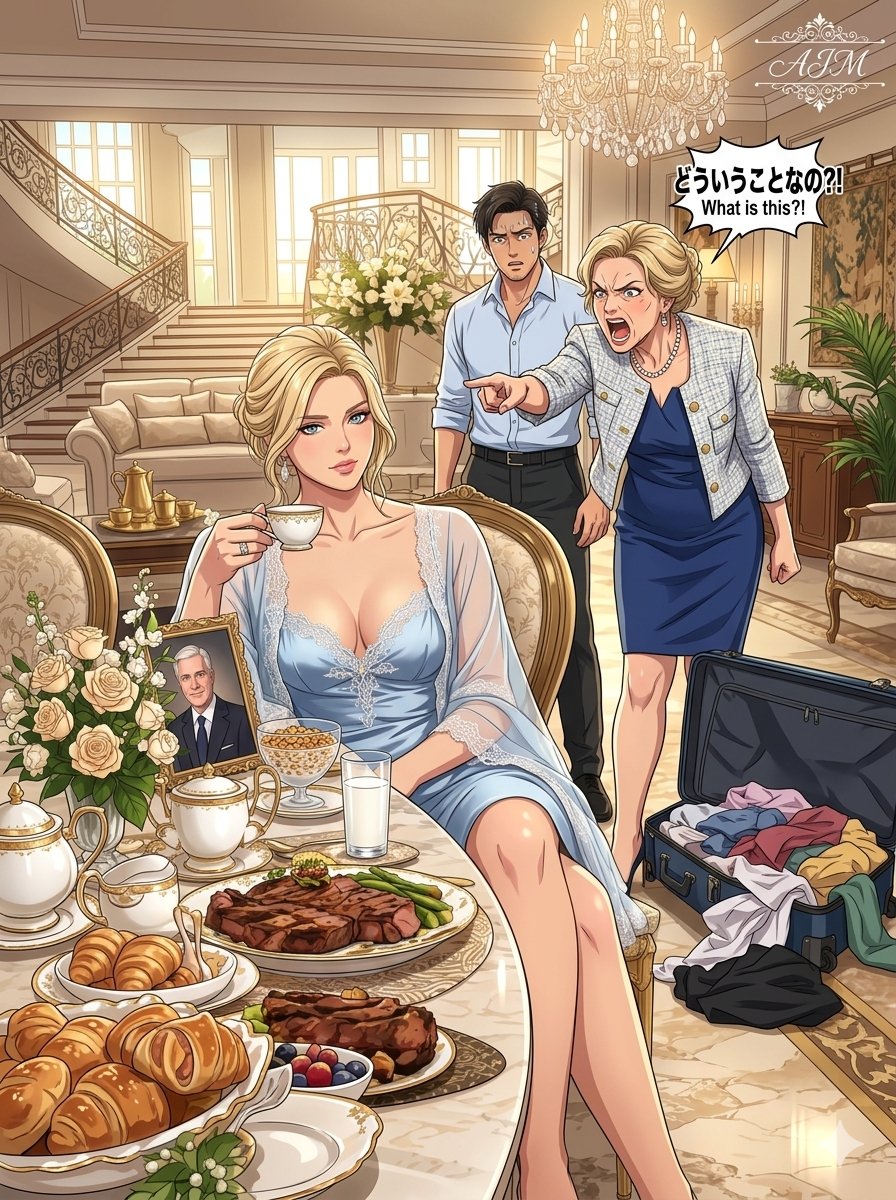
Chapter 1: The Sweltering Breaking Point
By the time I realized the upstairs climate control had been deliberately severed again, the silk of my blouse was already clinging damply to the space between my shoulder blades. Outside the paneled windows, Savannah was suffocating beneath the brutal, oppressive weight of a July afternoon.
Inside my own home, I possessed less than twenty minutes before I had to log into a high-stakes corporate video conference.
I unlocked my phone, a bead of sweat stinging my eye, and pulled up the smart-home application.
Upstairs Zone: OFF.
Status: Manually Override.
Again.
A cold, calcifying anger began to crystallize in my chest, completely at odds with the stifling heat of the second floor. I marched out of my office and stepped to the edge of the mahogany staircase landing.
Down in the foyer, my mother-in-law, Beatrice Vance, stood sentry beside the digital thermostat. Her arms were firmly crossed over her floral blouse, her chin tilted upward in a posture of absolute, unyielding defiance.
“Did you disable the cooling system?” I called down, my voice dangerously level.
Beatrice didn’t even attempt the grace of a lie. “There is absolutely no logical reason to refrigerate half the estate simply because you want to sit upstairs tapping away on a laptop.”
I stared down at her, gripping the banister until my knuckles blanched. “I explicitly told you at breakfast that I had an executive meeting at two o’clock.”
“You work from a home office, Serena,” she countered, waving a dismissive, manicured hand. “It isn’t exactly open-heart surgery. Open a window.”
The familiar, suffocating knot tightened in my esophagus.
Beatrice had been residing with us for twenty-four months. The original arrangement, brokered cautiously by my husband, Lucas, was supposed to be a temporary sanctuary. Her apartment lease had expired, and she allegedly needed “a few short weeks” to locate a suitable downsizing option.
A few weeks bled into a season. Seasons cascaded into a year. Then, Beatrice simply ceased pretending she was ever going to leave.
Worse, she stopped behaving like a guest.
The insidious takeover happened in increments. She rearranged my kitchen, exiling my cast-iron skillets to the basement. She swapped out my linen drapes for heavy, suffocating velvet without asking. But the transgression that nearly broke me was when she boxed up the framed, silver-gelatin photographs of my late father. Her reasoning? “There are entirely too many morbid reminders of dead people scattered about.”
That specific cruelty had hollowed me out.
This Victorian structure, with its wraparound porch and ancient oak floors, was not just real estate. It had belonged to my father. He bought it when I was twelve. After my mother succumbed to illness, he and I had painstakingly restored the wainscoting and the crown molding, side by side, breathing life back into the timber. When his own heart failed him six years ago, he bequeathed the deed entirely to me.
Not to Lucas. Not to our joint marital assets. To me.
I had inherited this sanctuary before Lucas ever slipped a ring on my finger. Lucas knew the legal boundaries perfectly well.
Beatrice, however, preferred to author a wildly different mythology. To the mail carrier, she called it “Lucas’s property.” At Sunday dinners, she would loudly proclaim, “When Lucas finally gets around to remodeling this kitchen…” or, “My son has acquired such a magnificent estate.”
I had corrected her. Exactly twice.
Both times, Beatrice had merely offered a patronizing chuckle. “Oh, sweetie. Marriage means everything is shared.”
I never bothered explaining the nuances of premarital property law to her. I foolishly assumed my husband would eventually pull his mother aside and establish the truth.
He never did.
Retreating into my stifling office, I dialed his number. He answered on the third ring, the background noise of his marketing firm buzzing behind him. “Serena, I’m literally walking into a pitch.”
“Your mother turned off the upstairs air-conditioning after I explicitly informed you both I needed the zone cooled for a quarterly review.”
Lucas exhaled a long, ragged sigh that vibrated through the speaker. “Just go downstairs and turn it back on, Serena.”
“That is entirely beside the point, Lucas.”
“Then what is the point?” he snapped, his irritation flaring.
I stepped back out to the landing, making sure my voice carried down the stairwell. “The point is that your mother operates under the delusion that she has the authority to ration utilities inside my own house.”
“Please, don’t phrase it like that,” Lucas hissed.
Down below, Beatrice caught my eye. A microscopic, triumphant smirk played at the corner of her mouth.
“She just thinks the electrical overhead is too steep this month,” Lucas continued, playing the eternal peacemaker.
“I pay the electrical overhead,” I replied, my voice dropping to a glacial whisper.
“I know.”
I went dead silent.
I know. Those two syllables held the weight of a dying star.
He knew. He knew I paid the utilities. The exorbitant property taxes. The homeowner’s insurance. The roof repairs. He knew I had single-handedly serviced the renovation loans. Most importantly, he knew the very ground his mother walked upon belonged to me.
Yet, every time she laid claim to my legacy, he remained a coward in the shadows. Every time I objected, Lucas pleaded for peace. But I was finally realizing that in this marriage, “peace” was merely the currency of my own surrender.
“Have a good pitch, Lucas,” I murmured, and severed the connection.
I didn’t march down and fight over the thermostat. I didn’t scream. I simply picked up my laptop, walked down the stairs, and conducted a multimillion-dollar logistics meeting from the formal dining room while Beatrice loudly, aggressively unloaded the dishwasher in the adjacent kitchen.
I wasn’t angry anymore. I was something far more dangerous. I was finished.
And tonight, the illusion of Lucas’s peace was going to burn to the ground.