The first time I understood my mother could take something from me while smiling, **she was holding my birthday cake in one hand and the keys to my brand-new SUV in the other.**
I had turned twenty-four the previous night.
My grandfather, Walter Bennett, had surprised me with a white SUV parked beneath the oak trees outside his North Carolina home. A red ribbon stretched across the hood, and for once, every bit of attention belonged to me.
“You’ve worked since you were sixteen,” Grandpa had said, pressing the keys into my hand. “You finished college without asking anyone to carry you. You deserve something reliable.”
I cried.
Not because of the SUV.
Because someone had noticed me.
Growing up beside my younger sister, Ava, that rarely happened.
Ava had the kind of effortless beauty people remembered. Blonde hair, bright smile, dramatic stories. She could arrive late and somehow make everyone grateful she’d shown up.
I was the reliable daughter.
The one who remembered birthdays.
Covered bills.
Answered when Mom called because something needed fixing.
And somehow, being dependable always meant **I was expected to need less.**
The morning after my birthday, I came downstairs ready for work and reached for the ceramic bowl where I’d left my keys.
Empty.
Mom sat at the kitchen island drinking coffee.
“Where are my keys?”
She didn’t look guilty.
“Ava took the SUV.”
I stared at her.
“What?”
“She has an interview downtown.”
“With my car?”
Mom sighed in that familiar way meant to make me feel childish.
“Amelia, don’t start. Her car is acting up, and she needs to make a good impression.”
“I need to get to work.”
“You have Uber.”
Those three words hit harder than they should have.
**You have Uber.**
As though Grandpa had spent nearly forty thousand dollars so Ava could improve her image while I paid strangers to drive me to the job I actually had.
Ava came home that evening carrying an iced coffee.
Fast-food wrappers littered the passenger seat.
The fuel gauge sat below half.
“Cute car,” she said, tossing the keys onto the counter.
“My car.”
She smiled.
“Sure.”
Two days later, the keys vanished again.
Then again.
By the end of the week, Ava no longer bothered asking.
When I confronted Mom, she kept folding laundry without looking at me.
“It makes more sense for Ava to use it right now.”
“How?”
“She’s networking.”
“I commute forty minutes.”
“She needs it for her image, Amelia.”
I laughed because the alternative was screaming.
“Her image?”
“You wouldn’t understand.”
That evening, Ava posted a photo online.
She leaned against the SUV’s driver-side door wearing sunglasses.
The caption read:
**NEW WHIP. HARD WORK PAYS OFF.**
I stared at the post until something inside me became very still.
For most of my life, I had reacted exactly as my family expected.
I protested.
Mom called me selfish.
Ava cried.
Then I apologized.
So this time, I changed the pattern.
**I stopped asking for the keys.**
I took screenshots.
Saved my Uber receipts.
Recorded dates.
And waited.
The opportunity arrived two Sundays later.
“We’re going to Grandpa’s for dinner,” Mom announced. “We’ll all take the SUV. You can sit in the back.”
I looked at her.
“The back?”
She shrugged.
“Ava’s already driving.”
I smiled.
“I’ll meet you there.”
I called an Uber.
When it pulled away from Grandpa’s long brick driveway that evening, he was already standing on the porch.
His eyes followed the departing vehicle.
Then he looked at me.
“Amelia?”
I climbed the steps.
“Hey, Grandpa.”
He frowned.
“Why are you coming here in an Uber?”
Before I could answer, Mom appeared behind him carrying a kitchen towel.
“Her sister needed the car more,” she said cheerfully.
Grandpa turned.
“What?”
Mom laughed lightly.
“We’re sharing it.”
I remained silent.
That was the first time she looked nervous.
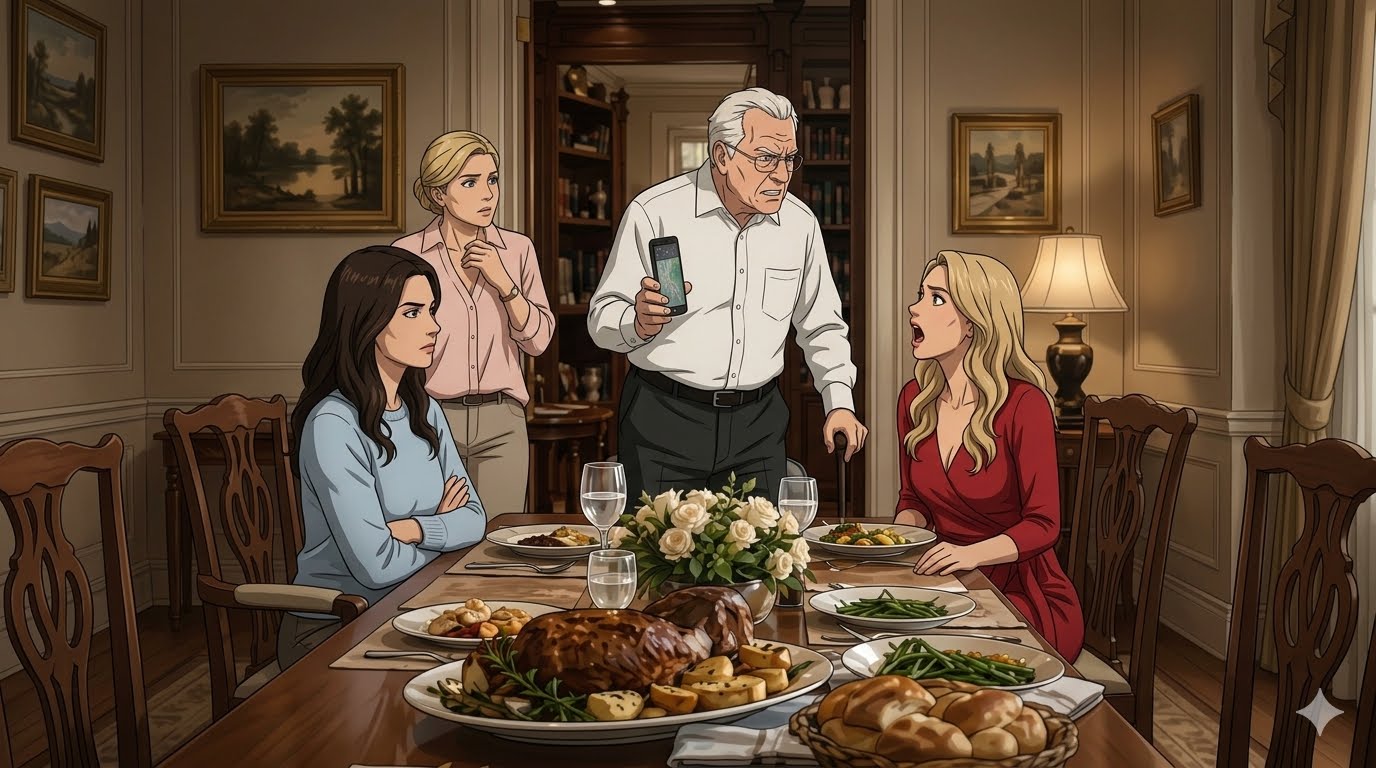
Dinner started twenty minutes later.
Roast beef. Green beans. Potatoes. Grandpa’s expensive crystal glasses that only came out on Sundays.
Ava dominated most of the conversation.
She told Grandpa about imaginary clients.
Imaginary meetings.
Imaginary business opportunities.
Eventually, she started talking about the SUV.
“It handles beautifully,” she said. “Especially on country roads.”
Grandpa stopped cutting his meat.
“Country roads?”
“Yeah. I drove toward the edge of town yesterday. I might help with some work at your farmhouse.”
I almost looked up.
Grandpa owned an old farmhouse about thirty miles away, property that had once belonged to my grandmother’s family.
Nobody visited often.
Grandpa lowered his fork.
“Is that right?”
Something in his voice shifted.
Mom looked at me.
The old silent command passed across the table.
Fix this.
I set down my fork.
“I wouldn’t know how it handles on country roads.”
Grandpa turned toward me.
“I liked driving it,” I continued, “**the one day I actually got to drive it.**”
Silence.
Grandpa’s face hardened.
“The one day?”
“The day you gave it to me.”
Mom jumped in immediately.
“Walter, this is being made into something it isn’t. We’re family. Ava needed transportation, and Amelia has been perfectly capable of—”
Grandpa raised one hand.
Mom stopped.
He looked directly at Ava.
“You drove the SUV toward the farmhouse yesterday?”
Ava swallowed.
“Yes.”
Grandpa pushed his chair back.
His cane hit the hardwood once.
“That’s interesting.”
He reached into his pocket.
**“Because I had a tracker installed in that vehicle.”**
Ava’s face drained white.
So did Mom’s.
That was when I understood this was about far more than my car.
Grandpa motioned toward the hallway.
“My study. Now.”
We followed him.
His study smelled of old leather, cedar, and the lingering trace of tobacco embedded in books from years before he quit smoking.
He set his phone on the desk.
A map glowed across the screen.
Small lines traced the SUV’s movements over the previous two weeks.
Ava crossed her arms.
“So? You tracked us?”
“I tracked my property until the title transfer finished.”
Grandpa enlarged the map.
There were trips downtown.
Shopping centers.
Restaurants.
A hotel nearly two hours away.
Ava’s jaw tightened.
Then Grandpa tapped another location.
A storage facility.
Another.
A pawn and antique dealer.
Then the farmhouse.
Five visits.
Not one.
**Five.**
Grandpa looked at Ava.
“You told me you drove there yesterday to check on work.”
“I did.”
“Then explain the other four visits.”
Ava glanced toward Mom.
Mom suddenly found the rug fascinating.
Grandpa lowered his voice.
“What did you take from my farmhouse?”
Nobody moved.
My heart began pounding.
“Take?” I said.
Grandpa didn’t look at me.
“A month ago, I noticed several items missing. Your grandmother’s silver. Two paintings. An antique jewelry box.”
Ava’s expression collapsed.
Mom stepped forward.
“This is ridiculous.”
Grandpa opened a drawer.
Inside were printed photographs from a security camera.
Ava carrying boxes.
Mom unlocking the farmhouse door.
My stomach dropped.
“You were stealing from Grandpa?”
“We weren’t stealing,” Mom snapped.
“Then what do you call it?”
“Those things were going to be ours eventually!”
Grandpa leaned back as though she’d struck him.
Mom immediately realized what she’d admitted.
Too late.
Ava burst into tears.
“You don’t understand. Mom said you were going to leave everything to Amelia anyway!”
I turned toward Mom.
“What?”
Her eyes flashed.
“Don’t act innocent.”
“I have no idea what she’s talking about.”
“Of course you don’t. You never have to ask for anything. Grandpa just gives it to you.”
Grandpa’s voice became dangerously calm.
“Why would you think I planned to leave everything to Amelia?”
Mom said nothing.
Then Grandpa opened the bottom desk drawer.
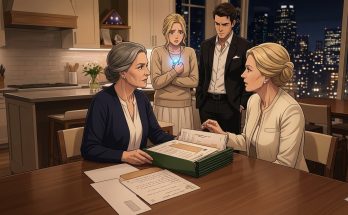
He removed a thick envelope.
The same envelope he’d apparently planned to show us before dinner fell apart.
He placed it on the desk.
“I was going to discuss this tonight.”
Mom’s breathing changed.
I could hear it.
“Walter,” she whispered.
Grandpa looked at her.
“You know what this is, don’t you?”
That question frightened me more than anything else.
Mom stepped backward.
Ava wiped her tears.
I looked between them.
“What’s going on?”
Grandpa slid the envelope toward me.
“Open it.”
Inside was a legal document.
I read the first page.
Then the second.
My name appeared again and again.
**Amelia Grace Bennett.**
Trust beneficiary.
Property.
Shares.
Accounts.
I looked up.
“I don’t understand.”
Grandpa lowered himself into his chair.
“Your grandmother created a trust before she died.”
Mom closed her eyes.
“She wanted certain property protected until you turned twenty-five.”
“Why me?”
Grandpa glanced toward Grandma’s photograph on the bookshelf.
“Because she believed you would protect the family history instead of selling it.”
Ava gave a bitter laugh.
“There. See? Amelia gets everything.”
“No,” Grandpa said.
His gaze snapped toward her.
“You received your share years ago.”
Ava froze.
So did I.
“What share?”
Grandpa turned to Mom.
“Tell them.”
Her lips tightened.
“Walter—”
“Tell them.”
She sank into a chair.
For the first time in my life, my mother seemed small.
“When your grandmother died,” she began, “she left money for both of you.”
I stared at her.
“How much?”
Mom remained silent.
Grandpa answered.
“Two hundred thousand dollars each.”
The room seemed to tilt.
Ava whispered, “What?”
I almost laughed.
“Where is it?”
Mom started crying.
Not delicately.
Not strategically.
Real tears.
“I was trying to keep us afloat.”
My stomach went cold.
“What did you do?”
“The money came with restrictions. Education. Housing. Investments. I was trustee until you reached a certain age.”
Grandpa stared at her in disgust.
“And she violated those restrictions.”
Mom shook her head.
“I intended to replace it.”
“How much did you spend?”
Grandpa clearly already knew.
But he wanted her to admit it.
Mom whispered, “Most of it.”
Ava shot to her feet.
“You spent my money?”
Mom turned toward her.
“On this family!”
“On what family?”
“The mortgage. Your private school. Vacations. Your pageants. Your car.”
Ava stared at her.
Then at me.
Suddenly, I remembered every time Mom had claimed there wasn’t enough money for my college textbooks.
Every summer I worked two jobs.
Every scholarship application.
Every night I ate noodles while studying.
**I had spent years believing we were struggling while my mother quietly burned through money my grandmother had left specifically for me.**
“How much of mine is left?” I asked.
Mom couldn’t meet my eyes.
Grandpa answered.
“About eleven thousand dollars.”
For several seconds, I felt nothing.
Then everything hit together.
Anger.
Grief.
Humiliation.
“You stole one hundred eighty-nine thousand dollars from me?”
“I raised you!”
Mom’s voice rose.
“I fed you. I clothed you. Do you have any idea what children cost?”
Grandpa slammed his palm onto the desk.
“She was a child! **You don’t invoice your child against her inheritance!**”
Mom flinched.
Ava stood completely still.
Then something unexpected happened.
She turned toward Mom.
“What about mine?”
Mom’s silence was answer enough.
Ava’s voice cracked.
“You spent mine too.”
“You benefited from it.”
“I didn’t know!”
“Well, now you do.”
Ava looked physically sick.
For the first time, we weren’t rivals.
We were two daughters uncovering the same betrayal.
But Grandpa wasn’t finished.
“The stolen items from the farmhouse,” he said. “Why?”
Mom wiped her face.
“We needed money.”
“For what?”
She said nothing.
Grandpa tapped the hotel location on the tracking map.
“Who is Daniel Mercer?”
Mom froze.
I recognized the name vaguely.
A real-estate developer.
Ava looked confused.
Grandpa continued.
“The SUV stopped at a hotel where Mercer was attending a development conference. Two days later, you went to the county records office. Yesterday, you went to the farmhouse.”
Mom abruptly stood.
“We should leave.”
“No,” Grandpa said.
“Now.”
He opened another folder.
Inside were document copies.
Property surveys.
A proposed purchase agreement.
And a signature.
Grandpa’s signature.
Except I knew immediately it wasn’t his.
“You forged this?” I whispered.
Mom looked toward Ava.
Ava backed away.
“Don’t look at me.”
Grandpa’s voice turned icy.
“You attempted to sell the farmhouse.”
Mom exploded.
“It’s falling apart! You don’t use it! The land alone is worth almost three million dollars. Mercer was willing to buy everything.”
“It isn’t yours.”
“It was going to become mine!”
“No.”
That single word silenced her.
Grandpa leaned forward.
“The farmhouse was never going to you.”
Mom stared.
He pointed toward the trust document in front of me.
“It belongs to Amelia.”
My breath caught.
“What?”
“Technically,” Grandpa said, “it has belonged to you since your grandmother died. I retained lifetime management rights.”
Mom stared at me with open hatred.
And suddenly I understood.
The SUV hadn’t created any of this.
**The car had exposed it.**
Mom didn’t resent the vehicle because Ava needed transportation.
She resented what it represented.
She already knew Grandma had protected something from her.
And she’d spent years telling herself it should have belonged to her instead.
Ava suddenly whispered, “You knew.”
Everyone looked at her.
She stared at Mom.
“You knew the farmhouse belonged to Amelia.”
Mom didn’t answer.
Ava’s face changed.
“How long?”
“Ava—”
“How long?”
“Years.”
Ava shook her head.
“And you told me Grandpa favored her. You told me Amelia was trying to take everything.”
Mom’s expression hardened.
“I was protecting your future.”
“No. You used me.”
The realization crossed Ava’s face.
Every complaint.
Every rivalry.
Every whisper from Mom that I thought I was better.
She had nurtured all of it.
Ava dropped into a chair.
Grandpa turned toward me.
“I owe you an apology.”
“You?”
“I suspected your mother had been accessing things she shouldn’t. I didn’t know how far it had gone.”
He looked down at the tracker.
“So when I bought you the SUV, I installed GPS.”
Mom laughed bitterly.
“You set us up.”
“No.”
Grandpa’s gaze remained steady.
“I protected my granddaughter’s property. **You chose what to do next.**”
My eyes burned.
“Why didn’t you tell me about the trust?”
“Your grandmother asked me not to until your twenty-fifth birthday.”
“Why?”
Grandpa hesitated.
And I immediately knew there was more.
Something worse.
“There’s another document,” he said.
Mom went completely still.
Grandpa reached into the envelope.
He pulled out a handwritten letter.
The paper was yellowed around the edges.
My name was written across the front.
Amelia.
In Grandma’s handwriting.
My hands trembled as I opened it.
My grandmother had died when I was twelve.
I remembered her perfume.
Her garden.
The peppermint candies in her purse.
How she used to brush my hair and tell me I had “old eyes.”
The letter began:
*My darling Amelia, if you are reading this, then Walter has decided you are ready for a truth I was too afraid to tell you while I was alive.*
I stopped breathing.
I looked toward Grandpa.
He nodded.
Keep reading.
The next lines didn’t make sense.
Until suddenly, they made far too much sense.
I read them twice.
“No.”
Mom covered her mouth.
Ava whispered, “What does it say?”
I couldn’t speak.
Grandpa answered.
“Amelia is not your sister.”
Ava frowned.
“What are you talking about?”
Grandpa looked at me.
Then at Mom.
“Amelia is your aunt.”
The world vanished.
I laughed once.
A short, broken sound.
“That’s impossible.”
Grandpa’s eyes filled with tears.
“No.”
He pointed to Grandma’s photograph.
“Your grandmother had another daughter.”
I stared at Mom.
She was sobbing now.
Not my mother.
The woman I’d called Mom.
“Her name was Caroline,” Grandpa said. “She was your mother’s younger sister.”
My skin turned cold.
Grandpa continued carefully.
“Caroline was seventeen when she became pregnant. She was frightened. Your grandmother and I made decisions we believed were protecting everyone.”
“Stop,” Mom whispered.
But I had to know.
“Where is Caroline?”
Grandpa lowered his eyes.
“She died giving birth to you.”
I couldn’t feel my hands.
The woman sitting across from me—Linda Bennett, the woman I’d called Mom every day of my life—was actually my aunt.
Ava wasn’t my younger sister.
She was my cousin.
The room blurred.
“Why?”
It came out barely louder than a whisper.
Grandpa wiped his eyes.
“Caroline begged Linda to raise you.”
I turned toward Linda.
“You knew?”
She nodded.
“All my life?”
“Yes.”
“And Grandma left the farmhouse to me because…”
“It belonged to Caroline,” Grandpa said. “Your grandmother intended it to pass to her. When she died, it passed to you.”
Suddenly, everything connected.
Why Linda hated the trust.
Why she’d treated my inheritance as if I’d stolen something from her.
Why she seemed angry whenever Grandpa gave me anything.
But I still didn’t understand one thing.
“Why did you spend my trust?”
Linda’s face twisted.
“Because your mother destroyed my life.”
Grandpa stood.
“Enough.”
“No!” Linda shouted. “She deserves the truth.”
She stared directly at me.
“I was twenty-one. I had plans. Then Caroline died, and suddenly there was a newborn baby everybody expected me to love because it was her dying wish.”
My chest tightened.
“I did love you,” she said, tears pouring down her face. “At first.”
At first.
Two words capable of destroying an entire childhood.
“But every time Dad looked at you,” she continued, “he saw Caroline. Every time Mom held you, she cried. Everything became about the daughter they lost and the baby she left behind.”
“So you punished me.”
“I was angry.”
“I was a baby.”
“I know!”
Ava was silently crying now.
I looked at her.
For years, I’d believed she was simply the favored daughter.
Now I understood something much uglier.
**Linda had used both of us to punish a dead sister.**
She spoiled Ava because Ava belonged to her.
She diminished me because I didn’t.
And she turned us against each other because our rivalry gave her resentment somewhere to go.
Grandpa moved toward me.
I stepped back.
Not because I blamed him equally.
I simply couldn’t bear anyone touching me.
Then Ava stood.
She walked to the desk.
Picked up the SUV keys.
And placed them in front of me.
“I’m sorry.”
I looked at her.
She trembled.
“I knew it was yours,” she said. “I knew taking it was wrong. I told myself Mom was right because… because believing you were spoiled made me feel better about being jealous.”
She swallowed.
“But I didn’t know any of this.”
I believed her.
That surprised me.
Linda scoffed.
“Oh, please. Now you two are going to become best friends?”
Ava turned toward her.
“No.”
Her voice was steady now.
“But I’m done being your weapon.”
Linda stared.
Ava pulled out her phone.
“What are you doing?”
“Calling the police.”
Linda lunged toward her.
Grandpa stepped between them.
“You wouldn’t,” Linda said.
Ava’s eyes filled again.
“You stole from Grandpa. You stole from Amelia. **You stole from me.** And you tried to sell property that belonged to her.”
Linda looked at me.
“Amelia.”
The desperation in her voice awakened something old in me.
The instinct to fix everything.
Forgive quickly.
Make her comfortable.
For twenty-four years, that instinct had controlled me.
This time, I let it die.
“My name was on the paperwork,” I said quietly.
She blinked.
“What?”
“The SUV. My name was on the paperwork. You knew it belonged to me, and you took it anyway.”
“Amelia, this is bigger than a car.”
“I know.”
I stepped closer.
“That’s why the car matters.”
She stared at me.
“Because you thought taking something small would be easy. You thought I’d stay quiet.”
My voice trembled, but I kept going.
“You were counting on the girl you raised me to be.”
Grandpa watched me.
I picked up the keys.
“But she doesn’t live here anymore.”
The police arrived forty minutes later.
Linda wasn’t led away in handcuffs that night.
Real life is rarely that cinematic.
But an investigation began.
The forged property agreement brought in lawyers.
The missing antiques were recovered from the dealer.
Financial records confirmed years of improper withdrawals.
Daniel Mercer denied knowing the signature had been forged, and his attorneys quickly distanced him from Linda.
She was removed from control of the trust.
Three months later, the farmhouse transfer to me was finalized.
But the biggest surprise came after the legal chaos settled.
I turned twenty-five the following spring.
Grandpa asked Ava and me to meet him at the farmhouse.
The property looked transformed.
Fresh paint.
A repaired porch.
New windows.
Ava had spent months helping restore it.
Not because I asked her.
Because, as she put it, she needed to return something that couldn’t fit inside an envelope.
We stood beneath the oak tree where my biological mother, Caroline, had apparently played as a child.
Grandpa handed me one final box.
Inside were photographs.
Caroline at sixteen.
Caroline holding her pregnant stomach.
Caroline laughing beside a lake.
Under the photographs rested another legal document.
I frowned.
“What’s this?”
Grandpa smiled.
“The final page of your grandmother’s trust.”
I read it.
Then looked at Ava.
She stared back at me.
The farmhouse belonged to me.
But not necessarily forever.
Grandma had included a condition decades earlier:
**If Amelia ever willingly chose to share the property with Linda’s child, the farmhouse would become equally theirs—not because either was entitled to it, but because Caroline’s daughter and Linda’s daughter should have the chance their mothers never had.**
Ava immediately shook her head.
“No.”
“What?”
“I’m not taking half your house.”
I laughed.
“You spent six months fixing it.”
“That doesn’t mean—”
“You also put fourteen thousand dollars of your recovered trust money into the roof.”
She looked at Grandpa.
“You told her?”
“He’s terrible at secrets,” I said.
Grandpa looked offended.
I held out my hand to Ava.
She stared at it.
“You’re serious?”
“You were my sister for twenty-four years.”
“Technically cousin.”
“Don’t ruin the moment.”
She laughed through her tears.
Then she took my hand.
That was when Grandpa gave us one last surprise.
“The farmhouse isn’t the most valuable part of the property.”
Ava and I turned toward him.
He pointed past the trees.
Years earlier, Grandma had rejected several offers from developers.
We’d assumed it was sentimental.
It wasn’t.
A renewable-energy company had recently determined that the surrounding land bordered one of the county’s most strategically valuable transmission expansion corridors.
They wanted a long-term lease.
Not the farmhouse itself.
Only part of the fields.
The offer?
**$186,000 a year.**
Split between us.
Ava’s mouth dropped open.
I stared at Grandpa.
He smiled.
“Your grandmother always did have good instincts.”
But the money wasn’t the real ending.
That came later in the afternoon.
Ava and I sat together on the newly repaired porch.
My white SUV was parked in the driveway.
Her old sedan sat beside it.
She nudged me.
“So… can I borrow your car?”
I slowly turned toward her.
She held a straight face for two seconds before bursting out laughing.
I threw a porch cushion at her.
And for the first time in our lives, **neither of us was competing.**
Linda eventually pleaded guilty to financial exploitation, forgery, and theft-related charges. Part of her sentence was suspended, but restitution was ordered.
I visited her once.
Only once.
She looked older.
She asked whether I hated her.
I thought about the stolen inheritance.
The SUV.
The years of favoritism.
The truth she’d hidden.
Then I thought about Caroline.
The seventeen-year-old girl who never had the chance to raise me.
“I don’t hate you,” I said.
Linda began crying.
But I wasn’t finished.
“I also don’t forgive you yet.”
Her face fell.
Old Amelia would have hurried to soften those words.
New Amelia let them remain.
“Maybe one day,” I said. “But forgiveness isn’t something you get because you’re family.”
I stood.
“It’s something you earn because you changed.”
Outside, Ava waited in the SUV.
In the passenger seat.
When I came out, she tossed me the keys.
“Your car,” she said.
I caught them.
“My car.”
Then she smiled.
“Our farmhouse?”
I smiled back.
“Our farmhouse.”
As we drove away, I thought about how strange justice could be.
Sometimes it didn’t arrive through shouting.
Sometimes it didn’t happen in a courtroom.
Sometimes it began with something embarrassingly small.
A missing set of keys.
An Uber receipt.
A sister’s smug smile.
A grandfather asking one simple question.
**“Where is your car?”**
My mother believed my silence meant she’d won.
My sister believed my silence meant weakness.
For years, I believed silence was simply how I survived.
I was wrong.
Because the night Grandpa opened that tracking map, my silence finally did exactly what I needed.
**It gave everyone else enough room to reveal who they really were.**
And once they did, I didn’t have to fight to prove the truth.
I only had to stop protecting them from it.