Beneath the scars she had carried for 40 years was a secret so shocking that it would change everything…
PART 1

“Don’t you dare touch my back! Get your hands off me, or I swear to God I’ll scream until the police get here!”
Eleanor’s shriek echoed down the hallways of Oakridge Senior Living, freezing even the elderly gentleman taking his soup in the dining hall.
Everyone knew that voice.
Eleanor Vance had been living in the assisted living facility for nearly three years. At seventy-six, she walked without a cane, solved crossword puzzles without her reading glasses when she was in a good mood, and could debate for half an hour about whether instant coffee tasted as good as dark roast.
But there was one thing no staff member had ever managed to do.
Bathe her.
She could wash her face, her hands, and even her hair with a bit of assistance. However, if a caregiver attempted to get anywhere near her back, the woman transformed instantly.
She screamed.
She slapped hands away.
She locked herself in the bathroom.
Once, she had thrown a plastic water pitcher clear across the room.
So when Hannah took the job at Oakridge, the head nurse gave her a fair warning: “Don’t push Eleanor on bath days. We’ve tried everything. Just let her be.”
Hannah was twenty-four. She had completed three semesters of nursing school before dropping out when her mother lost her job. She needed work desperately, and Oakridge was the only place that hired her on the spot.
During her first few weeks, Hannah discovered a quiet heartbreak that no textbook had prepared her for: caring for the elderly wasn’t just about handing out paper cups of medication or changing bed linens. It was about learning to live alongside people who had often been left behind by families far too busy to visit.
Eleanor was one of them.
Her son, Marcus, lived two hours away in Chicago. He called whenever he remembered and showed up every few months carrying a box of store-bought cookies.
One afternoon, Hannah accidentally overheard one of those phone calls.
“Mom, the staff told me you made another scene about taking a shower.”
Eleanor gripped the receiver tightly. “It wasn’t a scene, Marcus.”
“Well, just cooperate. I’m paying a lot of money for them to take care of you.”
The old woman went completely quiet.
Marcus continued, “I can’t keep taking time off work every time you decide to throw a tantrum.” Then he hung up.
Hannah watched Eleanor sit silently for ten minutes, staring at the dark screen of her phone. She didn’t cry. That hurt far more to watch.
From that day on, Hannah visited Eleanor’s room without ever mentioning the bath. She brought her hot coffee, old newspapers, and fresh crossword puzzles.
“Capital of Norway, four letters,” Hannah asked one morning.
“Oslo,” Eleanor replied without missing a beat.
“Show-off,” Hannah teased softly.
That was the first time Eleanor smiled.
Two weeks later, Eleanor let Hannah wash her feet. A few days after that, her hair.
But one morning, while Hannah was adjusting Eleanor’s cardigan, her fingers accidentally brushed against her shoulder blade.
Eleanor bolted upright. She grabbed Hannah’s wrist in a vise-like grip.
Hannah saw something in the old woman’s eyes that she had never seen before. It wasn’t anger.
It was pure, unadulterated terror.
“Not my back,” Eleanor whispered, her voice trembling. “Never.”
Hannah never tried again.
Until a rainy morning in February.
Eleanor called Hannah into her room before breakfast. “Close the door.”
Hannah obeyed.
“Bring a basin of warm water, some soap, and a sponge.”
“Are you sure, Eleanor?”
“Before I change my mind.”
Hannah returned five minutes later. Eleanor began unbuttoning her floral robe, her hands shaking violently.
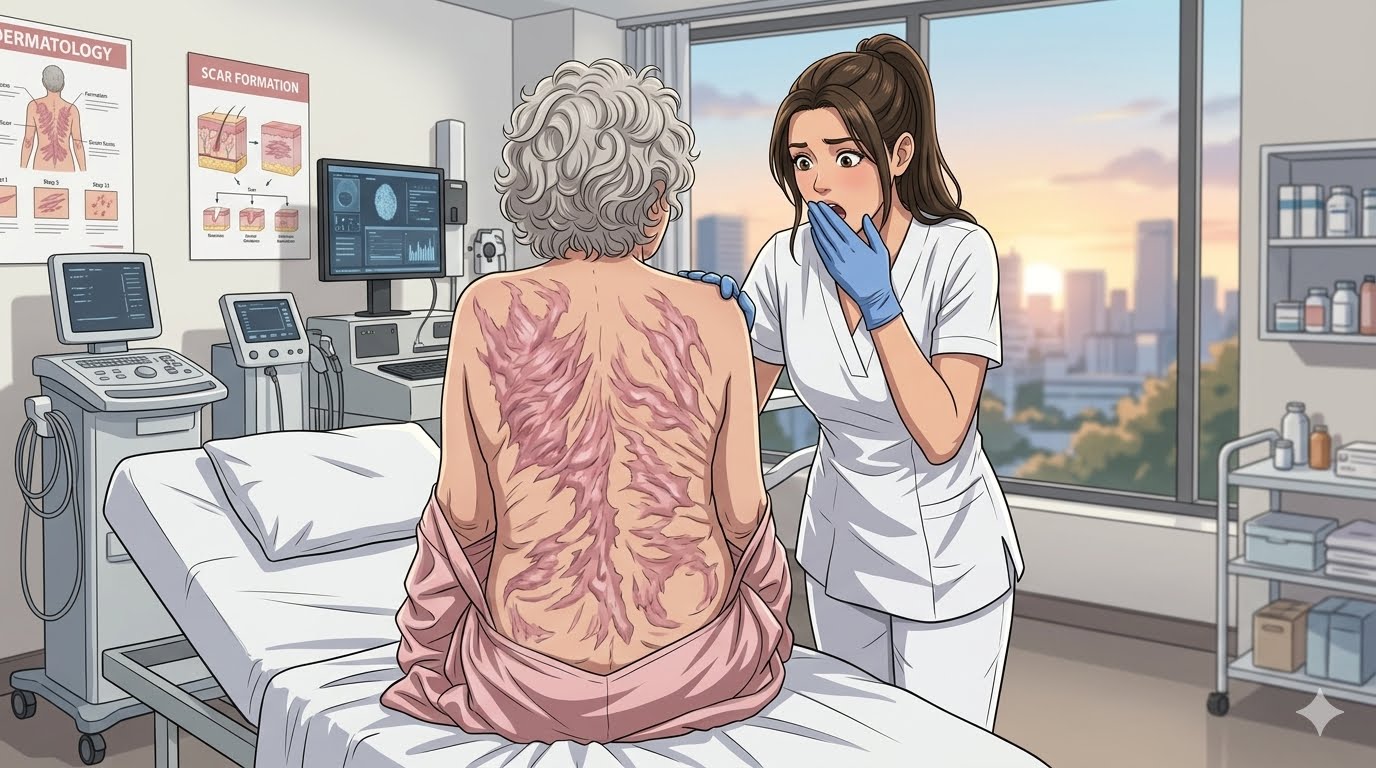
When she lifted her undershirt and turned her back, the sponge slipped straight from Hannah’s fingers, hitting the floor with a wet thud.
The old woman’s entire back—from her shoulder blades down to her waist—was covered in a single, thick, deeply distorted scar.
It looked like melted wax.
Hannah’s throat closed up. “My God… who did this to you?”
Eleanor didn’t answer right away. She turned her head slowly, looking at Hannah with pale, faded eyes.
“Nobody did this to me,” Eleanor whispered. “I chose to walk into the fire.”
PART 2
Hannah picked the sponge up off the floor, staring at it in stunned silence. She didn’t know what to say.
Eleanor remained facing the wall, hugging her arms across her chest as if she still needed to shield herself from the past.
“If you’re going to run out of the room, just do it now,” Eleanor said softly.
“I’m not running anywhere,” Hannah replied.
“Everyone changes their face when they see it.”
Hannah rinsed the sponge in the warm water. “Then I won’t look at you the way everyone else does.”
The moment the warm sponge first touched the scarred tissue, Eleanor flinched. Her body reacted out of pure instinct. Forty years of preventing anyone from laying a hand on her back couldn’t evaporate in a matter of seconds.
But slowly, her rigid shoulders began to drop.
Hannah washed her back with the delicate care she would give a newborn baby. When she finished, she dried her skin gently and helped her slip into a clean blouse.
“Nobody has touched my back in forty years,” Eleanor murmured.
Hannah paused, believing she had misheard. “Not even your husband?”
Eleanor shook her head softly.
Her husband, Robert, had passed away five years earlier. They had been married for nearly four decades.
“He knew I had scars,” Eleanor explained, looking out the window. “He just never saw how bad they were. I always changed in the bathroom. I slept in a thick nightgown. If he tried to hold me from behind, I’d take his hands and pull them around to my stomach.”
“Why hide it from him for forty years?”
“Because once you start hiding a part of yourself, every passing year makes it harder to bring it into the light.”
Then she began to tell her story.
In the summer of 1986, Eleanor and Robert lived in a rural township in northern Indiana. It was a quiet farming community of gravel roads, tin-roof homes, and dry summer heat.
A young family lived directly across the dirt road from them. They had a three-year-old daughter named Natalie.
On a particularly dry, windy July afternoon, Eleanor was hanging laundry on the line when she smelled thick smoke.
The house across the road was engulfed in flames.
“The mother had run to the local pharmacy,” Eleanor recalled, her eyes clouding over with distant memories. “The woman watching the little girl had fallen asleep in the back bedroom. I heard Natalie screaming from the window.”
Eleanor closed her eyes tightly. “Everyone on the road was shouting at me to wait… to wait for the volunteer fire department. But a three-year-old child doesn’t know how to wait for a fire truck.”
She kicked through a low side window. The smoke was so thick she had to crawl on her belly across the floorboards.
She found tiny Natalie huddled against a bedroom wall, weeping. Eleanor scooped the child against her chest, wrapping her arms completely around her.
When she turned to head back, the hallway she had crawled through was blocked by a wall of fire. The only way out was straight through the burning front porch.
“I pinned her face against my chest,” Eleanor whispered, “and I turned my back to the flames.”
Hannah gasped as the full picture came together. “You walked out backward.”
Eleanor nodded. “A burning wooden beam collapsed from the porch roof right across my back. I didn’t drop her. I carried her out to the lawn.”
The little girl suffered only minor smoke inhalation. Eleanor spent four months in a specialized burn unit.
When she finally returned home, the scars had permanently altered her body.
“Everyone called me a hero,” Eleanor continued, her voice tinged with faint bitterness. “I hated that word.”
“Why?”
“Because once people label you a hero, they stop seeing you as a human being. They want to touch the scars, ask about the pain, gawk at the wounds, and tell your story at dinner parties. I didn’t want to be a monument. I just wanted to live my life.”
Eventually, Robert and Eleanor moved away. Over the decades, she lost all connection with the little girl she had saved.
“Did you ever try to find her?” Hannah asked quietly.
“No.”
“Not even to know what became of her?”
Eleanor went silent for a moment, then offered a sad, gentle smile. “I knew she walked out of that house alive. That was enough for me.”
Later that afternoon, Hannah was drinking tea in the breakroom with another caregiver, Veronica, when she casually mentioned that Eleanor had lived in rural Indiana back in the eighties.
Veronica set her coffee cup down so fast it nearly tipped over. “Where did you say?”
“A little township outside South Bend.”
Veronica went pale. “My mother grew up out there.”
Hannah felt a sudden chill run down her spine. “What’s your mother’s name?”
“Natalie.”
Neither of them spoke for several seconds. Veronica’s breathing grew fast and shallow.
“My mom was three years old when her house caught fire,” Veronica stammered, her voice shaking. “A neighbor pulled her out. My mother spent her entire life trying to find the woman who saved her, but all she knew was her name was Eleanor.”
Hannah’s hands began to shake.
Veronica immediately grabbed her phone from her purse, her fingers flying across the screen. “Mom… Mom, listen to me.” Her voice cracked into a sob. “I think I’m standing in the building with the woman who saved your life.”
PART 3
Natalie arrived at Oakridge Senior Living at nine-twenty the following morning.
Hannah knew the exact time because she had spent thirty minutes pacing in front of the lobby clock.
Veronica had spent the entire night on the phone with her mother. Natalie, now forty-three years old, lived two hours away in Indianapolis and had boarded the very first morning bus. She refused to wait another day.
When she walked through the glass sliding doors, Hannah saw a polished, dark-haired woman holding a small, weathered leather photo album tightly against her chest.
Veronica ran over and hugged her. Natalie barely registered the embrace, her eyes scanning the hallway frantically. “Where is she?”
“Room seven,” Hannah said softly. “Let me talk to her first.”
Hannah stepped quietly into room seven. Eleanor was sitting by the window, working on her daily crossword puzzle.
“You have a visitor, Eleanor.”
“Is it Marcus?” Eleanor asked without looking up.
“No.”
The old woman raised her head, surprised. “Then who?”
Hannah stepped closer. “Someone from South Bend.”
The pen slipped from Eleanor’s fingers, rolling off the tray table and landing on the rug. She didn’t ask another question. For a long moment, she didn’t seem to breathe.
Finally, she whispered, “Send her in.”
Natalie stepped through the doorway.
Neither woman spoke. Eleanor squinted through the morning sunlight, trying to recognize the face of an adult she had only ever known as a toddler.
Natalie raised a hand to her cheek—a small, unconscious habit—and something sparked in Eleanor’s memory. She suddenly remembered a little girl with dirt on her cheeks, sitting on a porch step eating strawberry popsicles.
“Natalie?” Eleanor whispered.
Natalie burst into tears. “Yes.”
Eleanor brought both hands up to cover her mouth. “Oh, my dear Lord…”
Natalie took two slow steps forward. “You held me against your chest.”
Eleanor was trembling from head to toe. “You were so small…”
“You carried me out backward so the fire wouldn’t touch me.”
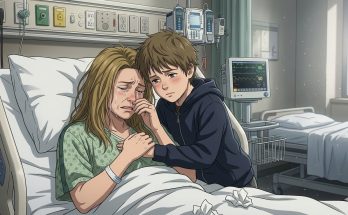
Eleanor couldn’t hold it back any longer. She wept—not with the sorrow of bad news, but with the heavy, releasing tears of a woman who had carried a secret for forty years.
Natalie knelt down right in front of her chair. “I searched for you for decades.”
“You shouldn’t have spent your life searching for me, sweetheart.”
“How could I not?”
“You didn’t owe me anything.”
Natalie shook her head firmly. “I didn’t come here to repay a debt.”
She opened her leather album and pulled out an old, faded color photograph. It showed a three-year-old girl in a yellow suns dress standing in front of a wooden house.
Eleanor recognized the house instantly. “Your home…”
“It’s the only picture my parents had left of that house,” Natalie whispered. She turned the photo over. On the back, in faded blue ink, was written:
For Mrs. Eleanor Vance, who gave our daughter back to us.
Eleanor stroked the handwritten words with the tip of her thumb. “Your mother wrote this while you were in the hospital. She never knew where to send it.”
Natalie took a deep breath. “I have one request, Eleanor.”
“What is it?”
“I want to see the scars.”
Eleanor went completely rigid. Hannah made a move to step forward, but Natalie added gently, “Only if you want me to.”
Eleanor looked at the faded photograph in her lap. Then she looked at the grown woman standing before her—a woman who existed because Eleanor had chosen to crawl through a inferno forty years ago.
For the first time in four decades, the shame evaporated.
Eleanor stood up slowly. She turned her back to Natalie and unbuttoned her blouse.
Natalie covered her mouth with both hands. She didn’t gasp in horror. She didn’t look away. She didn’t express pity.
She stepped closer. “May I touch them?”
Eleanor nodded silently.
Natalie gently placed her fingertips against the thick, raised tissue near Eleanor’s shoulder blade. Her voice broke completely. “All of this… all of this should have been mine.”
Eleanor turned around. “What are you saying?”
“That fire was coming for me,” Natalie sobbed. “You put your own body between me and the flames. I grew up, I went to college, I fell in love, I had a daughter—” she pointed toward Veronica “—I celebrated birthdays, I traveled, I argued with my husband, I reconciled, I held my parents’ hands when they grew old. Every single moment of my life happened because you carried me out of that house.”
Eleanor closed her eyes as tears spilled down her cheeks.
Natalie pointed to the scars. “I don’t see a ruined back, Eleanor. I see forty years of my life.”
Just then, a voice boomed from the doorway.
“What on earth is going on in here?!”
It was Marcus.
The facility director had called him earlier that morning after noticing the commotion in the lobby, believing there was a family emergency.
Marcus walked in, looking annoyed. “Mom, I had to cancel two corporate meetings to drive out here! What happened now—”
He stopped dead in his tracks.
He saw Natalie. He saw Veronica. And he saw his mother standing by the window with her blouse unbuttoned, her back fully exposed.
For the very first time in his adult life, Marcus saw the scars.
His arrogant posture collapsed instantly. His face went pale. “Mom… what… what happened to you?”
Eleanor slowly buttoned her blouse. “You never looked close enough to ask.”
Marcus looked completely lost. He knew his mother had been in a fire when he was a baby—his father had mentioned it once or twice—but he had always assumed it was a minor burn.
Not this.
Natalie turned to face Marcus. “Your mother saved my life.”
Over the next twenty minutes, Natalie told Marcus the entire story. Every word seemed to shrink the arrogant man standing in the room.
His mother hadn’t been throwing “tantrums” about taking a shower out of spite or senility. She had been guarding a traumatic, heroic sacrifice that she had carried in absolute silence while raising him. And for three years, he had berated her over the phone for making “a fuss” about staff touching her.
Marcus sank heavily onto the empty visitor’s chair, burying his face in his hands. “I… I had no idea.”
Eleanor looked at her son, her voice surprisingly free of anger. “You never asked, Marcus.”
That single sentence cut deeper than any shouting match ever could.
EPILOGUE
Real transformation doesn’t happen like a movie script. Marcus didn’t magically turn into a perfect son overnight simply because he cried in a nursing home chair.
But the following Saturday, he came back.
He didn’t bring a box of store-bought cookies. He brought two cups of fresh diner coffee and a book of word puzzles.
He came back the next weekend, too. Then he started calling every Wednesday evening—not to complain about bills, but to ask how her day was.
Natalie visited regularly, bringing her daughter Veronica along. Within months, Eleanor was no longer sitting alone in room seven.
Her back was still scarred. The skin remained thick, irregular, and rough. No miraculous medical treatment could ever erase what the fire had done to her body forty years ago.
What had vanished was the heavy, suffocating need to hide.
A year later, Natalie brought a new framed photograph to Oakridge.
It showed Eleanor sitting in the sunlit garden, flanked by Natalie, Veronica, Hannah, and Marcus, all smiling brightly under the summer sky.
They hung the frame right beside her bed.
On the back of the frame, Natalie had written:
“Some people carry their wounds as a secret shame, when in truth, those wounds are simply proof of how fiercely they loved the world.”
That night, before going to sleep, Eleanor did something she hadn’t done since she was thirty-six years old.
She unbuttoned her robe, switched off the bedside lamp, and lay down comfortably on her back.
There was no one watching. She didn’t need anyone to watch.
For four decades, she had believed that if people saw her scars, they would only see a broken, ruined woman. But a grateful stranger had looked at those same scars and seen forty years of beauty, life, and love.
The fire had scorched her skin in a matter of seconds.
The fear had taken forty years to let her go.
And all it took was one person who refused to look away to finally set her free.